
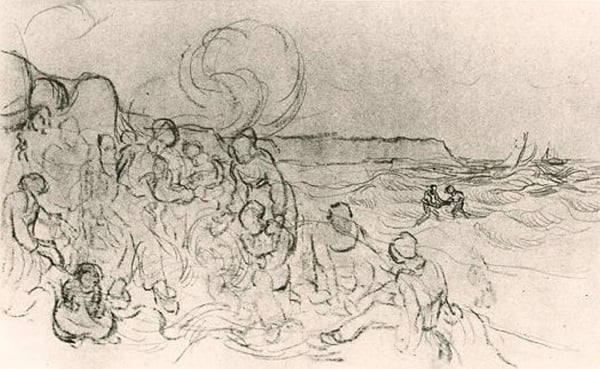
Expert analysis of Vincent van Gogh’s A Group of Figures on the Beach
Style: Post-Impressionism · Genre: sketch and study
Expert Analysis of "A Group of Figures on the Beach" by Vincent van Gogh
As a sketch and study within the Post-Impressionist movement, this work offers a rare, unpolished glimpse into Vincent van Gogh’s working method—a window into his disciplined observation and search for expressive form.
Significance within Post-Impressionism:
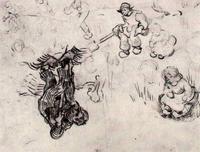
Van Gogh’s “A Group of Figures on the Beach” exemplifies the Post-Impressionist shift away from naturalistic representation toward personal, emotional interpretation. Although a study, it captures the fleeting, quotidian life of the shoreline with a raw immediacy that would later define his mature style. The choice of a beach scene—a subject of leisure and light—reflects his interest in everyday modern life, a concern shared by fellow Post-Impressionists like Seurat and Gauguin, though van Gogh’s approach here is more gestural than systematic.
Insights from the Sketch/Study Format:
The unfinished quality of the sketch reveals van Gogh’s spontaneous, searching line work. Figures are outlined with brisk, decisive strokes, suggesting he worked quickly to capture posture and movement rather than detail. This aligns with his belief that art should convey the artist’s immediate emotional response to a scene. The study likely served as a preparatory exercise for a larger composition, yet it stands as a self-contained record of his vision: the way people congregate on sand, the rhythm of their groupings, and the tension between individual forms and the open space.
Historical and Artistic Context:
Produced during a period when van Gogh was refining his ability to render the human figure in outdoor settings, this sketch prefigures his later masterpieces (e.g., The Beach at Scheveningen or Fishing Boats on the Beach at Saintes-Maries-de-la-Mer) where he would translate such observations into vivid color and impasto. Here, the monochromatic or limited palette of a study emphasizes structure over spectacle, demonstrating his foundational discipline even as he moved toward the bold, expressive colors of his final years.
Conclusion:
“A Group of Figures on the Beach” is significant not for its finish but for its vitality. It documents van Gogh’s persistent engagement with the human figure in nature, his intuitive grasp of composition, and his willingness to let an idea remain in a state of raw potential—a testament to the experimental core of Post-Impressionism itself.
Visually similar
20 works with related composition and palette
Sheet with Numerous Sketches of Working People
Vincent van Gogh
Sheet with Sketches of Peasants
Vincent van Gogh
Landscape with Cottages
Vincent van Gogh
The Fifth Plague. Livestock Disease
Gustave Dore
The Harvesters
Paul Cezanne
Study to "Boyarynya Morozova"
Vasily Surikov
Study for "The glory of Bishop Saint Nicholas"
Noè Bordignon
Le Bouclier
Theophile Steinlen
Bathers
Paul Cezanne
Studies for Four Figures
Palma il Giovane
In a foreign bank
Nicholas Roerich
Betrayal in the Garden of Gethsemane
Ilya Repin
The Death of Gideon's Sons
Gustave Dore
Close The Doors! Illustration of a text by Josep Pin I Soler
Joan Brull
Apollo and the Nine Muses Surrounded by Poets on Mount Parnassus
Karel Škréta
Various Figure Groups
Palma il Giovane
Sheet with Sketches of Working People
Vincent van Gogh
Lot and His Family Leaving Sodom
Rembrandt
Sketches of a Cottage and Figures
Vincent van Gogh
Sheet with Sketches of a Digger and Other Figures
Vincent van Gogh