
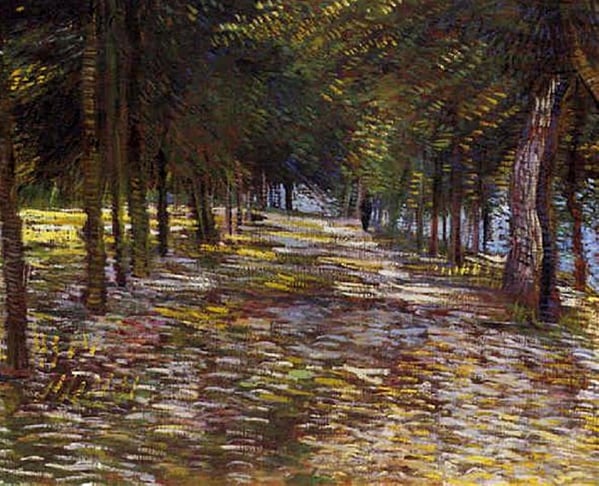
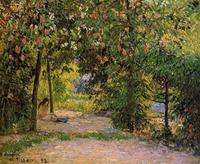
Avenue in Voyer d'Argenson Park at Asnieres
Détails
Analyse experte de Avenue in Voyer d'Argenson Park at Asnieres de Vincent van Gogh
Style : Neo-Impressionism · Genre : landscape
Expert Analysis: "Avenue in Voyer d'Argenson Park at Asnieres" by Vincent van Gogh
As a work classified within the Neo-Impressionist style, this landscape is significant for its bold synthesis of systematic color theory and personal expression—a tension that defines van Gogh’s brief but transformative Neo-Impressionist phase. Painted during his stay in Asnières (1887), the work captures a suburban park avenue under dappled light, yet its importance lies not in the subject but in the method.
Neo-Impressionist Foundations: True to the movement’s principles, van Gogh employs short, separate brushstrokes and broken color to achieve optical mixing. The avenue’s foliage and path are built from juxtaposed dots and dashes of complementary hues (e.g., red-orange against blue-green), producing a vibrating, luminous atmosphere that echoes Seurat’s and Signac’s theories. However, van Gogh diverges from the detached, scientific precision of orthodox Neo-Impressionism.
Significance Within the Style: The painting marks a critical moment when van Gogh began to infuse the cool, analytical technique with his own emotional urgency. Unlike Seurat’s static, harmonious compositions, the brushwork here is already more energetic—strokes are longer, more directional, and less uniform. The tree trunks rise like vertical flames, and the dappled shadows pulse with a restless vitality. This hybrid approach anticipates his later Post-Impressionist style, where pointillist logic gives way to swirling, subjective mark-making.
Landscape as Modern Motif: The choice of a park in the industrial suburb of Asnières (a meeting place for artists and workers) reflects Neo-Impressionism’s interest in modern leisure and urban nature. Yet van Gogh’s handling—the intense contrasts and near-tactile surface—transforms the scene from a mere record of light into a psychological landscape, charged with the artist’s own sense of striving and solitude.
In summary, Avenue in Voyer d'Argenson Park at Asnieres is significant as a transitional masterpiece that stretches Neo-Impressionism’s boundaries, using its disciplined color theory as a springboard for personal expression—a hallmark of van Gogh’s later work and a bridge between the rigid systems of the 1880s and the emotive force of early modernism.
Museum / Gallery
Visuellement similaire
20 œuvres à la composition et à la palette proches
The Allee du Champ de Foire at Argenteuil
Claude Monet
In the Woods
Gustave Loiseau
Pine Wood on the Cote d'Azur
Pierre-Auguste Renoir
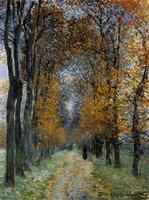
The Avenue
Claude Monet
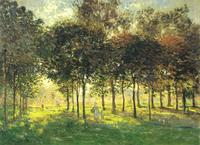
The Promenade at Argenteuil, Soleil Couchant
Claude Monet
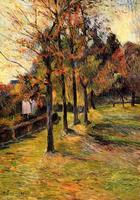
Tree linen road, Rouen
Paul Gauguin
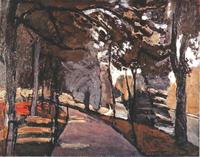
The path in the Bois de Boulogne
Henri Matisse
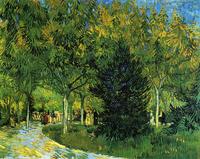
Avenue in the Park
Vincent van Gogh
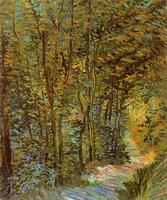
Path in the Woods
Vincent van Gogh
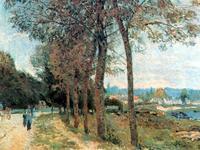
The Seine at Marly
Alfred Sisley
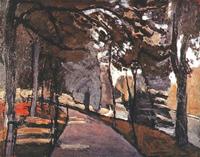
The Path in the Bois De Boulogne
Henri Matisse
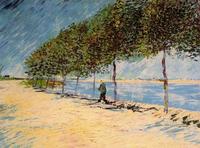
Walk Along the Banks of the Seine Near Asnieres
Vincent van Gogh
Lane of Poplars on the Banks of the Loing
Alfred Sisley
Banks of the Loing, Autumn
Alfred Sisley
The Forest at Boulogne
Alfred Sisley
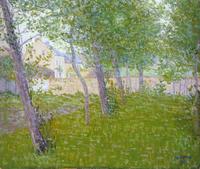
Garden by the House
Gustave Loiseau
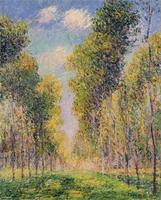
Alley of Poplars
Gustave Loiseau
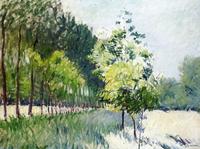
Orchard and avenue of trees
Gustave Caillebotte
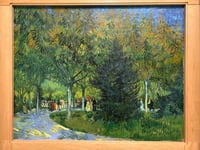
Wandelpad in het park
Vincent van Gogh
The Garden in Spring, Eragny
Camille Pissarro