
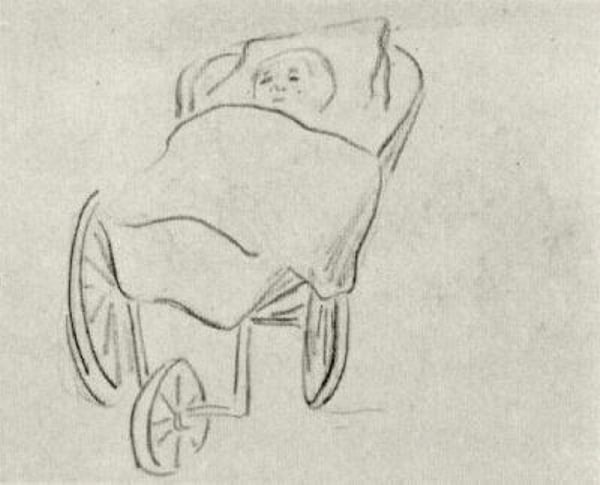
Baby in a Carriage
Details
Expert analysis of Vincent van Gogh’s Baby in a Carriage
Style: Realism · Genre: sketch and study
Expert Analysis: "Baby in a Carriage" by Vincent van Gogh
This modest sketch and study, executed in a Realist style, holds a unique place in Vincent van Gogh’s oeuvre. While the artist is globally celebrated for his later Post-Impressionist works—characterized by vibrant color, thick impasto, and expressive distortion—this piece reflects his early grounding in direct observation and unadorned representation.
Significance within Realism and Van Gogh’s Evolution
- As a sketch and study, the work emphasizes the artist’s focus on capturing an everyday, intimate moment with unembellished truthfulness. The subject—a baby in a carriage—is a quintessential Realist motif: ordinary, domestic, and stripped of idealization.
- Van Gogh’s approach here aligns with the Realist movement’s core tenet of depicting life as it is, without romanticism or drama. The quick, economical lines of the sketch suggest he was prioritizing the essential forms—the carriage’s structure, the infant’s silhouette—over decorative flourish.
- For van Gogh scholars, this piece is significant as a developmental marker. It showcases his disciplined drafting skills before his signature style emerged, proving that his later innovations were built on a solid foundation of representational accuracy. The work also reveals his sensitivity to humble subject matter, a theme he would later explore with religious and emotional intensity (e.g., The Potato Eaters).
Period and Context
- Created during his early career (likely before 1886, when he moved to Paris and encountered Impressionism), this Realist study demonstrates his debt to the Dutch Realist tradition—artists like Rembrandt and the Hague School who found beauty in unspectacular moments.
- Unlike his later, turbulent landscapes or portraits, this sketch is quiet and controlled. Its significance lies in its restraint: a testimony to van Gogh’s ability to observe the world with a steady, unforced eye before he began to bend it to his emotional will.
In summary, Baby in a Carriage is a vital work for understanding van Gogh’s artistic journey. It is a document of his Realist discipline, his respect for ordinary life, and the seedbed from which his revolutionary style would later grow.
Visually similar
20 works with related composition and palette
Good Night (Toy #5)
Gabriele Munter
Appassionata
Carol Rama
Two and a pushcart
Kazimir Malevich
Untitled
Hans Bellmer
Passionate
Carol Rama
Passionate
Carol Rama
Untitled
Emmerico Nunes
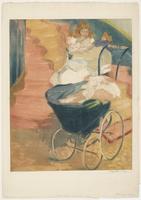
Little Girl on a Red Staircase
Jacques Villon
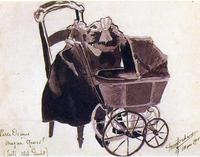
Parva Domus, Magna Quies
Marcel Duchamp
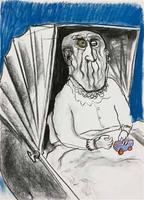
Untitled
Antonio Areal
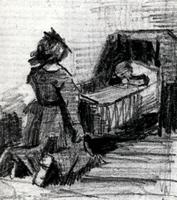
Girl Kneeling in Front of a Cradle
Vincent van Gogh
Zigeunermadonna Mit Planwagen
Otto Mueller
Zigeunerin Mit Kind Am Planwagen
Otto Mueller
Artist's son
Mikhail Vrubel
Girl Kneeling by a Cradle
Vincent van Gogh
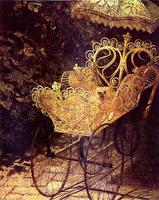
A Very Small Dog
Jamie Wyeth
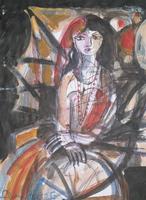
Lady
Shanu Lahiri
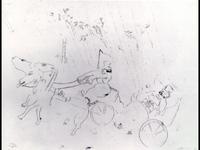
On the way to Sobakevich
Marc Chagall
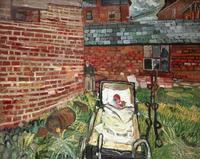
Baby in a Pram in a Garden
John Bratby
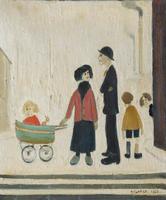
Family Group
L. S. Lowry