Expert analysis of Kazimir Malevich’s Two and a pushcart
Style: Cubism · Genre: genre painting
Expert Analysis of Two and a Pushcart by Kazimir Malevich
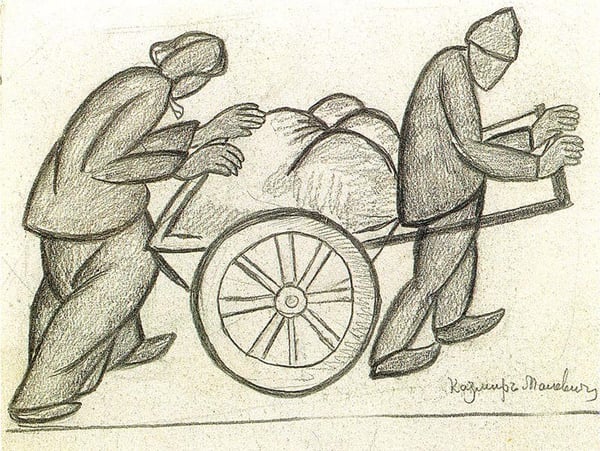
Kazimir Malevich’s Two and a Pushcart stands as a pivotal early work within the artist’s career, illustrating his engagement with Cubism before he moved toward the pure abstraction of Suprematism. As a genre painting—depicting everyday life—the work applies Cubist principles to a familiar, mundane scene, transforming it into a dynamic exploration of form and space.
Significance within Cubism and Malevich’s Oeuvre
The painting exemplifies the Cubist technique of fragmenting objects into geometric facets and reassembling them from multiple viewpoints. The “two” figures and the pushcart are not rendered illusionistically but as interlocking planes, suggesting volume and movement through angular shifts. This approach dissolves the boundaries between figures and their environment, integrating the human subjects with the inanimate pushcart as parts of a single, rhythmic composition. For Malevich, this was a critical step: by reducing a genre scene to its essential geometric structure, he laid the groundwork for his later abandonment of recognizable subject matter altogether.
Art-Historical Context
While Cubism was pioneered by Picasso and Braque, Malevich’s adaptation is notable for its focus on the vernacular—a worker’s cart and ordinary people—rather than still lifes or studio subjects. This choice roots the work in the Russian avant-garde’s interest in modern urban life and folk motifs, giving Cubism a distinctly Eastern European social inflection. The painting’s significance lies in its demonstration that even the most prosaic genre scene could be abstracted into a rigorous formal language, challenging viewers to see the world as a constellation of dynamic, interwoven volumes.
In Two and a Pushcart, Malevich proves that Cubism is not merely a stylistic exercise but a perceptual revolution—one that would eventually propel him into the non-objective realm of Suprematism. This work is thus a crucial marker of the transition from representation to abstraction, making it a landmark of early 20th-century modernist innovation.
Visually similar
20 works with related composition and palette
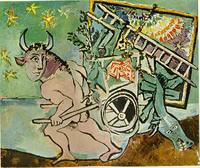
Minotaur transports a mare and foal
Pablo Picasso
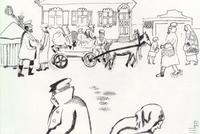
Street in Vitebsk
Marc Chagall
On the way to Sobakevich
Marc Chagall
Baby in a Carriage
Vincent van Gogh
Zigeunerfamilie Am Planwagen
Otto Mueller
The Wreckage
Sergey Solomko
Zigeunerin Mit Kind Am Planwagen
Otto Mueller
Zigeunerwagen
Otto Mueller
In Yerevan
Martiros Sarian
Zigeunermadonna Mit Planwagen
Otto Mueller
The chariot
Giorgio de Chirico
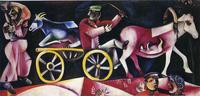
The Cattle Dealer
Marc Chagall
Dawn
Henri de Toulouse-Lautrec

Untitled
Sun Mu
Selifan
Marc Chagall
Fishermen with a Horsedrawn Sledge on the Beach near Scheveningen
Hendrick Avercamp
Vajda Lajos Szekér 1935
Vajda Lajos
Two Boys near a Cart
Vincent van Gogh
Three Persons Returning from the Potato Field
Vincent van Gogh
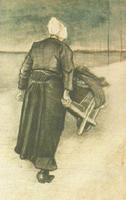
Scheveningen Woman with Wheeelbarrow
Vincent van Gogh