
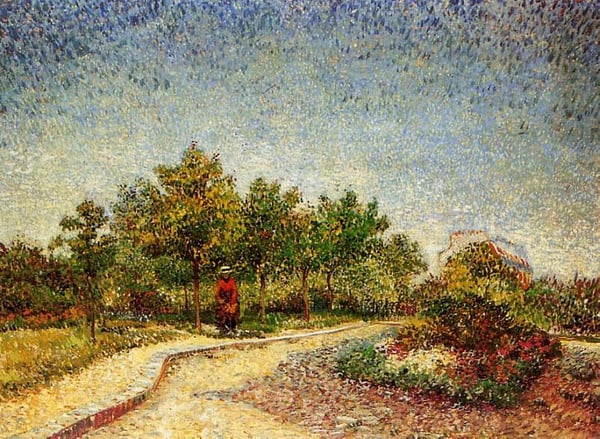
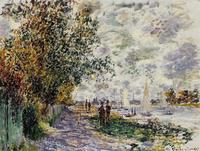
Lane in Voyer d'Argenson Park at Asnieres
Details
Expert analysis of Vincent van Gogh’s Lane in Voyer d'Argenson Park at Asnieres
Style: Neo-Impressionism, Pointillism · Genre: landscape
Expert Analysis: "Lane in Voyer d'Argenson Park at Asnieres" by Vincent van Gogh (1887)
This landscape is a pivotal work within Vincent van Gogh’s short but transformative Paris period (1886–1888), when he first encountered Neo-Impressionism and its offshoot, Pointillism, through the works of Georges Seurat and Camille Pissarro. Though van Gogh is best known for his later, fiercely expressive Post-Impressionist style, this painting captures a moment of disciplined experimentation that directly shaped his mature approach.
Significance within Neo-Impressionism and Pointillism
Here, van Gogh adopts the Pointillist technique—applying small, distinct dots of pure color that blend optically at a distance—but he infuses it with a restless energy that sets his work apart from the more static, scientific precision of Seurat. Instead of uniformly distributed dots, van Gogh uses varied stroke lengths and directions: dense, stippled clusters in the foliage give way to looser, comma-like marks in the path and sky. This creates a lively, almost pulsing surface that suggests the flickering light of a sun-dappled lane.
Color and Atmosphere
Van Gogh’s palette in this piece is characteristically vibrant. Complementary colors—orange and blue, yellow and violet—are juxtaposed in the tree trunks and shadows, heightening the sense of luminosity and depth. The lane recedes with a gentle curve, drawing the eye into the park’s interior, while the pale, broken strokes of pink and white in the sky hint at the hazy suburban afternoon light. This chromatic intensity anticipates the expressive color contrasts of his later works, such as The Starry Night.
Transitional Role in van Gogh’s Evolution
Lane in Voyer d’Argenson Park at Asnieres is not merely an imitation of Pointillist theory; it is a bridge. Van Gogh’s brushwork here is already more dynamic and personal than the methodical dotting of his peers. The trunk of the central tree, for example, is built from small, rhythmic strokes that twist and overlap, prefiguring the swirling lines of his iconic Irises and Cypresses. This work demonstrates how van Gogh absorbed Neo-Impressionist color theory but discarded its detachment, channeling instead a raw, emotional response to nature.
Historical Context
Asnières, a then-suburban village northwest of Paris, was a popular subject for the avant-garde (including Seurat, Signac, and Bernard) because it offered a blend of modern leisure and rural escape. Van Gogh painted several scenes of the Voyer d’Argenson park, using it as a laboratory for his new technique. This specific lane, with its arched canopy and distant figures, embodies the tension between structured observation and spontaneous feeling that defines van Gogh’s brief but vital Pointillist phase.
Conclusion
Lane in Voyer d’Argenson Park at Asnieres holds significance as a masterful engagement with Neo-Impressionist principles that simultaneously reveals the artist’s unstoppable drift toward a more visceral, personal style. It is a testament to van Gogh’s ability to transform even the most systematic technique into a vehicle for emotion and movement, marking a critical step in the evolution of modern art.
Museum / Gallery
Visually similar
20 works with related composition and palette
The Voyer d'Argenson Park in Asnieres
Vincent van Gogh
On the Outskirts of Paris
Vincent van Gogh
Way in the Voyer d'Argenson Park in Asnieres
Vincent van Gogh
Path in the Park at Arles
Vincent van Gogh
Avenue in the Park
Vincent van Gogh
Edge of the Fountainbleau Forest Morning
Alfred Sisley
Avenue with Flowering Chestnut Trees at Arles
Vincent van Gogh
Square in Argenteuil
Gustave Caillebotte
Afternoon in Eragny grey weather
Camille Pissarro
New England Road
Childe Hassam
Suburbs of Paris
Vincent van Gogh
Man with Spade in a Suburb of Paris
Vincent van Gogh
Path in the Country
Alfred Sisley
Wandelpad in het park
Vincent van Gogh
Walk Along the Banks of the Seine Near Asnieres
Vincent van Gogh
Edge of Fountainbleau Forest June Morning
Alfred Sisley
The Seine at Marly
Alfred Sisley
Landscape
Louis Abel-Truchet
The Barn, Morning, Eragny
Camille Pissarro
The Riverbank at Petit-Gennevilliers
Claude Monet