
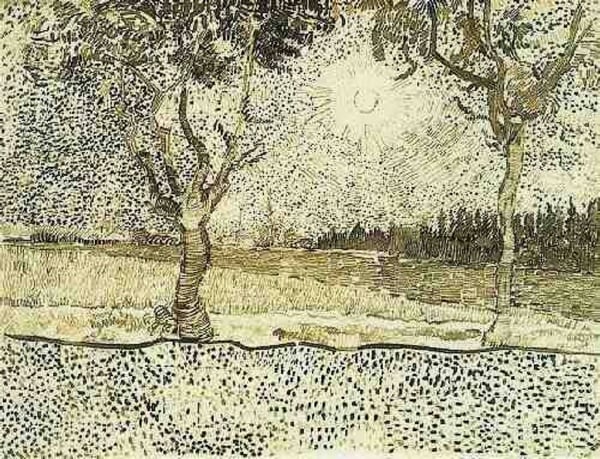
The Road to Tarascon
Dettagli
Analisi esperta di The Road to Tarascon di Vincent van Gogh
Stile: Post-Impressionism · Genere: sketch and study
Expert Analysis: "The Road to Tarascon" by Vincent van Gogh
This drawing—a pen-and-ink sketch on paper—exemplifies van Gogh’s intense, rapid draftsmanship during his Arles period (1888–1890). Though classified as a sketch and study, the work is far from a mere preliminary exercise; it is a finished statement in its own right, revealing the artist’s obsessive search for rhythm and emotional resonance through line.
Significance within Post-Impressionism:
Van Gogh’s decision to render a seemingly mundane country road as a dense, vibrating web of dashes, dots, and hatched strokes transforms the landscape into a field of pure energy. Unlike the Impressionists’ optical realism, his marks do not merely record light—they enact a psychological state. The cypress trees twist like flames, the sky pulses with parallel surges, and the road itself seems to bend under the pressure of the artist’s hand. This technique foreshadows Expressionism and shows how van Gogh used drawing to achieve the same raw immediacy as his painted landscapes.
Genre as a window into process:
As a study, the piece offers invaluable insight into van Gogh’s working method. He often sketched on location with reed pens, then used these rapid notations as prototypes for finished paintings (such as the lost The Road to Tarascon oil). Here, the open handling—unconstrained by color—allows the viewer to see van Gogh’s pure graphic thinking: how he built spatial depth through directional hatching, how he balanced empty paper against dense clustering, and how he encoded a sense of movement and urgency even in a quiet rural subject.
Key elements that define its significance:
- Dynamic mark-making: Each stroke is deliberate yet impulsive, evoking the heat and wind of Provence. The road zigzags off into the distance, drawing the eye forward while the agitated sky and vegetation create a counter-rhythm of tension.
- Emotional charge: The composition amplifies a feeling of solitude and journey—a theme recurrent in van Gogh’s work. The road becomes a metaphor for his own restless search for meaning.
- Technical innovation: Van Gogh pushed the medium of reed pen and ink to its limits, achieving a range of textures—from soft stippling to sharp, calligraphic strokes—that rivals the expressive power of his impasto brushwork.
In summary, The Road to Tarascon stands as a testament to van Gogh’s belief that even the simplest sketch could convey profound emotion. It bridges the gap between preparatory drawing and autonomous artwork, and remains a key example of Post-Impressionism’s shift from optical sensation to metaphysical expression.
Museum / Gallery
Visivamente simili
20 opere con composizione e palette affini
Pine Trees in Front of the Wall of the Asylum
Vincent van Gogh
Storm
Walter Gramatté
Pine Trees Seen against the Wall of the Asylum
Vincent van Gogh
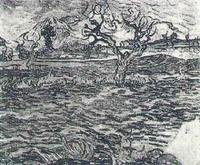
Landscape with Olive Tree and Mountains in the Background
Vincent van Gogh
Landscape in Mâcon
Hippolyte Petitjean
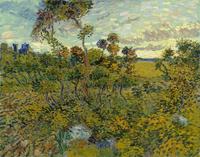
Sunset at Montmajour
Vincent van Gogh
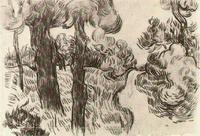
Path between Pine Trees
Vincent van Gogh
Paysage
Henri Matisse
Egry József, Balatoni Táj
Egry József
Helene de Sparte set design
Leon Bakst
Pine Trees in the Garden of the Asylum
Vincent van Gogh
Countryside at Collioure
Henri Matisse
Pine Trees along a Road to a House
Vincent van Gogh
The Little Farm
Charles Angrand
Trees in Baran-Eli
Konstantin Bogaevsky
Madame Matisse in the Olive Grove
Henri Matisse
In the Garden
Bela Czobel
Landscape at Ladyzhino
Natalia Goncharova
A Bare Treetop in the Garden of the Asylum
Vincent van Gogh
Olive Trees
Henri Matisse