
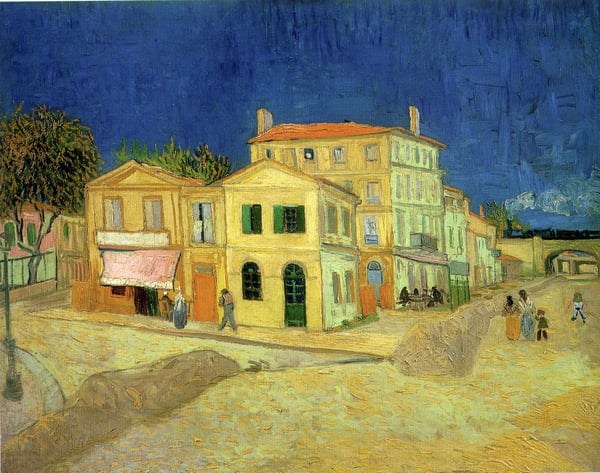
The Yellow House
Details
Expert analysis of Vincent van Gogh’s The Yellow House
Style: Post-Impressionism · Genre: cityscape
Analysis of "The Yellow House" by Vincent van Gogh (1888)
Style & Context:
As a definitive work of Post-Impressionism, van Gogh’s The Yellow House transcends the objective recording of a cityscape. Instead, it becomes a deeply personal and symbolic manifesto. Painted in Arles in 1888, the artwork depicts the house at 2 Place Lamartine, which van Gogh rented as his studio and envisioned as a "Studio of the South"—a communal haven for like-minded artists. This intention imbues the scene with a sense of hope, ambition, and fragile utopianism.
Significance within Post-Impressionism:
Van Gogh’s treatment of the cityscape exemplifies the Post-Impressionist break from naturalistic representation. The composition is strikingly straightforward yet charged with emotional intensity. The building is rendered in a brilliant, unmodulated yellow—a color he associated with sunlight, joy, and the spiritual warmth of the South. This bold, symbolic use of color (rather than local color) is a hallmark of his mature style. The thick, directional brushstrokes (impasto) animate the walls, sky, and street, conveying the artist’s restless energy and his desire to infuse the mundane with vibrant life.
Key Elements:
- The yellow facade: Dominant and almost glowing, it symbolizes van Gogh's ideal of a creative sanctuary. The green shutters and blue sky provide a complementary contrast that intensifies the yellow’s brilliance.
- The suburban setting: The tree, the small figures, and the railway bridge in the background ground the scene in modern reality, but van Gogh’s swirling lines and exaggerated perspective flatten space, making the house appear both solid and ethereal.
- Personal narrative: This painting is inseparable from van Gogh’s biography—it was here that he hoped to build an artists’ colony with Paul Gauguin, whose arrival led to the infamous ear incident. The house thus represents both his highest aspirations and his impending psychological crisis.
Legacy:
The Yellow House is significant not only as a masterful example of Post-Impressionist cityscape but also as a visual diary of van Gogh’s utopian dream. Its radiant, almost hallucinatory color and tactile surface demonstrate how he transformed a simple street corner into a monument of artistic longing and vulnerability. The work remains a touchstone for understanding how emotion and meaning can be embedded in everyday architecture through the power of paint.
Museum / Gallery
Visually similar
20 works with related composition and palette
Vincent's House in Arles (The Yellow House)
Vincent van Gogh
The Rispal Restaurant at Asnieres
Vincent van Gogh
Restaurant de la Machine at Bougival
Maurice de Vlaminck
Street in Marly
Alfred Sisley
The Restaurant de la Sirene at Asnieres
Vincent van Gogh
Village Landscape
Matthew Smith
Street in Moret Sur Loing
Alfred Sisley
The city of Arles. The square.
Pyotr Konchalovsky
Garden Behind a House
Vincent van Gogh
Quay on Oise in Pontoise
Gustave Loiseau
Marie Louise House in Spring
Henri Martin
Landscape, near Auxerre
Gustave Loiseau
Village Street and Steps in Auvers with Two Figures
Vincent van Gogh
The Embankment of Lagny under Flood Water
Maxime Maufra
Royan, Charente Inférieure
Samuel Peploe
Pont Aven, Grey Weather
Gustave Loiseau
The House of Pere Pilon
Vincent van Gogh
Restaurant de la Sirene at Asnieres
Vincent van Gogh
Osny, rue de Pontoise, Winter
Paul Gauguin
Hector Berlioz's house
Maurice Utrillo