
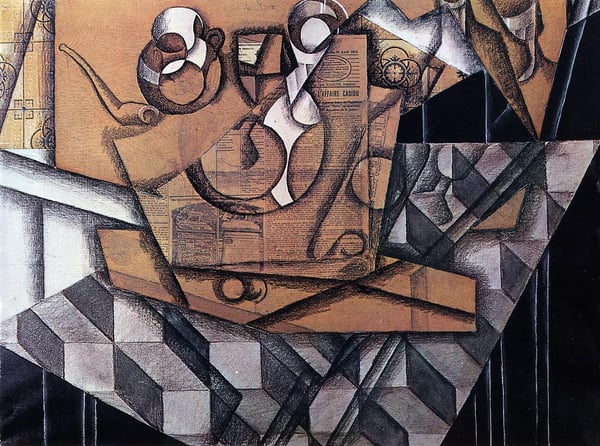
Analisi esperta di Tea Cups di Juan Gris
Stile: Synthetic Cubism · Genere: still life
Expert Analysis: Tea Cups by Juan Gris
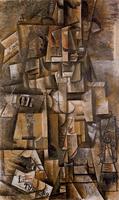
Juan Gris’s Tea Cups exemplifies the mature phase of Synthetic Cubism—a movement he helped define alongside Picasso and Braque. While Analytic Cubism dissected objects into faceted, monochromatic planes, Synthetic Cubism reassembled them using bolder colors, flattened shapes, and often collage-like patterning. Here, Gris transforms a humble still-life subject into a visually dense composition that celebrates the very process of perception.
What makes Tea Cups significant:
-
Synthetic Composition: Rather than breaking the cups into scattered facets, Gris builds them up from overlapping, clearly outlined geometric planes. The forms are more legible yet still fragmented—the curved rim of a cup may appear as a simple arc, while its body becomes a tilted oval. This deliberate simplification shows the artist “synthesizing” reality from abstract components.
-
Vibrant, Controlled Palette: Unlike the subdued browns and grays of Analytic Cubism, Gris uses crisp blues, ochres, blacks, and whites. The strong contrasts create a sense of shallow, two‑dimensional space, emphasizing the flatness of the canvas—a hallmark of Synthetic Cubism’s decorative approach.
-
Play with Texture and Pattern: Gris often introduced simulated wood grain, marbling, or cross‑hatching to evoke different surfaces. In Tea Cups, you can see this in the backdrop or tabletop: patterns that act as visual shorthand for wood or fabric. This technique imitates the collage aesthetic without literal pasted paper, demonstrating Synthetic Cubism’s integration of real‑world textures into painted form.
-
Ambiguous Space: The cups, saucers, and a possible spoon are locked in a shallow, tilting space. Background and foreground merge; shadows are rendered as flat dark shapes. This spatial ambiguity challenges traditional perspective and forces the viewer to read the still life as a set of interdependent visual signs rather than a realistic scene.
-
Still Life as Intellectual Construct: For Gris, a teacup was not an object to be imitated but a concept to be reconstructed from its visual and tactile qualities. Tea Cups is significant because it shows how Synthetic Cubism achieved a new kind of realism—one based on the logic of the painting itself, not on optical illusion.
In short, Tea Cups is a masterful example of Synthetic Cubism’s shift toward clarity, color, and structural wit. It proves that still life could be both an elegant formal exercise and a rich meditation on how we see and know everyday things.
Museum / Gallery
Visivamente simili
20 opere con composizione e palette affini
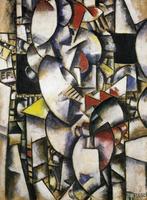
Naked model in the workshop
Fernand Leger
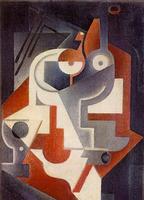
Newspaper, Glass and Pear
Juan Gris
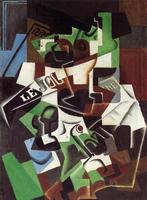
Fruit Bowl, Pipe and Newspaper
Juan Gris
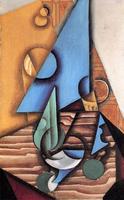
Bottle and Glass on a Table
Juan Gris
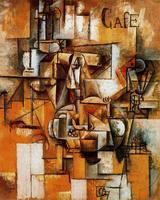
The pigeon pea
Pablo Picasso
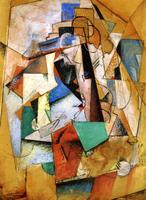
Composition
Georges Valmier
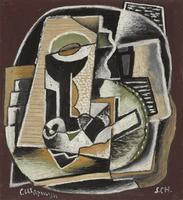
Composition, cubisme ornemental
Serge Charchoune
Vanity Box
Kazimir Malevich
Bottle of Beaune and a Fruit Dish
Juan Gris
Untitled
Artin Demirci
The Glass ( The Fruit Bowl)
Juan Gris
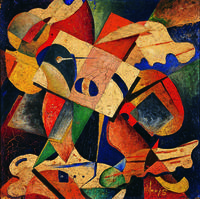
Composicion IV
Oswaldo Vigas
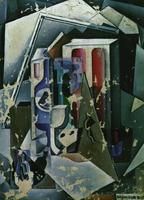
Still Life
Salvador Dali
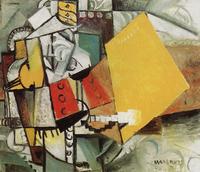
Guard
Kazimir Malevich
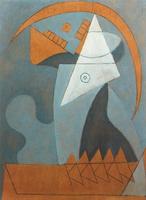
Bild
Pablo Picasso
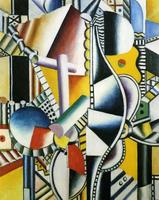
Propellers 2nd state
Fernand Leger
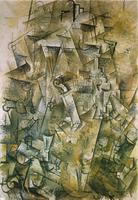
Still life with harp and violin
Georges Braque
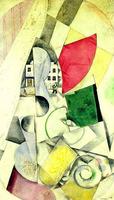
Cubist landscape
Marc Chagall
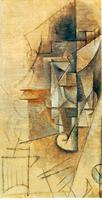
A glass
Pablo Picasso
The aficionado (The torero)
Pablo Picasso