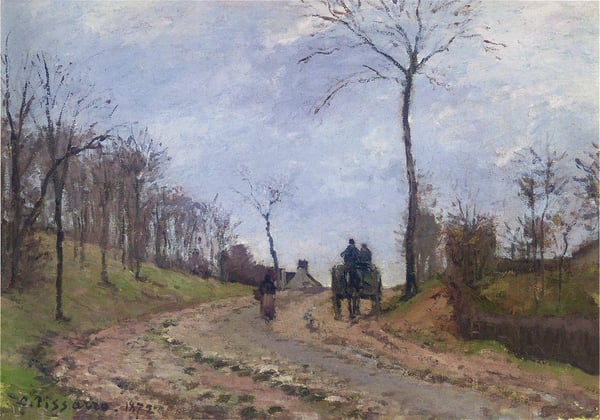
Carriage on a Country Road, Winter, Outskirts of Louveciennes
Dettagli
Analisi esperta di Carriage on a Country Road, Winter, Outskirts of Louveciennes di Camille Pissarro
Stile: Impressionism · Genere: landscape
Expert Analysis of "Carriage on a Country Road, Winter, Outskirts of Louveciennes" by Camille Pissarro
Camille Pissarro’s Carriage on a Country Road, Winter, Outskirts of Louveciennes is a quintessential example of Impressionist landscape painting, reflecting the movement’s radical shift toward capturing transient atmospheric effects and everyday rural life. Painted during his residence in the village of Louveciennes (a suburb west of Paris), this work embodies the core tenets of Impressionism: en plein air observation, a brightened palette, and a focus on the interplay of light and weather.
Significance within Impressionism
-
Celebration of the Ordinary – Unlike academic painting’s preference for historical or mythological subjects, Pissarro elevates a mundane rural scene—a carriage on a snow-dusted road—to a subject worthy of serious art. This democratization of subject matter was a hallmark of Impressionism, and Pissarro, often called the “father of Impressionism,” championed it throughout his career.
-
Winter Light and Atmosphere – The winter setting is critical: Pissarro’s brushwork captures the muted, diffused light of a cold day, with subtle tonal shifts in the snow, sky, and bare trees. Impressionists were obsessed with how weather and season altered perception, and this painting exemplifies their ability to render the chill, stillness, and silvery gray of a winter afternoon.
-
Pictorial Structure and Color – Even in this seemingly casual composition, Pissarro exhibits his interest in structure. The road recedes diagonally, guiding the eye past the carriage toward the distant buildings—a device he favored to create depth. The palette, though subdued by winter, contains touches of muted orange in the carriage contrasting with cool blues and whites, demonstrating Impressionism’s use of complementary colors to enliven a scene.
-
Representative of Pissarro’s Role – Pissarro spent several years in Louveciennes (1869–1872) painting its countryside and outskirts. This work highlights his commitment to rendering the specific character of a locale, not as an idealized pastoral but as a real, working landscape. He was a mentor to younger Impressionists (including Cézanne and Gauguin), and his careful observation of nature influenced the movement’s development.
Conclusion
Carriage on a Country Road, Winter, Outskirts of Louveciennes is significant not only as a beautiful landscape but as a document of Impressionism’s core ambitions: to paint the fleeting effects of light and atmosphere on a humble, everyday scene. Pissarro’s ability to find poetry in a winter road and a passing carriage—without sentimentality—underscores his mastery of the Impressionist vision.
Museum / Gallery
Visivamente simili
20 opere con composizione e palette affini
The Road to Saint Cyr at Louveciennes
Camille Pissarro
Stagecoach to Louveciennes
Camille Pissarro
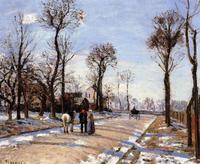
Street Winter Sunlight and Snow
Camille Pissarro
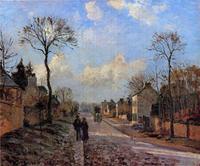
A Road in Louveciennes
Camille Pissarro
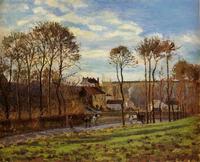
Pontoise, Les Mathurins
Camille Pissarro
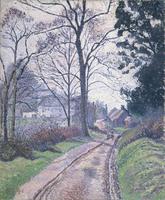
Crockers Lane, Coldharbour
Lucien Pissarro
Thaw, Pontoise
Camille Pissarro
The Road in Gouvieux
Camille Corot
The Path Leading to the House
Camille Corot
Road to Louveciennes
Camille Pissarro
The Road from Versailles to Saint Germain, Louveciennes. Snow Effect
Camille Pissarro
The Louveciennes Road
Camille Pissarro
Snow Effect at Veneux
Alfred Sisley
Road to Saint Germain, Louveciennes
Camille Pissarro
Boulevard des Fosses. Pontoise
Camille Pissarro
The House of Monsieur Musy, Louveciennes
Camille Pissarro
Autumn Landscape at Goulazon
Maxime Maufra
Trouville, Le Chemin de la Corderie
Eugene Boudin
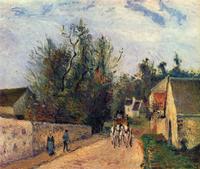
The Stage on the Road from Ennery to l'Hermigate, Pontoise
Camille Pissarro
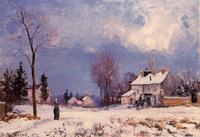
The Road from Versalles to Saint Germain at Louveciennes
Camille Pissarro