Expert analysis of Camille Pissarro’s Kitchen Garden in Eragny, Afternoon
Style: Impressionism · Genre: landscape
Expert Analysis: Kitchen Garden in Eragny, Afternoon by Camille Pissarro
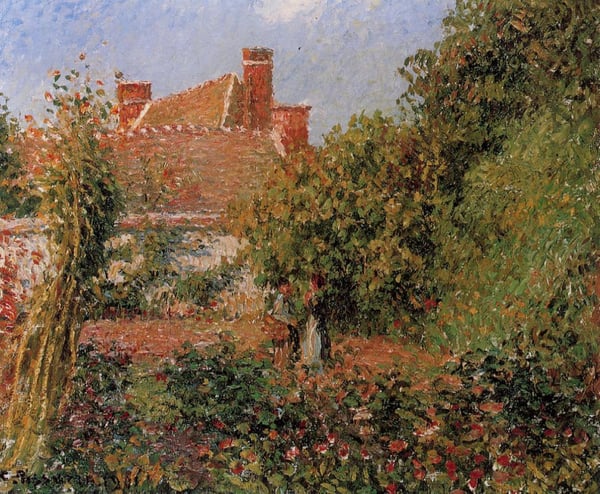
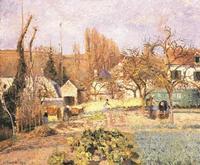
Camille Pissarro’s Kitchen Garden in Eragny, Afternoon (c. 1895–1900) exemplifies the artist’s mature Impressionist vision and his lifelong commitment to depicting rural life with dignity and directness. As a landscape within the Impressionist style, the work captures a fleeting moment of natural light and atmospheric effect—the “afternoon” of the title—while simultaneously grounding the viewer in the rhythms of agricultural labor.
Significance in Impressionism:
Pissarro was the only artist to exhibit in all eight Impressionist exhibitions, and his kitchen-garden scenes from Eragny (the village where he settled in 1884) are among the purest expressions of the movement’s core principles. Here, he abandons grand historical or mythological subjects in favor of a humble, everyday vista: rows of vegetables, fruit trees, and a patch of cultivated earth. The painting’s significance lies in how Pissarro transforms this ordinary plot into a shimmering mosaic of color and light. He employs short, broken brushstrokes—a hallmark of Impressionism—to render the dappled sunlight filtering through leaves, the texture of soil, and the shifting greens and yellows of vegetation. The afternoon light is not merely a backdrop but the true subject, modulating from warm gold to cool shadow as the eye moves across the canvas.
Pissarro’s Role as Mentor and Innovator:
Pissarro was a central figure in the Impressionist circle, mentoring younger artists like Cézanne and Gauguin. In Kitchen Garden in Eragny, Afternoon, his technique shows a subtle evolution: the brushwork is freer and more fractured than in his earlier works, yet he retains a strong compositional structure. The diagonal sweep of the garden rows leads the eye into the depth of the scene, while the soft, atmospheric perspective keeps the focus on the interplay of surface color. This balance between spontaneity and order reflects Pissarro’s philosophical belief that art should both capture the sensory experience of nature and honor the quiet dignity of peasant life—a theme that sets him apart from the more urban-focused Impressionists.
Historical and Artistic Context:
Painted during Pissarro’s late period, this work also reveals his partial shift toward a more systematic approach, influenced by his brief engagement with Neo-Impressionism in the 1880s. The dots and dashes of color in the garden’s foliage and the sky echo the divisionist technique, yet Pissarro never fully abandoned the intuitive, atmospheric quality of pure Impressionism. The result is a painting that feels both luminous and grounded—a testament to his ability to synthesize innovation with personal vision.
In short, Kitchen Garden in Eragny, Afternoon is significant because it distills the essence of Impressionism: the pursuit of transient light, the elevation of the ordinary, and the harmony between human cultivation and nature’s vitality. It stands as a quiet masterpiece of the genre landscape and a poignant record of Pissarro’s enduring belief that the most profound beauty lies in the everyday.
Museum / Gallery
Genre
Style
Visually similar
20 works with related composition and palette
Vegetable Garden in Eragny, Overcast Sky, Morning
Camille Pissarro
Study at Pontoise
Camille Pissarro
Party wall
Paul Gauguin
The Garden of Monet at Argenteuil
Claude Monet
The Garden of Petit Gennevillers, the Pink Roofs
Gustave Caillebotte
Autunm in Eragny
Camille Pissarro
The Garden at Kervaudu
Ferdinand du Puigaudeau
The Artist's Garden at Eragny
Camille Pissarro
House in the Country
Gustave Loiseau
Azaleas
John Henry Twachtman
La Maison De La Sourde, Éragny
Lucien Pissarro
The Artist's House at Giverny
Claude Monet
The Garden Behind the House
Gustave Loiseau
Epinay-sur-Orge
Armand Guillaumin
Camille Monet in the Garden at the House in Argenteuil
Claude Monet
The Garden at Bougival
Berthe Morisot
The Garden at Pontoise
Camille Pissarro
In the Garden
Claude Monet
Kitchen Garden at the Hermitage, Pontoise
Camille Pissarro
Flowers in the Artist's Garden
Marie Duhem