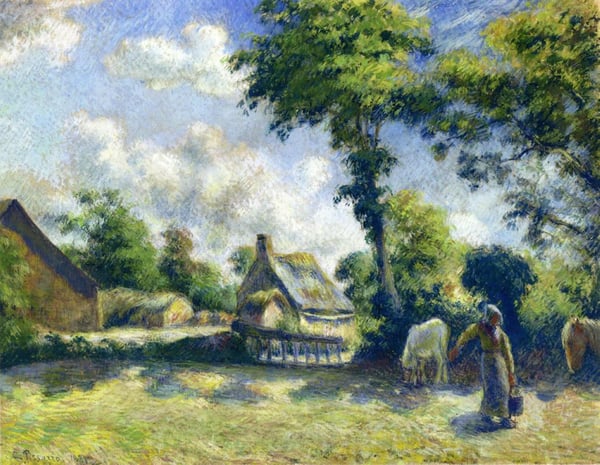
Landscape at Melleray, Woman Carrying Water to Horses
Details
Expert analysis of Camille Pissarro’s Landscape at Melleray, Woman Carrying Water to Horses
Style: Impressionism · Genre: landscape
This work, Landscape at Melleray, Woman Carrying Water to Horses (c. 1870s–80s), is a quintessential example of Camille Pissarro’s contribution to Impressionism and the genre of landscape. Pissarro, often called the “father of Impressionism,” was deeply committed to painting en plein air, capturing the fleeting effects of light and atmosphere on the rural countryside. Here, the scene at Melleray—a small village in Brittany—is not merely a topographical record but a study in harmony between human labor and the natural world.
Significance within Impressionism: Pissarro’s approach differs from that of Monet or Renoir in its quiet, unglamorous subject matter. Instead of fashionable Parisian parks or boating parties, he elevates the ordinary rustic life. The woman carrying water to horses is a figure integrated into the landscape, not dominating it. Her action, the horses, and the surrounding trees and sky are all rendered with broken, rapid brushstrokes that dissolve hard outlines. This technique—applying pure colors side by side to mix optically—allows the scene to shimmer with the actual sensation of a specific moment of daylight. The cool greens and soft blues suggest a humid, overcast day, while the open composition gives the landscape breathing room.
Significance as a landscape: As a landscape genre piece, it challenges traditional hierarchy by merging figure, animal, and terrain into a unified tapestry. Pissarro’s attention to the horizontal layers—ground, midground trees, distant horizon—creates a sense of depth without forcing perspective. The woman’s tilted stance and the horses’ relaxed postures imply a cyclical, timeless rural rhythm. This reflects Pissarro’s anarchist sympathies: he sees peasant work as dignified and essential, not picturesque. The painting’s significance thus lies in its democratic vision of nature and labor, mediated through the Impressionist revolution in color and light. It is a serene yet radical statement that the everyday landscape is worthy of profound artistic scrutiny.
Museum / Gallery
Visually similar
20 works with related composition and palette
Archicourt, Near Arras
Camille Corot
Cottage
Vincent van Gogh
Cottages near pond
Theodore Rousseau
Tree in the farm yard
Paul Gauguin
Grape Harvesters
Pierre-Auguste Renoir
Spring Morning, Pontoise
Camille Pissarro
French Farm
Guy Rose
The Mill, Saint-Cenery
Eugene Boudin
The House of Monsieur Musy, Louveciennes
Camille Pissarro
The washing place
Johan Hendrik Weissenbruch
Near the Mill, Chierry, Aisne
Camille Corot
Autumn Landscape
Johan Hendrik Weissenbruch
The Farm
Pierre-Auguste Renoir
Drinker at the edge of the Cure
Maximilien Luce
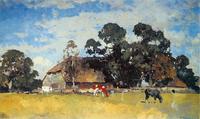
Cows in a meadow
Cornelis Vreedenburgh
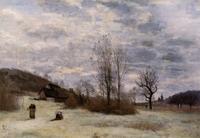
Plains near Beauvais
Camille Corot
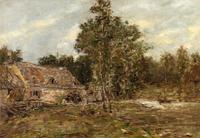
The Mill, Saint-Cenery
Eugene Boudin
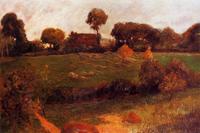
Farm in Brittany
Paul Gauguin
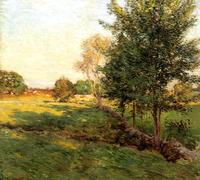
Lenghtening Shadows
Willard Metcalf
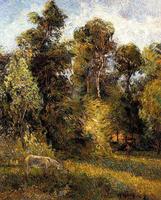
The Forest Edge
Paul Gauguin