Camille Pissarro sanatçısının Mother Lucien s Field at Eragny eseri hakkında uzman analizi
Tarz: Impressionism · Tür: landscape
As an expert in Impressionism, I can provide a focused analysis of Camille Pissarro’s Mother Lucien’s Field at Éragny based on the supplied facts.
Artwork: Mother Lucien’s Field at Éragny
Artist: Camille Pissarro
Style: Impressionism
Genre: Landscape
This painting is a quintessential example of Pissarro’s mature Impressionist work, created during his most productive period in the village of Éragny (where he lived from 1884 onward). The significance of this piece lies in how it embodies two core principles of the Impressionist movement: the direct observation of nature and the depiction of modern rural life through light and color.
Analysis:
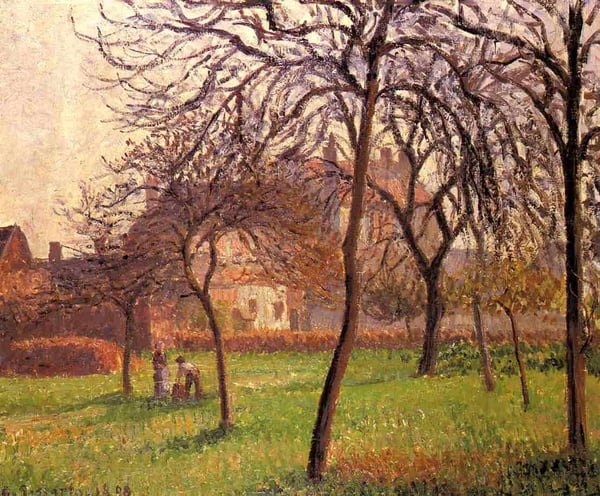
Pissarro was the only artist to exhibit in all eight Impressionist exhibitions, and his landscapes from Éragny are renowned for their balance of structural order and atmospheric spontaneity. In Mother Lucien’s Field at Éragny, the artist captures a seemingly ordinary agricultural scene—a field under an open sky—but transforms it through a masterful handling of broken brushwork and nuanced color. Instead of outlining forms, Pissarro builds the landscape with short, discrete dabs of paint that vibrate optically. The field is not uniformly green; it is a mosaic of yellows, pale greens, violets, and ochres, mirroring the shifting sunlight across the terrain. The sky, too, is alive with touches of blue, pink, and grey, suggesting the transient weather conditions of the French countryside.
What makes this work significant within Impressionism is its demonstration of Pissarro’s “anarchist” vision of harmony between humanity and nature. Unlike many contemporaries who painted leisure activities in parks or along the Seine, Pissarro persistently celebrated the labor of peasant farmers—the field itself is a product of human toil, yet it is presented with the same dignity and sensory immediacy as a Monet haystack. The title, referencing “Mother Lucien” (likely a local figure), anchors the scene in specific, humble reality rather than idealized pastoralism.
Technically, the painting showcases Pissarro’s evolution: by the 1890s, he had absorbed some pointillist discipline (from his time working with Seurat), but here he returns to a freer touch, blending structure with expressiveness. The composition is deceptively simple—a diagonal sweep of the field leads the eye into the distance, while a cluster of trees or farm buildings (typical of Éragny) provides a stabilizing anchor. The light is not harsh but diffused, creating a palpable atmosphere of a quiet afternoon.
In the broader context of Impressionism, Mother Lucien’s Field at Éragny is significant because it encapsulates Pissarro’s role as the “father” of the movement—a mentor who insisted that art must be grounded in sincere observation of everyday life. It is a testament to how Impressionism could find profound beauty and meaning in the most ordinary landscape, forever changing how we see the world.
Museum / Gallery
Görsel olarak benzer
İlişkili kompozisyon ve renk paletine sahip 20 eser
Afternoon in Eragny grey weather
Camille Pissarro
The Barn, Morning, Eragny
Camille Pissarro
Trees in Bloom
Gustave Loiseau
Autunm in Eragny
Camille Pissarro
Morning, Autumn Sunlight, Eragny
Camille Pissarro
The Garden
Gustave Loiseau
Pear Tress in Bloom, Eragny, Morning
Camille Pissarro
Chestnut Trees, Louveciennes, Spring
Camille Pissarro
Pear Trees and Flowers at Eragny, Morning
Camille Pissarro
Louvier Road in Winter
Gustave Loiseau
Spring Landscape
Gustave Loiseau
Pere Gallien's House at Pontoise
Camille Pissarro
Piette's Home on Montfoucault
Camille Pissarro
Apple Trees in a Field
Camille Pissarro
La Maison De La Sourde, Éragny
Lucien Pissarro
Woman in an Orchard, Spring Sunshine in a Field, Eragny
Camille Pissarro
Walnut Tree in Spring
Camille Pissarro
Spring at Veneux
Alfred Sisley
Trees in Bloom
Alfred Sisley
Overcast Weather at Nesles la Vallee
Gustave Loiseau