Analisi esperta di The Baptism of Constantine di Raphael
Stile: High Renaissance · Genere: history painting
Expert Analysis of "The Baptism of Constantine" by Raphael
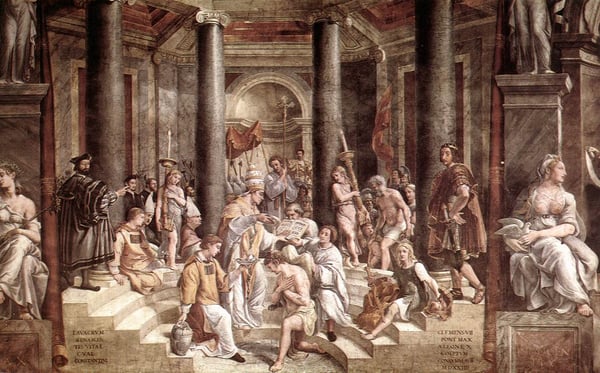
Raphael’s Baptism of Constantine (c. 1520–1524, fresco in the Vatican’s Sala di Costantino) stands as a pivotal work of the High Renaissance, exemplifying the era’s fusion of classical grandeur with Christian narrative. Though completed largely by Raphael’s workshop after his death, the composition reflects his masterful handling of space, light, and human drama.
Significance within the High Renaissance:
-
Synthesis of Architecture and Narrative: The scene unfolds beneath a vast, barrel-vaulted basilica, drawing on Roman architectural forms to elevate the baptism—a turning point in Western history—into a timeless, monumental event. The use of perspective directs the eye to the central font, where Constantine kneels, receiving the sacrament from Pope Sylvester I.
-
Naturalism and Idealized Figures: Raphael’s figures embody the High Renaissance ideal—balanced, serene, yet emotionally potent. The emperor’s humble posture contrasts with the dignified pope, while attendants and onlookers display a range of ages and expressions, showcasing Raphael’s skill in capturing individual psychology within a unified composition.
-
Light as a Symbolic Device: Soft, diffused light washes over the scene, emphasizing the spiritual illumination of Constantine’s conversion. The chiaroscuro modeling of drapery and flesh recalls Leonardo’s sfumato, but Raphael applies it with his characteristic clarity, reinforcing the theological message: the emperor’s earthly power yields to divine grace.
-
Historical and Political Context: The fresco is part of the Sala di Costantino cycle, commissioned by Pope Clement VII to legitimize papal authority by linking it to Constantine’s conversion. Raphael’s design subtly asserts the Church’s supremacy over the state—a key ideological concern of the High Renaissance papacy.
Enduring Legacy: This work marks a transition from Raphael’s earlier, more lyrical style to a late phase of heightened monumentality and rhetorical force, influencing later Baroque fresco cycles (e.g., Pietro da Cortona). Its seamless blend of classical allusion, spiritual gravity, and narrative clarity defines the High Renaissance ambition: to render the divine with the perfection of the antique.
Museum / Gallery
Visivamente simili
20 opere con composizione e palette affini
The Banquet of Cleopatra
Giovanni Battista Tiepolo
The Meeting of Anthony
Giovanni Battista Tiepolo
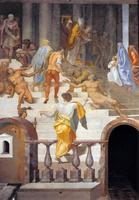
The Presentation of the Virgin
Daniele da Volterra
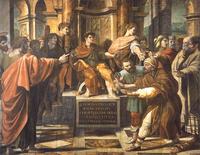
The Blinding of Elymas (cartoon for the Sistine Chapel)
Raphael
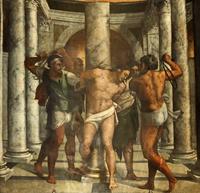
The Flagellation of Jesus
Sebastiano del Piombo
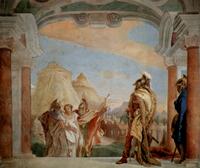
Eurybates and Talthybios Lead Briseis to Agamemmon
Giovanni Battista Tiepolo
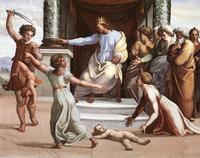
The Judgment of Solomon
Raphael
The Judgment of Solomon
Sebastiano del Piombo
The Fainting of Esther
Paolo Veronese
Paul III Farnese Directing the Continuance of St Peter's
Giorgio Vasari
Saints Mark and Marcellinus being led to Martyrdom
Paolo Veronese
The Sacrifice of Iphigenia
Giovanni Battista Tiepolo
St Sebastian Reproving Diocletian
Paolo Veronese
Das Opfer Des Seleukus Von Lokris
Domenico Beccafumi
Gaius Servilius Ahala presents the body of Spurius Maelius to Cincinnatus
Domenico Beccafumi
Dinner of St. Gregory the Great (Clement VII)
Giorgio Vasari
The Judgment of Solomon
Nicolas Poussin
Presentation of Mary in the Temple
Francesco de' Rossi (Francesco Salviati), "Cecchino"
The Family of Darius before Alexander
Paolo Veronese
The Marriage of Alexander and Roxanne
Il Sodoma