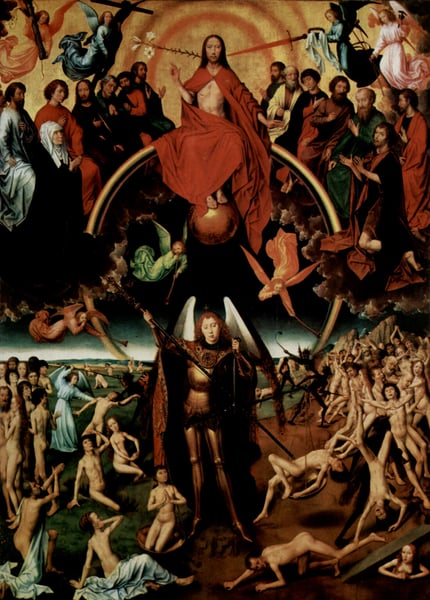
The Last Judgment triptych, central panel, Maiestas Domini with Archangel Michael weighing the souls
Details
Expert analysis of Hans Memling’s The Last Judgment triptych, central panel, Maiestas Domini with Archangel Michael weighing the souls
Style: Northern Renaissance · Genre: religious painting
Expert Analysis: The Last Judgment Triptych (Central Panel) by Hans Memling
Hans Memling’s central panel of the Last Judgment triptych (c. 1467–1471) stands as a masterwork of the Northern Renaissance, synthesizing the region’s hallmark precision, symbolic density, and spiritual immediacy. Painted during a period when Netherlandish art was celebrated for its luminous oil technique and naturalistic detail, this panel exemplifies Memling’s ability to compress a cosmic drama into a harmonious, meticulously ordered composition.
Significance within the Northern Renaissance:
Memling, a pupil or follower of Rogier van der Weyden, inherits the Flemish tradition of richly symbolic realism, but he refines it with a cooler, more serene clarity. The central panel—titled Maiestas Domini with Archangel Michael Weighing the Souls—directly confronts the viewer with the moment of divine judgment. Christ sits enthroned in a mandorla of light, his feet resting on a golden globe, flanked by the Virgin Mary and John the Baptist as intercessors. The setting is a celestial golden field punctuated by apostles and angels, while below, Archangel Michael presides over the scales of justice. The damned are plunged into a hellish maw on the left, and the blessed rise to a heavenly gate on the right. This spatial arrangement—hieratic above, narrative below—demonstrates Memling’s genius for organizing complex theological content into legible, balanced tiers.
Key elements of significance:
-
Synthesis of Elegance and Morality: Unlike the tortured emotionalism of earlier Last Judgments (e.g., Van der Weyden’s Beaune Altarpiece), Memling tempers terror with refinement. Christ’s gesture is calm, the angels’ faces placid, even the damned are rendered with clinical precision rather than grotesque frenzy. This reflects the Northern Renaissance’s shift toward interior piety and measured contemplation.
-
Microscopic Detail and Symbolism: Memling’s oil technique allows for jewel-like luminosity. The scales of Michael are exquisitely rendered, with tiny souls appearing as naked figures. The armor of Michael, the folds of Christ’s robe, and the iridescent wings of angels all showcase Flemish virtuosity in texture and light. Each detail—the lily and sword emerging from Christ’s mouth (mercy and judgment), the giant fish swallowing the damned—carries typological weight, inviting prolonged meditation.
-
Archangel Michael as Pivot: The central role given to Michael weighing the souls is unusual for its prominence. He is not just a bystander but the fulcrum of the composition, literally balancing fate. This emphasizes personal accountability, a key concern of Northern Renaissance devotion, where the individual’s moral choices are weighed against divine mercy.
-
Narrative Integration within Triptych Form: As the central panel of a triptych, it was originally flanked by wings showing saints and donors. The panel thus functioned as an altarpiece, likely for a church or chapel, where the faithful would confront their own judgment. Memling’s bright, layered space creates a window into the hereafter—both terrifying and reassuring—that compels the viewer to examine their own soul.
In sum, Memling’s Last Judgment central panel is significant for its calm, crystalline depiction of eschatological drama, its flawless integration of Northern Renaissance naturalism with medieval symbolic tradition, and its enduring power to engage the viewer in profound spiritual reflection. It stands as a high point of Flemish panel painting, demonstrating how art can make the eternal tangible.
Museum / Gallery
Visually similar
20 works with related composition and palette
Last Judgement (Altarpiece for the Church of the Holy Apostles in Cologne, central panel)
Stefan Lochner
The Ascension of Christ
Pietro Perugino
The Last Judgment
Jan Provoost
Madonna in Glory with Saints
Domenico Ghirlandaio
The Virgin enthroned, with angels and saints, Vallombrosa Alterpiece
Pietro Perugino
The dying man
Lucas Cranach the Elder
The Ascension of Christ
Pietro Perugino
Polyptych Annunziata (Assumption of Mary)
Pietro Perugino
Juicio Final
Maarten de Vos
The Last Judgement
Petrus Christus
The Coronation of the Virgin
Domenico Ghirlandaio
Pala di San Francesco al Monte (The Coronation of the Virgin)
Pietro Perugino
Madonna in Glory with the Child and Saints
Pietro Perugino
Triptych of the Resurrection: The Resurrection (centre) The Martyrdom of St. Sebastian (left) and The Ascension (right)
Hans Memling
Gazing Ball (Perugino Madonna and Child with Four Saints)
Jeff Koons
The Last Judgment triptych, left wing, The Blessed at the gate to heaven (Paradise) with St. Peter
Hans Memling
Christ in Glory with St. Benedict (c.480-547), St. Romuald (c.952-1027), St. Attinia, St. Grecinia and the donor, abbot Buonvicini
Domenico Ghirlandaio
Allegory of Christianity
Jan Provoost
Madonna and Child with Four Saints (Tezi Altarpiece)
Pietro Perugino
Cathedral of Sansepolcro Internal
Pietro Perugino