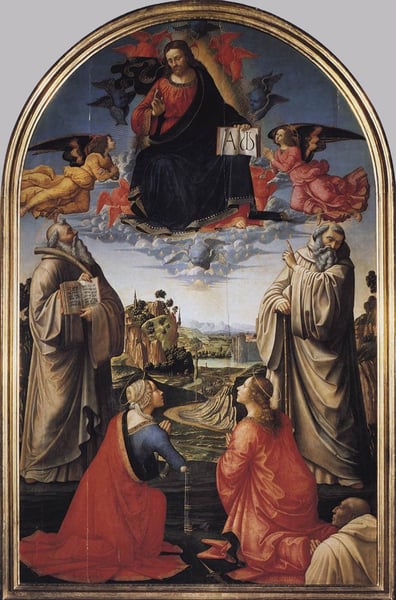
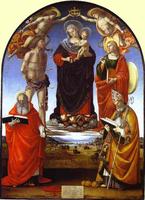
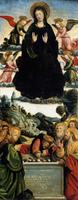
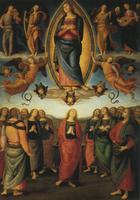
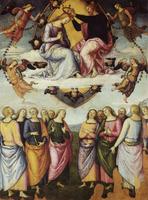
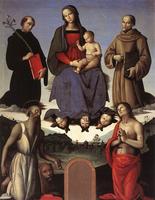
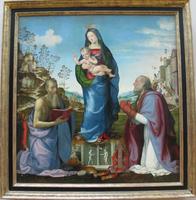
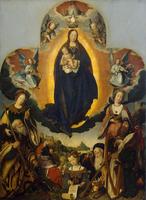
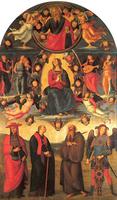
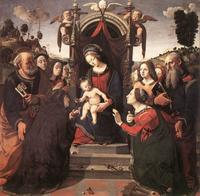
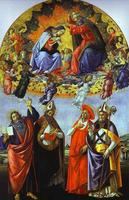
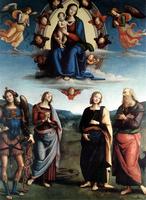
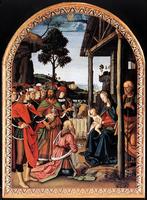
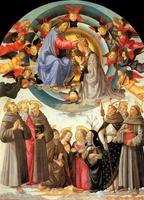
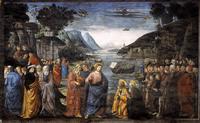
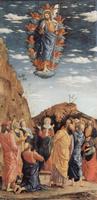
This work, Christ in Glory with St. Benedict, St. Romuald, St. Attinia, St. Grecinia and the Donor, Abbot Buonvicini, by Domenico Ghirlandaio, is a prime example of Early Renaissance religious painting. Its significance lies in how Ghirlandaio masterfully fuses traditional sacred iconography with the humanist and naturalistic innovations of the period.
As an Early Renaissance work, the painting demonstrates Ghirlandaio’s renowned skill in creating a believable, ordered space. The central figure of Christ in Glory is likely rendered with a clarity of form and a sense of volumetric presence, while the surrounding saints—the monastic founders St. Benedict and St. Romuald, along with the lesser-known St. Attinia and St. Grecinia—are depicted with individualized, dignified features, reflecting the period’s growing interest in naturalistic portraiture. The inclusion of Abbot Buonvicini as a donor is particularly telling: it places a contemporary, recognizable figure within the same sacred scene, a hallmark of Florentine Early Renaissance patronage that asserted the importance of individual piety and the patron’s role in salvation.
Furthermore, the choice of saints—particularly St. Romuald, founder of the Camaldolese order, alongside St. Benedict—connects the work to a specific monastic community. Ghirlandaio’s ability to balance a clear compositional hierarchy (with Christ at the apex) with detailed, earthly depictions of fabric, architecture, and human expression exemplifies the era’s goal of making the divine accessible and immediate. This painting not only showcases Ghirlandaio’s talent for integrating donors and narrative clarity but also stands as a testament to how Early Renaissance artists transformed devotional images into sophisticated, human-centered visual experiences that would influence later masters like Michelangelo, who apprenticed in Ghirlandaio’s workshop.