Analyse experte de Youth de Rene Magritte
Style : Cubism · Genre : symbolic painting
Expert Analysis of "Youth" by René Magritte
Stylistic and Period Context
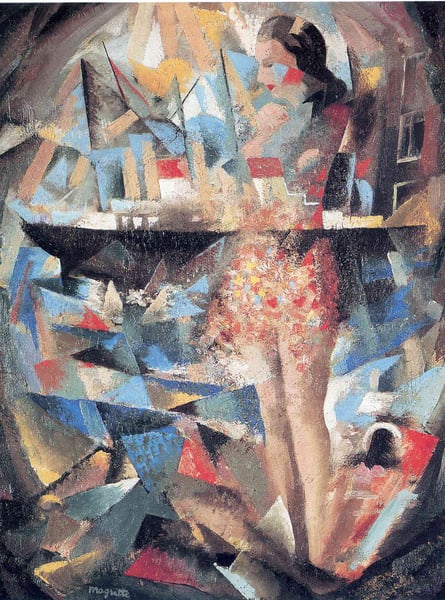
Within Magritte’s early years, the artist was actively experimenting with the visual language of Cubism—a departure from his later signature Surrealist style. This painting, titled Youth, belongs to that formative phase, where he was absorbing the geometric fragmentation and multi-perspectival approach of Cubism while infusing it with symbolic content. The work stands as a crucial document of Magritte’s artistic development, showing his transition from traditional representation toward a more analytical, abstracted reality.
Significance in Magritte’s Oeuvre
What makes Youth significant is its fusion of Cubist form with symbolic intention—a combination rare in Magritte’s corpus. Unlike the purely formal Cubism of Picasso or Braque, Magritte embeds allegorical meaning into the shattered planes and faceted shapes. The title “Youth” suggests a meditation on growth, potential, or the passage of time, conveyed through Cubism’s fracturing of a coherent image into multiple viewpoints. This early work prefigures Magritte’s lifelong interest in dislocating familiar objects to reveal hidden meanings, even before he fully embraced Surrealism.
Genre and Interpretation
As a symbolic painting, Youth likely employs Cubist devices to evoke the fragmentation of identity or memory associated with youth. The geometric distortions may represent the discord between inner experience and outer perception. In the broader context of early 20th-century art, Magritte’s adoption of Cubism for symbolic ends was an innovative step—he was not merely replicating a style but using its structural language to question reality itself. This painting thus serves as a bridge between early modernist abstraction and the artist’s later, more overtly surreal and enigmatic imagery.
Key Takeaway
Youth by René Magritte is significant as a rare example of the artist working within Cubism while already prioritizing symbolic content. It demonstrates his early ambition to merge formal innovation with philosophical inquiry, laying the groundwork for his groundbreaking contributions to Surrealist thought.
Genre
Style
Visuellement similaire
20 œuvres à la composition et à la palette proches
Venus of the ports
Mario Sironi
The Port
Félix Del Marle
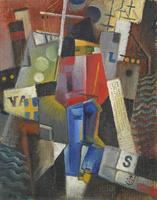
Sjöman
Gosta Adrian-Nilsson
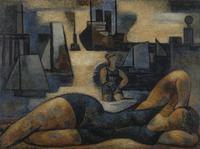
Blue beach
Marcel Gromaire
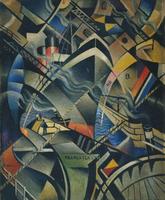
The Arrival
C. R. W. Nevinson
Grey Steam Boat
Alfred Wallis
Untitled
Dimitris Mytaras
Hafenstadt
Gustave Buchet
Large and Small Steamboats
Alfred Wallis
Large and Small Steamboats
Alfred Wallis
Boats of Jewish Immigrants (Hamaapilim)
Jean David
Ondeggiavano
Enzo Cucchi
Tramp Steamer
Edward Hopper
Le Port de Cannes
Pierre Bonnard
Motor Vessel with Four Men
Alfred Wallis
Motor Vessel with Four Men
Alfred Wallis
Marine
Gustave Buchet
Three Boats off the Shore
Alfred Wallis
Death Ship
Alfred Wallis
Port Scene
Jean David