
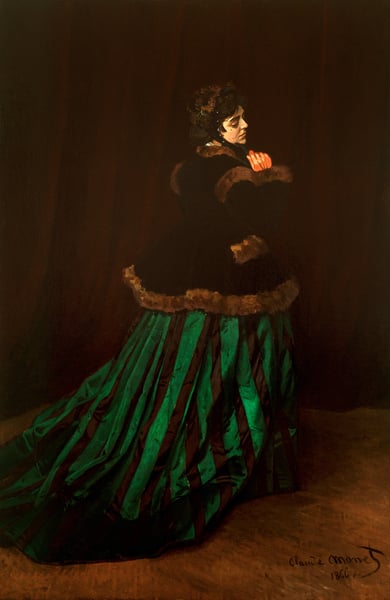
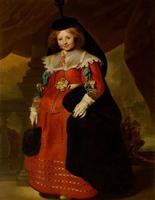
Camille (also known as The Woman in a Green Dress)
Details
Expert analysis of Claude Monet’s Camille (also known as The Woman in a Green Dress)
Style: Academicism · Genre: genre painting
Expert Analysis of "Camille (also known as The Woman in a Green Dress)" by Claude Monet
Style & Period Context:
Despite Monet’s later fame as a leader of Impressionism, this work is classified under Academicism—the conservative, officially sanctioned style of the mid-19th century French art establishment. Academicism prized precise draftsmanship, polished finish, and narrative clarity, often drawn from history, mythology, or everyday life treated with idealized realism. Here, Monet adheres to these conventions while subtly infusing the work with his emerging personal vision.
Genre Significance:
The painting is a genre painting—a depiction of contemporary, everyday life. At a time when the Académie des Beaux-Arts ranked such scenes below history painting, Monet elevates a simple domestic or outdoor moment into a dignified subject. The woman in the green dress (Camille Doncieux, the artist’s future wife) is presented not as a mythological figure but as a real, modern woman, which aligns with the Academician interest in capturing the “natural” through careful observation.
What Makes It Significant:
- Bridge between Traditions: The work shows Monet’s technical grounding in Academic principles: controlled brushwork, a balanced composition, and attention to fabric texture (the striking green silk dress). Yet hints of his later Impressionist concerns appear—the play of light on the dress’s folds and the relatively loose treatment of the background.
- Early Portrait of Camille: As a recurring muse, Camille appears here with a directness and psychological presence unusual for Academic genre pieces. Monet’s personal connection imbues the scene with intimacy, moving the genre beyond mere anecdote.
- Career Milestone: Painted in 1866, this work gained Monet his first significant critical and commercial success when it was accepted into the Paris Salon—the ultimate validation within Academicism. It proved he could master the system before ultimately breaking from it.
In summary, “Camille (The Woman in a Green Dress)” is significant as a masterful Academic genre piece that documents Monet’s technical prowess and his transitional moment—standing with one foot in tradition and the other already stepping toward the revolution of Impressionism.
Museum / Gallery
Visually similar
20 works with related composition and palette
A Genoese Lady with Her Child
Anthony van Dyck
Arrangement in Black, No. 2 Portrait of Mrs. Louis Huth
James McNeill Whistler
Portrait of Princess M.Orlova-Davydova
Konstantin Makovsky
Portrait of Catarina van Leunink
Gerard Terborch

Lydia Field Emmet
William Merritt Chase
Portret Damy
Leon Wyczółkowski
Polyxena of Lobkowicz
Maria Bozoky
Portret Zofii Z Gałczyńskich Kossakowej
Henryk Rodakowski
Madame Gaye
Marià Fortuny

Arrangement in Black The Lady in the Yellow Buskin
James McNeill Whistler
Mrs. Ellinor Guthrie
Frederic Leighton

Ready For The Ride
William Merritt Chase
Mrs. William Astor
Carolus-Duran
Portrait of Teresa Francisca Mudarra Y Herrera
Claudio Coello
Portrait of Queen Mariana of Austria
Diego Velazquez
Portrait of the Infanta Margarita
Diego Velazquez
Portrait of Ines de Zuñiga y Velasco
Juan Carreno de Miranda

Portrait of a Girl at the Age of 10
Cornelis de Vos
The author Emma Kraft
Elisabeth Jerichau-Baumann
Emerentia Von Berensteyn
Pieter Soutman