
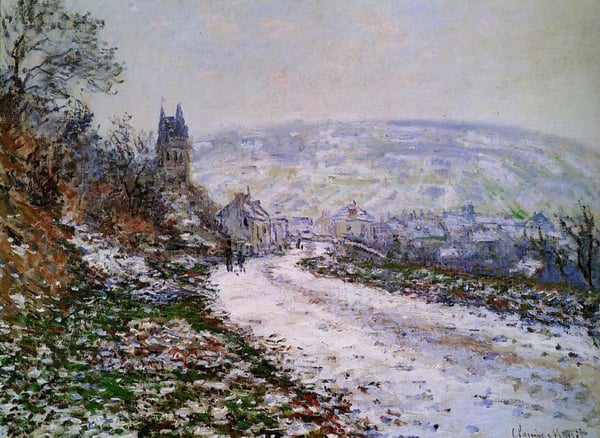
Analisi esperta di Entering the Village of Vetheuil in Winter di Claude Monet
Stile: Impressionism · Genere: landscape
Expert Analysis: "Entering the Village of Vetheuil in Winter" by Claude Monet
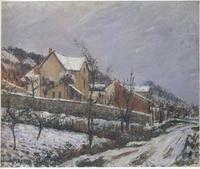
Claude Monet’s Entering the Village of Vetheuil in Winter (c. 1879) stands as a luminous exemplar of Impressionism’s revolutionary approach to landscape, particularly in its handling of the winter season. Painted during Monet’s productive yet difficult period in the village of Vétheuil, this work demonstrates the artist’s unyielding commitment to capturing fleeting atmospheric conditions—a core tenet of the Impressionist movement.
Significance within Impressionism:
The painting transforms a seemingly mundane rural scene into a study of shifting light and color. Monet eschews traditional tonal modeling of snow (which would rely on white and gray) and instead builds the snowy ground from subtle harmonies of blue, lavender, pink, and pale yellow—reflecting the complex interplay of winter daylight, shadows, and the village’s warm structures. This technique, often called “broken color,” applies paint in visible, rapid brushstrokes that optically blend when viewed from a distance, mimicking the viewer’s perception of natural light in real time.
Compositional and Contextual Importance:
The composition leads the eye into the village along a road flanked by leafless trees and patches of snow, with the church steeple of Vétheuil anchoring the background—a motif Monet revisited frequently during his stay (1878–1881). This period marked a transition in his career: he was experimenting with serial views and more dynamic weather effects, moving beyond the pure plein-air sketches of the 1870s. Here, the muted winter palette contrasts with the energized, almost restless brushwork, suggesting the cold air and the quiet stillness of the season. The lack of human figures emphasizes the landscape as the sole subject, allowing nature’s atmospheric phenomena—the gray sky, the soft reflections on the frozen road—to dominate.
Legacy:
Entering the Village of Vetheuil in Winter is significant as a bridge between Monet’s earlier Impressionist landscapes (e.g., at Argenteuil) and his later, more abstract series (e.g., Haystacks or Rouen Cathedral). It demonstrates his growing confidence in using winter light as a vehicle for exploring color relativity, prefiguring his fascination with how the same subject changes under different conditions. Today, it remains a compelling testament to Impressionism’s core ambition: to capture not what the eye knows, but what it sees in a transient moment of light and atmosphere.
Visivamente simili
20 opere con composizione e palette affini
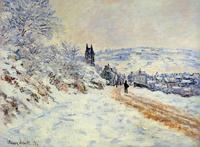
The Road to Vertheuil, Snow Effect
Claude Monet
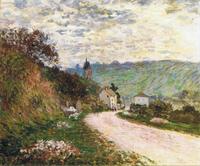
The Route a Vetheuil
Claude Monet
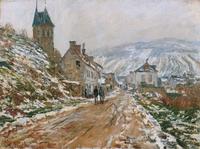
The Road in Vetheuil in Winter
Claude Monet
Path at Giverny
Claude Monet
The Road to Vetheuil
Claude Monet
The Seine at Bougival
Claude Monet
Road to Giverny in Winter
Claude Monet
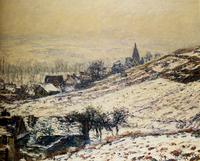
Winter at Giverny
Claude Monet
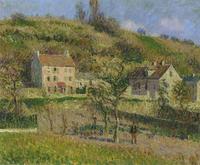
Coast at Chaponival
Gustave Loiseau
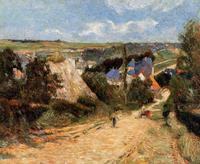
Street in Osny
Paul Gauguin
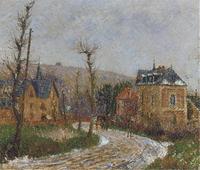
The Road to Dieppe
Gustave Loiseau
L'Hermitage in Pontoise
Gustave Loiseau
Street Snow Effect
Camille Pissarro
Snowy Weather at Veneux Nadon
Alfred Sisley
The Siene at Lavacourt, Effect of Snow
Claude Monet
Crossroads at l'Hermitage, Pontoise
Camille Pissarro
The Hermitage at Pontoise
Camille Pissarro
Winter in Saint-Sauves-d'Auvergne
Armand Guillaumin
At Les Petit-Dalles
Claude Monet
Village in Snow
Gustave Loiseau