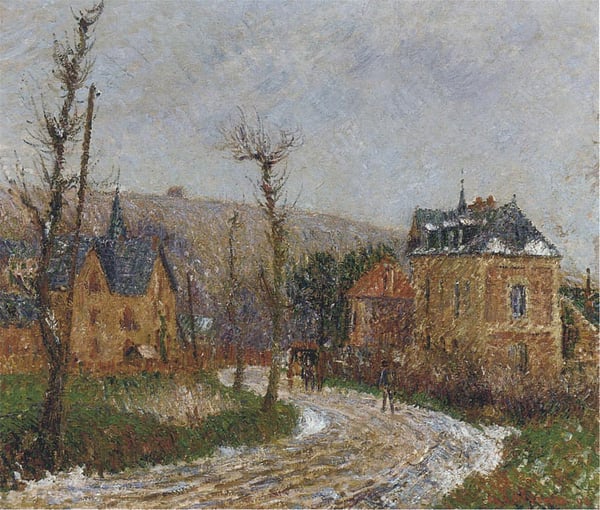
The Road to Dieppe
Analisi esperta di The Road to Dieppe di Gustave Loiseau
Stile: Post-Impressionism · Genere: cityscape
Expert Analysis of "The Road to Dieppe" by Gustave Loiseau
Gustave Loiseau’s The Road to Dieppe is a compelling example of Post-Impressionist cityscape painting that bridges the spontaneity of Impressionism with the structural discipline of later modernist tendencies. Loiseau, a lesser-known yet pivotal figure in the Post-Impressionist movement, is celebrated for his atmospheric studies of the French countryside and coastal towns. This work captures a rural road leading toward the port town of Dieppe, a subject typical of his interest in everyday locales and the fleeting effects of light and weather.
Significance within Post-Impressionism: Loiseau’s contribution lies in his distinctive technique of “envelope” painting—using thick, interwoven brushstrokes of pure color to create a shimmering, unified surface that conveys the ambient mood of a scene. In The Road to Dieppe, this method transforms a simple roadway into a tapestry of shifting hues, where the sky, foliage, and path merge into a vibrant, almost abstract whole. Unlike Impressionists who prioritized optical accuracy, Loiseau (influenced by the Pont-Aven School and Camille Pissarro) infused his landscapes with a rhythmic, decorative quality, foreshadowing the expressive color fields of Fauvism. The painting’s dense, broken strokes and muted yet rich palette (ochres, greens, and soft blues) capture the damp, atmospheric feel of the Normandy coast, demonstrating Loiseau’s mastery of capturing transient weather—a hallmark of his series approach, similar to Monet’s haystacks or cathedrals.
Significance within the Cityscape Genre: As a cityscape, The Road to Dieppe eschews monumental architecture in favor of a modest, liminal space: a road becomes the narrative thread linking the rural to the urban. Loiseau’s interest lies in the periphery—the journey rather than the destination. This aligns with Post-Impressionism’s shift toward subjective perception and emotional resonance over mere documentation. The winding road draws the eye into the distance, while the textured brushwork imbues the scene with a sense of movement and atmospheric depth. By focusing on a road leading to Dieppe, Loiseau emphasizes the changing character of the landscape under different light conditions, a theme that would later influence the Nabis and early modernists.
Conclusion: The Road to Dieppe is significant as a synthesis of Impressionist light studies and Post-Impressionist structural composition. Loiseau’s unique application of color and texture elevates an ordinary view into a contemplative exploration of atmosphere and place, making it a noteworthy contribution to the evolution of cityscape painting in the late 19th century.
Visivamente simili
20 opere con composizione e palette affini
Entering the Village of Vetheuil in Winter
Claude Monet
Louvier Road in Winter
Gustave Loiseau
Village in Snow
Gustave Loiseau
Road to Giverny in Winter
Claude Monet
The Road from Versailles to Saint Germain, Louveciennes. Snow Effect
Camille Pissarro
Winter in Saint-Sauves-d'Auvergne
Armand Guillaumin
Thaw, Pontoise
Camille Pissarro
Snow at Louveciennes
Alfred Sisley
The red painted house
Gustave Loiseau
Winter Landscape at the Val de Falaise
Claude Monet
The Road from Versalles to Saint Germain at Louveciennes
Camille Pissarro
The Route a Vetheuil
Claude Monet
The Seine at Bougival
Claude Monet
The Effect of Snow at Hermitage
Camille Pissarro
Pontoise, Les Mathurins
Camille Pissarro
Pothius Quay in Pontoise
Gustave Loiseau
Crossroads at l'Hermitage, Pontoise
Camille Pissarro
Near Pointoise
Camille Pissarro
The Road in Vetheuil in Winter
Claude Monet
The Garden
Gustave Loiseau