
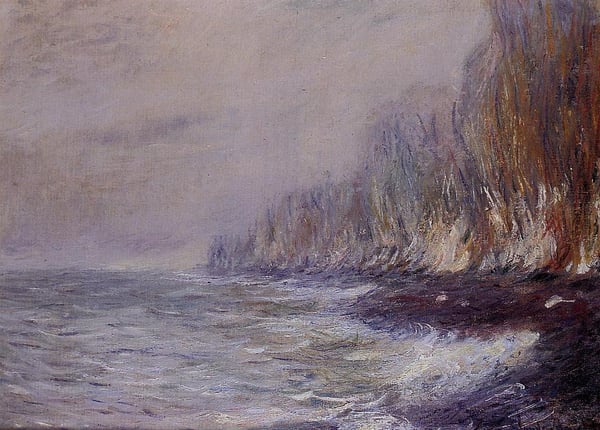
Claude Monet sanatçısının The Effect of Fog near Dieppe eseri hakkında uzman analizi
Tarz: Impressionism · Tür: landscape
Expert Analysis: "The Effect of Fog near Dieppe" by Claude Monet
Style: Impressionism
Genre: Landscape
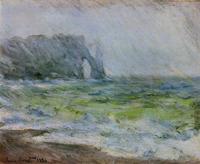
Claude Monet’s The Effect of Fog near Dieppe is a quintessential example of Impressionism’s revolutionary approach to capturing the fleeting, atmospheric conditions of a specific moment. Painted during the 1890s, this work belongs to Monet’s series of studies focused on the interplay of light, weather, and the coastal landscape—a hallmark of his later career.
Significance within Impressionism and Monet’s Oeuvre:
-
Mastery of Atmospheric Effects – The title itself underscores Monet’s obsession with effets (effects) rather than topographical accuracy. Fog here is not a barrier to vision but a subject in its own right. Monet dissolves solid forms—the cliffs of Dieppe, boats, and the sea—into soft, veiled masses, using a muted palette of silvery grays, pale blues, and subtle lavender tones. This approach epitomizes the Impressionist goal of rendering the optical experience of light scattering through moisture.
-
Breaking with Traditional Landscape – Unlike the clear, idealized vistas of academic painting, Monet’s fog blurs boundaries between sea, sky, and land. The composition lacks a fixed horizon line, instead offering a hazy continuum. The brushwork is loose and rapid—short, broken strokes that build texture and suggest movement in the mist. The absence of sharply defined details forces the viewer to perceive the scene as a unified, atmospheric whole, a radical departure from the crisp finish of earlier landscape traditions.
-
Series and Scientific Observation – This painting is part of Monet’s broader fascination with series (e.g., Haystacks, Rouen Cathedral, London Parliament). By painting the same motif under varied conditions, he systematically recorded how light transforms color and form. The Effect of Fog near Dieppe demonstrates his near-scientific study of refraction and humidity, while remaining profoundly poetic. The fog acts as a natural filter, muting contrasts and creating a near-monochromatic harmony—a challenge Monet embraced to push the limits of tonal painting.
-
Influence on Modern Perception – The work is significant for its influence on later movements, such as Abstract Expressionism and Color Field painting. By prioritizing sensory impression over narrative, Monet elevates the transient—a foggy morning at a coastal town—to a timeless meditation on vision itself. The painting invites viewers to experience the chill, dampness, and quietude of the scene, a hallmark of Impressionism’s goal to make the spectator feel the moment.
In sum, The Effect of Fog near Dieppe is not merely a landscape; it is a study of perception, a document of weather, and a testament to Monet’s belief that the true subject of art is not the object but the light that reveals it.
Görsel olarak benzer
İlişkili kompozisyon ve renk paletine sahip 20 eser
Cliffs at Pourville, Rain
Claude Monet
Cliff at Pourville
Claude Monet
Cliffs at Pourville in the Fog
Claude Monet
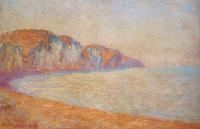
Cliff at Pourville in the Morning
Claude Monet
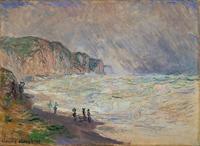
Heavy Sea at Pourville
Claude Monet
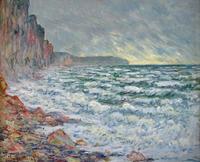
The Sea at Fecamp
Claude Monet
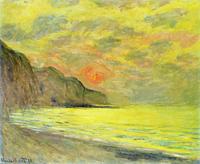
Sunset, Foggy Weather, Pourville
Claude Monet
Seascape
Pierre-Auguste Renoir
Cliffs near Dieppe
Eugene Delacroix
Pourville, Sunset
Claude Monet
Cliffs at Pourville, Morning
Claude Monet
The Beach at Fecamp
Claude Monet
Low Tide at Pourville, Misty Weather
Claude Monet
Receding Waves
Claude Monet
Trouville, la mer
Kees van Dongen
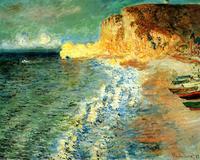
Morning at Etretat
Claude Monet
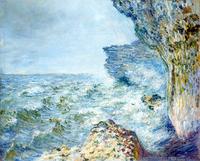
The Sea at Fecamp
Claude Monet
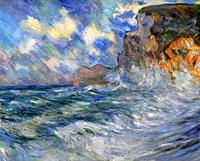
Cliffs at Etretat
Lilla Cabot Perry
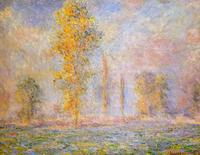
Meadow at Giverny
Claude Monet
The Manneport, Etretat in the Rain
Claude Monet