Expert analysis of Edgar Degas’s At Saint-Valery-sur-Somme
Style: Impressionism · Genre: landscape
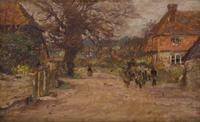
Expert Analysis of "At Saint-Valery-sur-Somme" by Edgar Degas
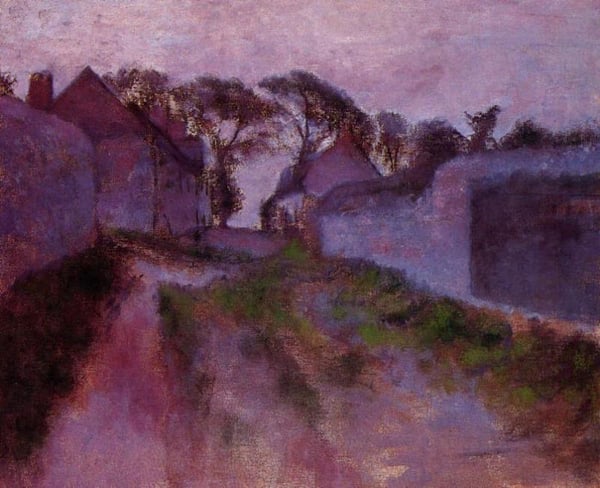
While Degas is most celebrated for his intimate depictions of dancers, bathers, and the racetrack, At Saint-Valery-sur-Somme reveals a lesser-known but equally vital dimension of his Impressionist practice: the landscape. Painted during his visits to the Normandy coast, this work exemplifies how Degas adapted the movement’s core principles—light, atmosphere, and fleeting perception—to the open air, even as he retained his signature compositional audacity.
Significance within Impressionism:
-
A Departure from the Figure: Degas famously resisted the pure plein air approach of Monet or Sisley, preferring studio work and artificial light. This landscape, however, captures a specific coastal moment—the soft, mutable light of the Somme estuary—through a subdued palette of ochres, grays, and muted blues. The lack of human activity pushes the environment itself to the foreground, making atmosphere the true subject.
-
Unconventional Framing: Even in a landscape, Degas applies his characteristic cropping and asymmetry. The horizon is often placed high or dramatically low, and the composition may feel "snapshot-like"—a debt to photography and Japanese prints. This disrupts the picturesque tradition and prioritizes a modern, fragmented vision of nature.
-
Textural Experimentation: Degas likely worked in pastel or layers of oil with rapid strokes, creating a surface that oscillates between the tactile (sand, foliage) and the evanescent (sky, water). The loose handling suggests a spontaneous response to the environment, yet the structure remains deliberate—each mark reinforces the equilibrium of earth, sea, and sky.
Why It Matters: At Saint-Valery-sur-Somme demonstrates that Impressionism was not a monolithic style but a flexible language. Degas brings his analytical eye to a genre he rarely pursued, proving that even a "landscape" can carry the tension, movement, and psychological weight of his figurative works. It stands as a testament to his refusal to be confined, and to Impressionism’s capacity to find beauty in the ordinary—a quiet shoreline under a shifting sky.
Museum / Gallery
Visually similar
20 works with related composition and palette
Rue Quesnoy, Saint-Valery-sur-Somme
Edgar Degas
Male and Female Peasants on a Path Crossing the Countryside
Camille Pissarro
Village Street, Vaudreuil
Gustave Loiseau
A Peasant in the Lane at Hermitage, Pontoise
Camille Pissarro
A Path in Louveciennes
Alfred Sisley
Farmyard at La Percaillerie (Normandy)
Albert Marquet
Street in Veneux
Alfred Sisley
The village path - thatched cottages in Valhermeil
Camille Pissarro
View of Belle Île
Henri Matisse
The diligence
Camille Pissarro
Village Street, Louveciennes
Pierre-Auguste Renoir
Peasant Pushing a Wheelbarrow, Maison Rondest, Pontoise
Camille Pissarro
The House of Monsieur Musy, Louveciennes
Camille Pissarro
Czobel Bela Grosrouvre 1925
Bela Czobel
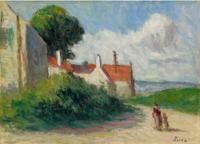
Landscape In Asquin-sous-Vézelay
Maximilien Luce
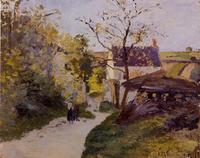
The Large Walnut Tree at Hermitage
Camille Pissarro
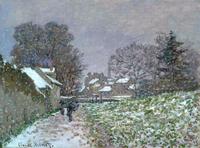
Snow at Argenteuil 02
Claude Monet
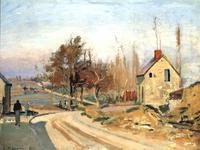
Road from Osny to Pontoise, Hoar Frost
Camille Pissarro

A Village Street in Winter
Alfred Sisley
Summer, the Village Road
James Charles