Analisi esperta di Portraits at the Stock Exchange di Edgar Degas
Stile: Impressionism · Genere: genre painting
Expert Analysis of Portraits at the Stock Exchange by Edgar Degas
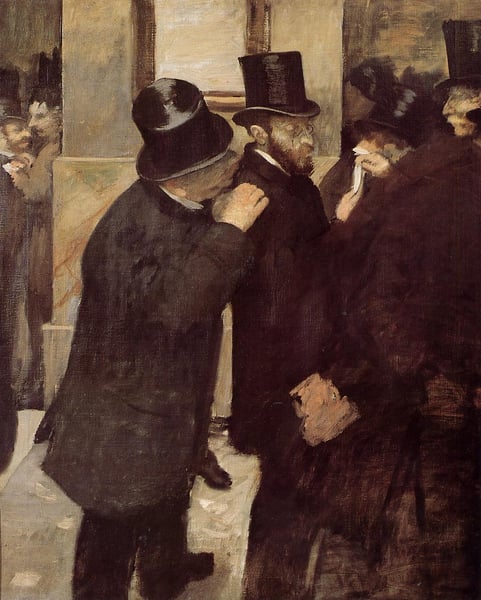
As a genre painting executed in the Impressionist style, Portraits at the Stock Exchange captures a quintessentially modern, urban scene—the bustling world of finance—while simultaneously elevating it through the lens of portraiture. The work’s significance lies in how Degas merges two seemingly distinct artistic modes: the candid observation of contemporary life (genre) and the studied characterization of individuals (portraiture).
Impressionist Innovations: Degas applies the core tenets of Impressionism—loose brushwork, emphasis on fleeting moments, and a focus on modern subjects—but with his own distinctive rigor. Rather than dissolving form in atmospheric light, he uses sharp, cropped compositions and unconventional viewpoints (influenced by photography and Japanese prints) to capture the restless energy of the stock exchange. The scene feels unstaged, as if caught in a split second of conversation or transaction, which aligns with the Impressionist desire to freeze transient impressions.
Genre as Social Document: The stock exchange was a topical, even controversial setting in late 19th-century Paris—a symbol of capitalism and social ambition. By depicting it, Degas engages with the Realist tradition of documenting everyday life, but filtered through Impressionist spontaneity. The “portraits” here are not formal, idealized likenesses; instead, faces emerge from a crowd of top hats and gestures, suggesting that identity itself is fluid within the anonymity of the marketplace. This psychological ambiguity is a hallmark of Degas’s modernism.
Significance within Degas’s Oeuvre: While Degas is best known for dancers and bathers, Portraits at the Stock Exchange exemplifies his less celebrated but equally incisive interest in male-dominated public spaces. The painting challenges the typical Impressionist focus on leisure (cafés, theaters) by turning to commerce—a realm of tension, competition, and performative masculinity. It is a rare example of Degas merging his acute portraiture skills with a critique of modern economic life, making the work a key link between Impressionism’s visual innovations and its deeper social commentary.
Museum / Gallery
Visivamente simili
20 opere con composizione e palette affini
Passers By
Honore Daumier
Six Friends of the Artist
Edgar Degas
Chez Maxim's
Giovanni Boldini

Friends at the Theatre, Ludovic Halevy and Albert Cave
Edgar Degas
Jeantaud, Linet and Laine
Edgar Degas
Leaving the Conservatoire
Pierre-Auguste Renoir
Brussels students
Jan Toorop
Construction workers
Theophile Steinlen
Self Portrait with Evariste de Valernes
Edgar Degas

Conversation
Pierre-Auguste Renoir
The Amateurs (Paul Lafond and Alhonse Cherfils Examening a Painting)
Edgar Degas
Bal Bullier
William James Glackens
Monsieur Louis Pascal
Henri de Toulouse-Lautrec
Monsieur Boileau
Henri de Toulouse-Lautrec
Captain Nathan H. Manter
Eastman Johnson
Two Men Against the Wall
Goran Djurovic
Dr. Tapie Celeyran in a corridor of the French Comedy
Henri de Toulouse-Lautrec
In the Studio
Giovanni Boldini
Men's heads
Ilya Repin
Henri Rouart in front of His Factory
Edgar Degas