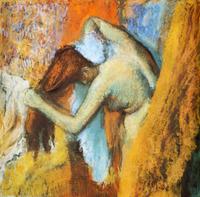
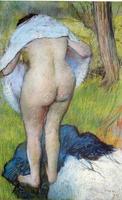
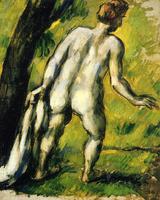
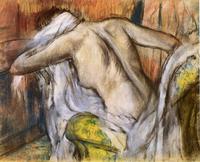
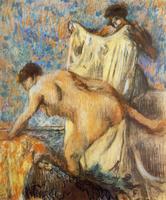
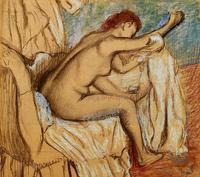
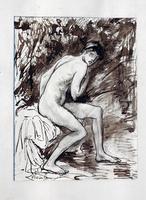
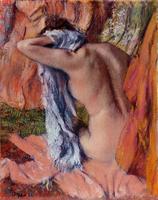
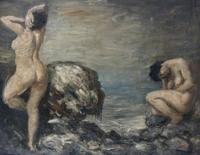
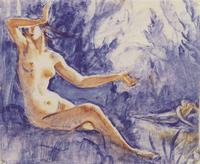
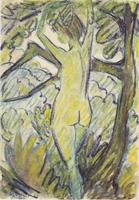
"Bather by the Water" by Edgar Degas stands as a pivotal work within Impressionism, redefining the classical nude genre through its intimate, unidealized approach. Degas eschews the traditional posed, mythological nudes of academic painting in favor of a candid, private moment: a woman absorbed in her own ablutions, unaware of the viewer. The composition is deliberately off-center, with the bather placed at an oblique angle, suggesting a snapshot-like immediacy. Degas’s use of pastel—his preferred medium for late-career nudes—creates a luminous, almost tactile surface, with layered strokes that capture the play of light on flesh and water. The scene’s shallow depth and cropped view emphasize the figure’s physicality and the ordinary act of bathing, challenging conventions of beauty and voyeurism. This work exemplifies Degas’s radical contribution to Impressionism: merging modern life with a rigorous study of form, while elevating the everyday to a subject of profound artistic significance.