Analisi esperta di Melancholy di Edgar Degas
Stile: Impressionism · Genere: allegorical painting
Expert Analysis of "Melancholy" by Edgar Degas
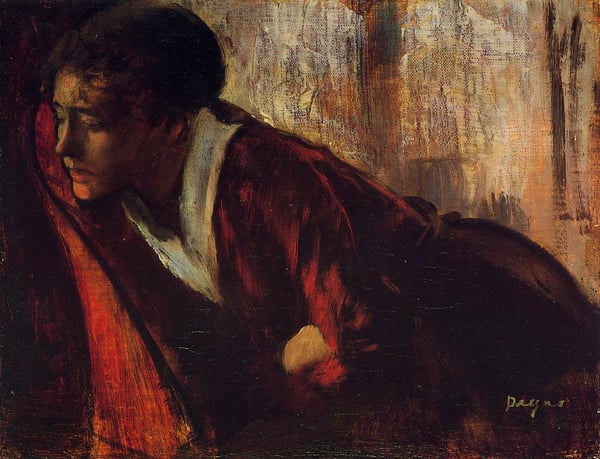
Edgar Degas’s Melancholy occupies a singular place within Impressionism by bridging the movement’s observational immediacy with the more traditional, introspective realm of allegorical painting. While Degas is best known for scenes of ballet dancers, horse races, and Parisian modernity, this work demonstrates his willingness to adapt Impressionist techniques—fragmented composition, unconventional cropping, and a muted, atmospheric palette—to explore a timeless emotional state.
The significance of Melancholy lies in its subversion of allegorical expectations. Classical allegories often rely on idealized figures and clear symbolic props (a skull, a drooping head, a dark sky). Degas, however, applies the painterly looseness and spontaneity of Impressionism to a subject that normally demands precision. The result is an image that feels both intimate and psychologically raw. The figure (likely a female form) is not posed in a grand, theatrical manner but appears caught in a private moment, her contours softened by rapid, expressive brushstrokes. The light—diffuse, almost hazy—evokes a mood that is less about narrative and more about the raw sensory experience of melancholy itself.
Within the Impressionist period, this work is significant because it expands the movement’s emotional range. Most Impressionists focused on the fleeting, the joyous, and the atmospheric; Degas, ever the realist, used the same techniques to depict isolation and introspection. Melancholy shows that Impressionism could accommodate allegory not by reverting to academic conventions, but by reimagining it through modern, psychological truth. It is a quiet masterpiece that proves Degas’s genius for finding profound meaning in the ordinary—even in the ordinary weight of sadness.
Museum / Gallery
Visivamente simili
20 opere con composizione e palette affini
Two Women s Heads (The Loge)
Pierre-Auguste Renoir
Woman Seated on a Canape
Edgar Degas
Portrait of S.A. Repina
Ilya Repin
Woman at a Window
Edgar Degas
Portrait of a Girl
Ilya Mashkov
Reader in Green
Pierre-Auguste Renoir
Lucy (Study)
Cesare Tallone
Unknown woman in red
Mstislav Dobuzhinsky
Young Girl Reading
Federico Zandomeneghi
Young Girl Crocheting
Suzanne Valadon
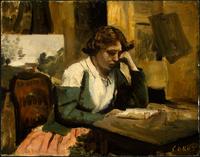
Young Girl Reading
Camille Corot
Thinking
Nicolae Vermont
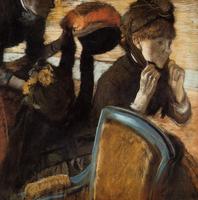
At the Milliner's
Edgar Degas
Thinking
Ipolit Strambu
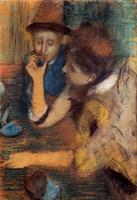
The Jewels
Edgar Degas
The poor girl
Pellizza da Volpedo
Portrait of Madame Redon
Odilon Redon
At the Table
Marie Bashkirtseff
Tine, a Young Girl from Skagen
Anna Ancher
Young Girl at the Window
Rembrandt