
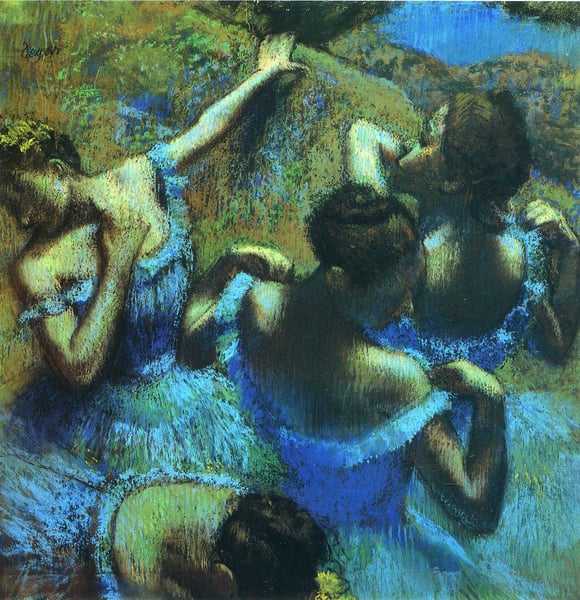
Expert analysis of Edgar Degas’s Blue Dancers
Style: Impressionism · Genre: genre painting
Expert Analysis: "Blue Dancers" by Edgar Degas
Edgar Degas’s Blue Dancers (c. 1899) stands as a quintessential example of Impressionist genre painting, yet it transcends the movement’s typical preoccupation with light and atmosphere through its radical approach to composition, color, and psychological observation. Executed in pastel on paper—a medium Degas championed for its vibrancy and immediacy—the work captures a fleeting, behind-the-scenes moment of ballet rehearsals rather than a staged performance, embodying the Impressionist fascination with modern life and spontaneous perception.
Significance within Impressionism and Degas’s Oeuvre
-
Innovative Use of Pastel and Color
Degas’s mastery of pastel is on full display. The title’s Blue is not merely descriptive; it denotes a chromatic key that unifies the entire scene. Layers of cerulean, cobalt, and ultramarine are applied in broken strokes and cross-hatching, creating a luminous, almost abstract surface that dissolves the dancers’ forms into pure sensation. This technique anticipates later developments in Fauvism and Expressionism, where color becomes an autonomous emotional force. -
Radical Composition and Cropping
Inspired by Japanese ukiyo‑e prints and the new visual language of photography, Degas crops the figures asymmetrically. The dancers fill the frame at unconventional angles—a turned back, a raised arm, a tilted chin—suggesting a candid, unposed reality. The diagonal thrust of their bodies and the compressed space contravene traditional academic balance, emphasizing movement and psychological tension over idealized beauty. -
Genre Painting as Modern Life
Degas elevates genre painting—scenes of everyday life—to a serious study of labor, repetition, and physical discipline. Unlike earlier depictions of ballerinas as ethereal performers, Degas presents them in rehearsal, often seen from above or the side, revealing the strain and fatigue behind the grace. This unsentimental gaze aligns with the Impressionist goal of capturing authentic, unscripted moments, but Degas’s detachment also offers a proto‑modernist critique of spectacle and voyeurism. -
Fusion of Drawing and Painting
Blue Dancers exemplifies Degas’s belief that “drawing is not the same as form, but a way of seeing form.” The pastel strokes function both as line and color: edges are defined by rapid, hatched marks that simultaneously model volume and dissolve it into light. This fluid boundary between draftsmanship and painterliness was a hallmark of his late works, influencing artists from Matisse to Picasso.
Conclusion
Blue Dancers is significant not only as a masterpiece of Impressionist pastel but as a work that challenges the genre’s own conventions. Through its radical cropping, chromatic audacity, and unsentimental view of its subjects, Degas transforms a routine ballet rehearsal into a timeless meditation on movement, perception, and the artist’s role as a detached observer of modern life. The painting remains a crucial bridge between the fleeting impression and the formal experiments of the twentieth century.
Museum / Gallery
Visually similar
20 works with related composition and palette
Dancers
Edgar Degas

Four Dancers
Edgar Degas
Dancers
Edgar Degas
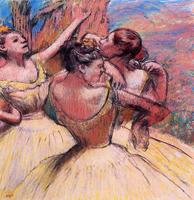
Three Dancers
Edgar Degas
Four Ballerinas on Stage
Edgar Degas
Dancers
Edgar Degas
Ballerinas Adjusting Their Dresses
Edgar Degas
Three Dancers, Green Blouses
Edgar Degas
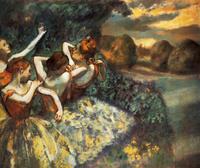
Four Dancers
Edgar Degas

Two Dancers in Green Skirts, Landscape Scener
Edgar Degas

Dancers, Pink and Green
Edgar Degas

Red Ballet Skirts
Edgar Degas
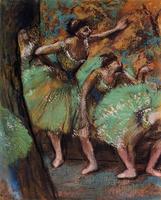
Dancers
Edgar Degas
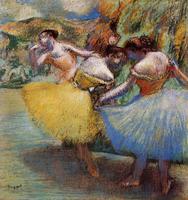
Three Dancers
Edgar Degas

Dancers
Edgar Degas
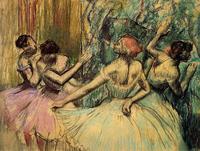
Dancers in the Wings
Edgar Degas
Dancers
Edgar Degas

Three Dancers in Pink
Edgar Degas
Two Dancers
Edgar Degas
Dancers in Green and Yellow
Edgar Degas