
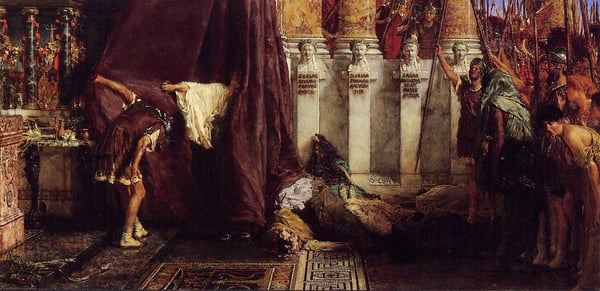
Analisi esperta di Ave Caesar! Io Saturnalia! di Sir Lawrence Alma-Tadema
Stile: Romanticism · Genere: history painting
Expert Analysis of "Ave Caesar! Io Saturnalia!" by Sir Lawrence Alma-Tadema
Sir Lawrence Alma-Tadema’s "Ave Caesar! Io Saturnalia!" (1880) is a masterwork of Romanticism that reimagines ancient Roman life with unprecedented archaeological precision and emotional warmth. Despite being categorized under Romanticism—a style typically associated with dramatic emotion, sublime nature, and medieval or exotic subjects—Alma-Tadema applies Romantic sensibility to classical antiquity, elevating historical painting into a vivid, empathetic encounter with the past.
What Makes This Work Significant:
-
Historical Immersion and Archaeological Fidelity
Alma-Tadema was a renowned antiquarian who meticulously studied Roman artifacts, architecture, and daily customs. In this painting, he captures the Saturnalia festival—a Roman celebration of role-reversal, feasting, and merriment—with extraordinary detail: the marble textures, the togas, the garlands, the inscribed "Ave Caesar!" (Hail Caesar) on the background wall, and the playful gesture of the crowd. The scene feels alive, as if the viewer has stepped into a real Roman street. -
Romanticism’s Humanist Core
While Romanticism often centers on individual emotion or nature’s power, here Alma-Tadema channels it into a communal, celebratory moment. The figures are not heroic or mythic; they are ordinary Romans laughing, drinking, and shouting. The title’s double cry—“Io Saturnalia!” (the festival’s exclamation) and “Ave Caesar!”—blends reverence with revelry, a Romantic fascination with the duality of human experience. -
Innovative Use of Light and Color
The painting glows with a sun-drenched, almost photographic clarity. Alma-Tadema’s signature use of pale marble, blue skies, and warm golden light creates a sense of idyllic timelessness. This luminous palette, coupled with the crisp rendering of shadows and reflections, makes the scene feel both historically authentic and romantically idealized. -
Narrative Ambiguity and Viewer Engagement
The central figure—a young woman raising her hand in a salute or toast—invites the viewer into the festival. Is she a participant or a performer? The crowd’s varied expressions (joy, drunkenness, curiosity) suggest a microcosm of Roman society. This ambiguity is a hallmark of Romantic history painting: not a static lesson, but a living, emotional tableau. -
Cultural Legacy
The work helped popularize a romanticized view of ancient Rome in Victorian Britain, influencing film, theater, and later neoclassical art. Its blend of academic rigor with poetic sentiment set a standard for historically inspired Romanticism.
In essence, "Ave Caesar! Io Saturnalia!" is significant because it demonstrates how Romanticism could embrace classical order without sacrificing emotional resonance. Alma-Tadema transforms a dusty historical festival into a vibrant, accessible human drama—making the ancient world feel both exotic and intimately familiar.
Museum / Gallery
Genere
Stile
Visivamente simili
20 opere con composizione e palette affini
Nero's Torches (Leading Light of Christianity)
Henryk Siemiradzki
The visit of the Queen of Sheba to King Solomon
Edward Poynter
Caracalla
Sir Lawrence Alma-Tadema
After the Audience
Sir Lawrence Alma-Tadema
Spring
Sir Lawrence Alma-Tadema
A Roman Emperor Claudius
Sir Lawrence Alma-Tadema
Christian Dirce
Henryk Siemiradzki

A Bath (An Antique Custom)
Sir Lawrence Alma-Tadema
The Execution of the Doge Marino Faliero
Eugene Delacroix
Il Sacrificio Di Polissena
Giambattista Pittoni
The Queen of Sheba's Visit to King Solomon
Edward Poynter
Paying Homage To The Emperor
Alessandro Pigna
Roman Bathing Scene II
Alexander Rothaug
Feast of Belshazzar
Ivan Tvorozhnikov
Incendie De Persepolis
Georges Rochegrosse
The Presentation Of The Virgin
Prospero Piatti
Belshazzar's Feast
Vasily Surikov
King László V and Ulrik Cillei
Bertalan Szekely
The Daughters of Thespius
Gustave Moreau
Salome and the Tigers
Rudolf Ernst