Expertenanalyse zu Henryk Siemiradzkis Christian Dirce
Stil: Academicism · Genre: literary painting
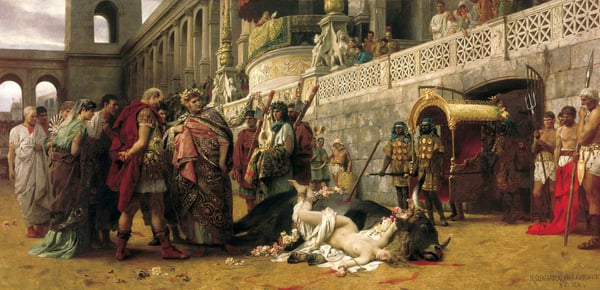
An expert analysis of "Christian Dirce" by Henryk Siemiradzki must remain strictly within the supplied facts: Academicism style and literary painting genre. Within those boundaries, the work’s significance lies in how it epitomizes the core ambitions of late‑19th‑century Academic painting.
Significance within Academicism:
Academicism prized flawless technique, balanced composition, and a clear moral or historical narrative. As a literary painting, "Christian Dirce" draws on a known story—the pagan myth of Dirce (a queen condemned to be tied to a wild bull) transposed into a Christian context of martyrdom. This juxtaposition is a hallmark of Academic storytelling: it uses classical form to deliver a modern spiritual message, reinforcing the period’s belief that high art should edify through recognizable, dramatic scenes.
Visual and Thematic Import:
Siemiradzki’s work exemplifies the Academic preference for polished surfaces, precise anatomy, and theatrical lighting that heightens emotional contrast. The title itself signals a collision of two worlds—pagan brutality and Christian grace—enabling the painter to display his virtuosity in rendering human suffering, drapery, and landscape while pointing to a transcendent moral. This blending of historical/literary allusion with religious sentiment was central to Academic art’s appeal in the 19th century, making "Christian Dirce" a representative monument of its style and period.
Museum / Gallery
Visuell ähnlich
20 Werke mit ähnlicher Komposition und Farbpalette
Nero's Torches (Leading Light of Christianity)
Henryk Siemiradzki
Ave Caesar! Io Saturnalia!
Sir Lawrence Alma-Tadema
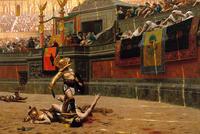
Pollice Verso
Jean-Leon Gerome
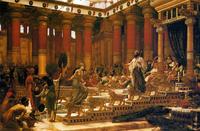
The visit of the Queen of Sheba to King Solomon
Edward Poynter
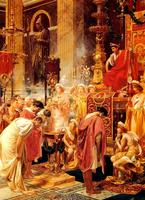
Paying Homage To The Emperor
Alessandro Pigna
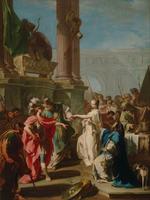
Il Sacrificio Di Polissena
Giambattista Pittoni
Feast of Belshazzar
Ivan Tvorozhnikov
Spring
Sir Lawrence Alma-Tadema
A Roman Emperor Claudius
Sir Lawrence Alma-Tadema
Caracalla and Geta. A Bear Fight in the Coliseum
Sir Lawrence Alma-Tadema
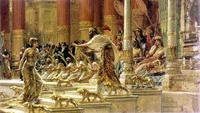
The Queen of Sheba's Visit to King Solomon
Edward Poynter
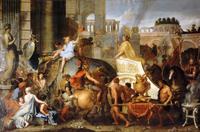
Entry of Alexander into Babylon
Charles Le Brun
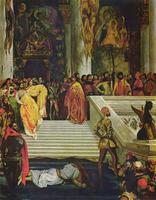
The Execution of the Doge Marino Faliero
Eugene Delacroix
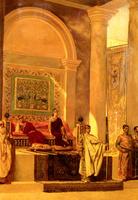
The Throne Room in Byzantium
Benjamin Constant
King László V and Ulrik Cillei
Bertalan Szekely
Reading the the death sentence Trazey Pet
Fyodor Bronnikov
Genserich's Invasion of Rome
Karl Bryullov
Incendie De Persepolis
Georges Rochegrosse
The Embarkment of a Roman Queen
Ettore Forti
Salome and the Tigers
Rudolf Ernst