
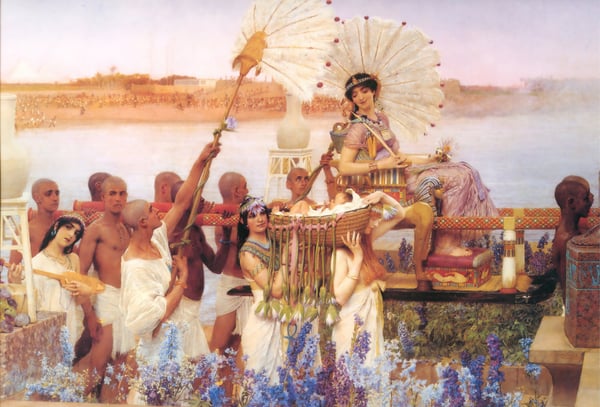
Analisi esperta di The Finding of Moses di Sir Lawrence Alma-Tadema
Stile: Romanticism · Genere: religious painting
Analysis of "The Finding of Moses" by Sir Lawrence Alma-Tadema
Style Context:
Although Alma-Tadema is often associated with Victorian classicism, within the framework of Romanticism this work exemplifies the movement’s fascination with the exotic and the historical sublime. Romantic painters frequently turned to biblical and ancient themes as vehicles for emotional intensity and moral allegory—here, the discovery of the infant Moses on the Nile is treated not as a moment of action but as a tableau of serene, almost theatrical grandeur.
Significance:
-
Fusion of Religious Narrative and Archaeological Accuracy:
Alma-Tadema meticulously reconstructs an idealized ancient Egyptian setting—the polished stone, the intricate lotus columns, the luxurious fabrics—while preserving the core biblical story. This blend of factual archaeology (typical of his practice) with Romantic sentiment elevates the religious genre beyond mere illustration. The viewer is invited into a historically plausible world that still throbs with the wonder of divine providence. -
Emotional Restraint and Elevated Serenity:
Unlike many Romantic religious paintings that emphasize dramatic motion or intense expressions, Alma-Tadema’s composition is calm, almost ceremonial. The figures gather around the basket with quiet reverence, their gestures graceful and measured. This restraint is a hallmark of his mature style and marks a distinct contribution to Romanticism: the sublime is found not in chaos but in the solemn beauty of a historically realized moment. -
Detail as Devotion:
Every surface—the sheen of Pharaoh’s daughter’s gown, the veining of marble steps, the glint of river reeds—is rendered with obsessive precision. In Romantic terms, this attention to detail serves to heighten the viewer’s sense of awe and immersion. The painting becomes a devotional object in itself, where the sacred narrative is validated by the tangible, almost tactile reality of its setting.
Conclusion:
Within the Romantic genre of religious painting, "The Finding of Moses" stands out for its intellectual rigor (archaeological authenticity), its emotional poise (quiet wonder over melodrama), and its luxurious visual appeal. Alma-Tadema demonstrates that Romantic spirituality can be conveyed through the perfect, polished surfaces of the ancient world—a significant departure from the turbulent skies and dramatic chiaroscuro favored by many of his contemporaries.
Museum / Gallery
Visivamente simili
20 opere con composizione e palette affini

Antony and Cleopatra
Sir Lawrence Alma-Tadema

Saints Timothy and Maura
Henryk Siemiradzki
Cleopatra Testing Poisons on Those Condemned to Death
Alexandre Cabanel
Joseph Dwelleth in Egypt
James Tissot
Pharaoh Notes the Importance of the Jewish People
James Tissot
Phryne on the Poseidon's celebration in Eleusis
Henryk Siemiradzki
Joseph, Overseer of Pharaoh`s Graneries
Sir Lawrence Alma-Tadema
Phryne at the Poseidonia in Eleusis
Henryk Siemiradzki

Pastimes in Ancient Egyupe 3 000 Years Ago
Sir Lawrence Alma-Tadema
A Dedication to Bacchus
Sir Lawrence Alma-Tadema
Joseph and His Brethren Welcomed by Pharaoh
James Tissot

Phryne on the Poseidon's celebration in Eleusis (detail)
Henryk Siemiradzki
Cleopatra
Wilhelm Kotarbinski

Dance Amongst Daggers
Henryk Siemiradzki
Moses Speaks to Pharaoh
James Tissot
Joseph Interprets Pharaoh's Dream
James Tissot
The Plague of Flies
James Tissot
Pharaoh and the Midwives
James Tissot

The artist's studio
Anatolio Scifoni
The sacrifice of the virgin in the Nile
Federico Faruffini