Chestnut Trees and Farmstead of Jas de Bouffin
Dettagli
Analisi esperta di Chestnut Trees and Farmstead of Jas de Bouffin di Paul Cezanne
Stile: Impressionism · Genere: landscape
Expert Analysis: "Chestnut Trees and Farmstead of Jas de Bouffin" by Paul Cézanne
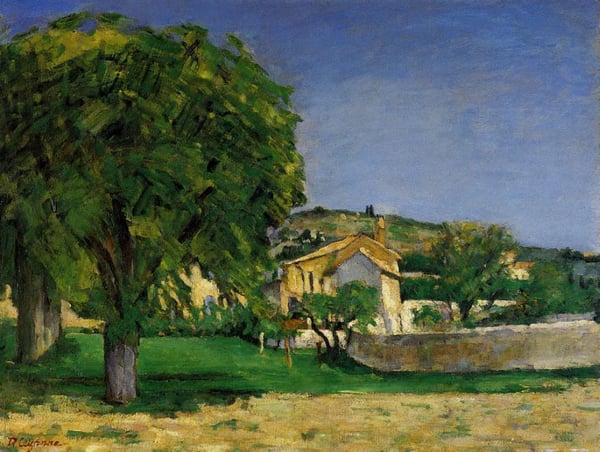
Though classified here as an Impressionist landscape, this work already hints at the tectonic shifts that would make Cézanne a bridge between Impressionism and early Modernism. Painted during his mature Impressionist period, the canvas depicts the farmstead of Jas de Bouffin near Aix-en-Provence—a site the artist returned to obsessively, treating it not as a picturesque subject but as a laboratory for visual structure.
Break from Transient Effects
Where typical Impressionists chased changing light and atmospheric shimmer, Cézanne insists on solidity. The chestnut trees, rendered in dense, parallel brushstrokes of green and ochre, anchor the composition with a palpable weight. Their trunks rise like columns, organizing the pictorial space rather than dissolving into atmosphere. The farm buildings are simplified into geometric planes—roofs tilt as cubes, walls flatten into rectangles—anticipating his later dictum to “treat nature by the cylinder, the sphere, the cone.”
Color as Structural Force
Cézanne uses color not merely to record local hue but to model form. Warm earth tones in the foreground meet cool blues and greens in the middle distance, creating a push-pull that generates depth without linear perspective. Patches of pure white canvas left exposed suggest light vibrating through the foliage, yet the picture never sacrifices stability for sparkle. Every stroke feels deliberate and constructive.
Significance
This work is significant because it shows Cézanne testing the limits of Impressionism from within. He retains the broken brushwork and outdoor brightness of the movement, but he redirects its energy toward permanence and order. The farmstead of Jas de Bouffin becomes a recurring theme through which he systematically explores how to reconcile fleeting optical sensations with enduring pictorial architecture. In doing so, he lays the groundwork for Post-Impressionism and, ultimately, Cubism. The painting is a quiet manifesto: nature can be both sensuous and solid.
Museum / Gallery
Visivamente simili
20 opere con composizione e palette affini
Horse-chestnut-trees in Jas de Bouffan
Paul Cezanne
Labastide farmhouse near Labastide du Vert
Henri Martin
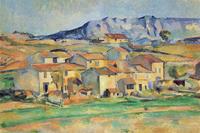
Mont Sainte-Victoire
Paul Cezanne
Balchik Landscape
Lucian Grigorescu
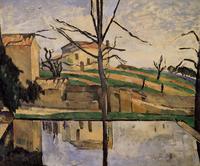
The Pool at Jas de Bouffan
Paul Cezanne
Brookleton Yulgreave
Lucien Pissarro
The Pink House
Henri-Edmond Cross
Landscape in Provence
Paul Cezanne
Landscape
Pierre-Auguste Renoir
Ile de France Landscape
Paul Cezanne
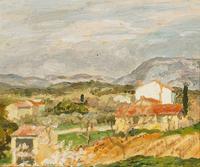
Sketch for 'Sanary, France'
Rupert Bunny
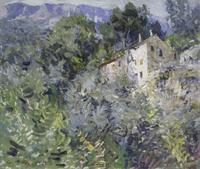
In the south of France
Konstantin Korovin
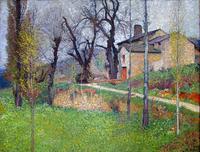
The House of Sabotier
Henri Martin
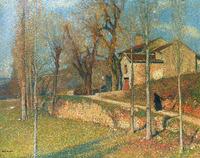
Near Colliure in Twilight
Henri Martin
Petit Paysage Corse
Henri Matisse
Landscape near Toulouse
Henri Martin
Lane at alchamps, Arles
Paul Gauguin
Mas, near Arles
Paul Gauguin
Farmhouse in a Wheat Field
Vincent van Gogh
Springtime at the Sea
Matej Sternen