Mont Sainte-Victoire
Details
Expert analysis of Paul Cezanne’s Mont Sainte-Victoire
Style: Post-Impressionism · Genre: landscape
Expert Analysis: Mont Sainte-Victoire by Paul Cézanne
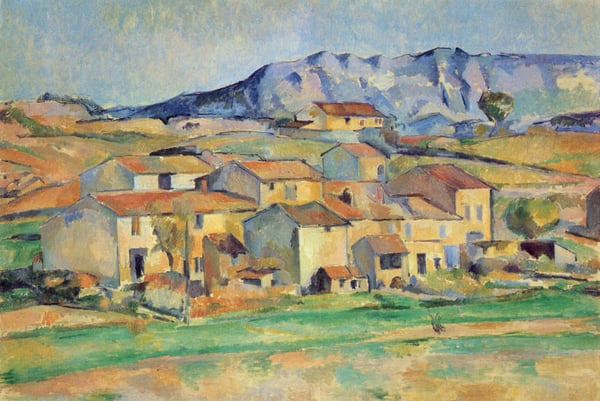
In this landmark landscape from his mature period, Paul Cézanne elevates the rural motif of Mont Sainte-Victoire into a rigorous structural meditation on vision itself. Painted in his distinctive Post-Impressionist idiom, the work transcends mere depiction to become a cornerstone of modern art.
Significance within Post-Impressionism and Cézanne’s Mature Period
As a Post-Impressionist, Cézanne broke decisively from the Impressionist focus on fleeting atmospheric effects. Instead, he sought a permanent, ordered reality beneath surface appearance. This painting exemplifies his mature ambition to “make of Impressionism something solid and durable, like the art of museums.”
- Geometric Simplification: Cézanne reduces the mountain, trees, and buildings to geometric facets—cylinders, spheres, and cones. The brushstrokes are parallel, hatched planes that simultaneously build form and dissolve it, anticipating the fractured planes of Cubism.
- Color as Structure: Rather than modeling with shadow, Cézanne constructs depth through modulations of warm and cool hues. The mountain’s chalky blues and greens push into the distance, while the foreground’s ochres and oranges hold the picture plane. This “constructive stroke” creates a taut, architectonic composition.
- Multiple Perspectives: The scene is assembled from shifting viewpoints—the mountain recedes yet tilts forward; the horizon is both high and low. This flattening of space, combined with deliberate distortions (the tilted tree, the compressed valley), forces the viewer to perceive the landscape as an interplay of two-dimensional design and three-dimensional depth.
Why It Matters
Mont Sainte-Victoire was not a single image but an obsessive series—Cézanne painted the mountain over 60 times from various angles, each version a new formal inquiry. This work encapsulates his revolutionary belief that painting is not a window onto nature but a parallel, constructed reality. By rejecting naturalist fidelity in favor of an autonomous pictorial logic, Cézanne directly paved the way for Picasso, Braque, and the entire trajectory of 20th-century abstraction. In this stark, shimmering landscape, art history found its bridge from Impressionism to the modern age.
Visually similar
20 works with related composition and palette
Springtime at the Sea
Matej Sternen
Houses in Provence, near Gardanne
Paul Cezanne
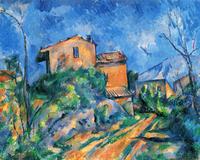
Maison Maria with a View of Chateau Noir
Paul Cezanne
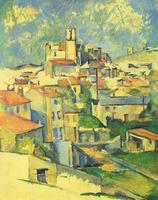
Gardanne
Paul Cezanne
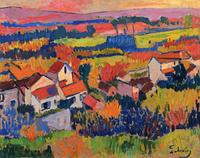
Landscape near Chatou
Andre Derain
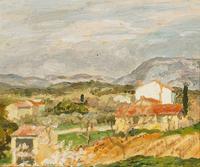
Sketch for 'Sanary, France'
Rupert Bunny
Labastide farmhouse near Labastide du Vert
Henri Martin
Chestnut Trees and Farmstead of Jas de Bouffin
Paul Cezanne
Village Street
Henri Martin
Houses at the L'Estaque
Paul Cezanne
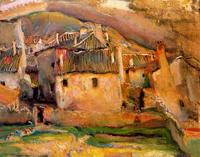
Buitrago houses
Carlos Saenz de Tejada
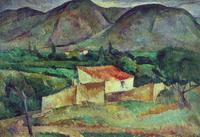
Crimea
Pyotr Konchalovsky
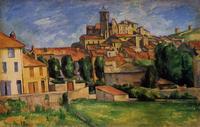
Gardanne (Horizontal View)
Paul Cezanne
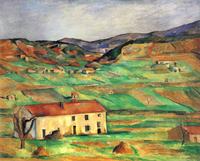
Gardanne
Paul Cezanne
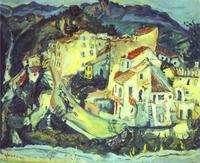
Landscape of Cagnes
Chaim Soutine
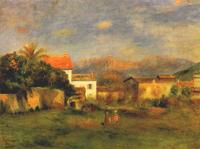
View of cagnes
Pierre-Auguste Renoir
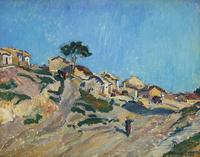
Cartierul tătărăsc la amiază
Jean Alexandru Steriadi
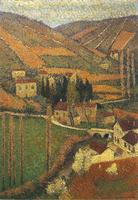
The Campaign
Henri Martin
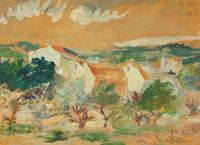
Balchik Landscape
Lucian Grigorescu
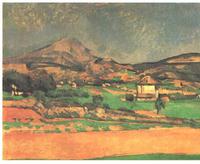
Plain by Mont Sainte-Victoire
Paul Cezanne