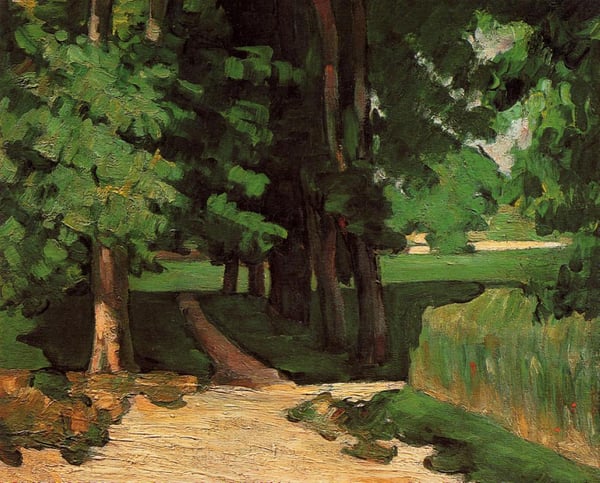
Lane of Chestnut Trees at the Jas de Bouffan
Details
Expert analysis of Paul Cezanne’s Lane of Chestnut Trees at the Jas de Bouffan
Style: Romanticism · Genre: landscape
Artwork Analysis: "Lane of Chestnut Trees at the Jas de Bouffan" by Paul Cézanne
Though Paul Cézanne is most often celebrated as a pioneering figure of Post-Impressionism, the supplied facts designate this work as belonging to the Romanticism style while being created during his Impressionist period, and falling under the landscape genre. This unusual combination reveals a transitional moment in the artist’s career, making the painting significant as a bridge between two major movements.
Significance within its Style and Period:
-
Romantic Feeling within an Impressionist Framework
- The composition captures a specific, personal place—the chestnut-lined lane at the Jas de Bouffan, the Cézanne family estate. The Romantic tendency toward intimate, emotionally resonant landscape is present: the viewer is invited into a quiet, dappled path that evokes a sense of nostalgia and contemplation.
- Unlike the more objective, spontaneous plein-air works of pure Impressionism, Cézanne’s treatment here already hints at a structured, almost architectural arrangement of trees and shadows, foreshadowing his later geometric reduction of nature.
-
Impressionist Period Execution
- During his Impressionist phase (roughly the 1870s–early 1880s), Cézanne worked alongside Pissarro and adopted broken brushwork, a lighter palette, and an interest in atmospheric effects. In Lane of Chestnut Trees, the flickering light through the canopy and the soft, muted greens and browns show his engagement with Impressionist color theory and optical mixing.
- Yet even at this stage, he resists dissolving form entirely; the trunks and branches retain a firm, sculptural presence, prefiguring the “constructive stroke” that would define his mature Post-Impressionist style.
-
A Hybrid Work that Presages Modern Landscape
- The painting’s significance lies in its synthesis: the Romantic reverence for nature’s sublimity (a beloved, almost sacred lane) meets the Impressionist commitment to capturing a fleeting moment of light. Cézanne’s composition already organizes the scene into distinct verticals and diagonals, a sense of order that would later influence Cubism.
- As a result, Lane of Chestnut Trees at the Jas de Bouffan stands as a critical document of Cézanne’s evolution—a landscape that retains Romantic mood while pushing toward the structural innovations that would revolutionize modern art.
Conclusion: This artwork is not merely a pleasant rural view; it is a hinge piece that demonstrates how Cézanne used Romantic sensibility to anchor his Impressionist technique, ultimately laying the groundwork for a new way of seeing and representing the natural world.
Museum / Gallery
Visually similar
20 works with related composition and palette
Pine Wood on the Cote d'Azur
Pierre-Auguste Renoir
Rider at the Edge of the Forest
Alfred Sisley
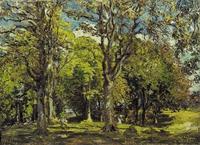
The Oak Grove, Bridgnorth, Shropshire
Philip Wilson Steer
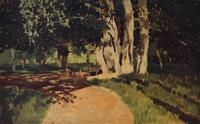
In the park
Isaac Levitan
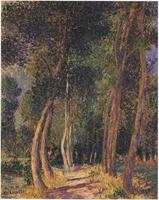
In the Woods
Gustave Loiseau
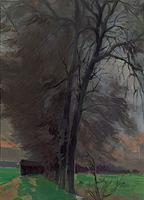
Le canal bethune
Alekos Kontopoulos
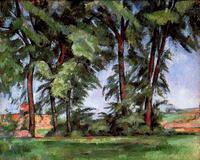
Tall Trees at the Jas de Bouffan
Paul Cezanne
Oaks
Ivan Shishkin
Forest Vista
Stefan Popescu
The Park at Sevres
Alfred Sisley
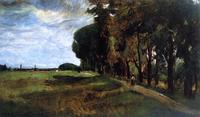
View near Polling
John Henry Twachtman
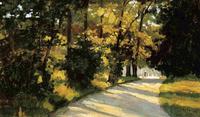
Yerres, Path Through the Woods in the Park
Gustave Caillebotte
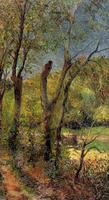
Willows
Paul Gauguin
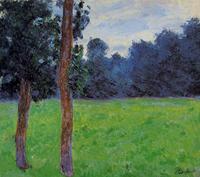
Two Trees in a Meadow
Claude Monet
Path through the undergrowth
Pierre-Auguste Renoir
Forest. Sunny Day.
Isaac Levitan
Shepherd Resting
Camille Corot
Oak Grove at Abramtsevo
Viktor Vasnetsov
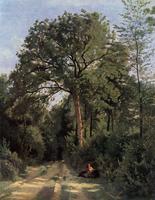
Forest Entrance at Ville d'Avray
Camille Corot
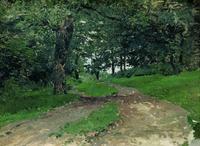
Forest
Isaac Levitan