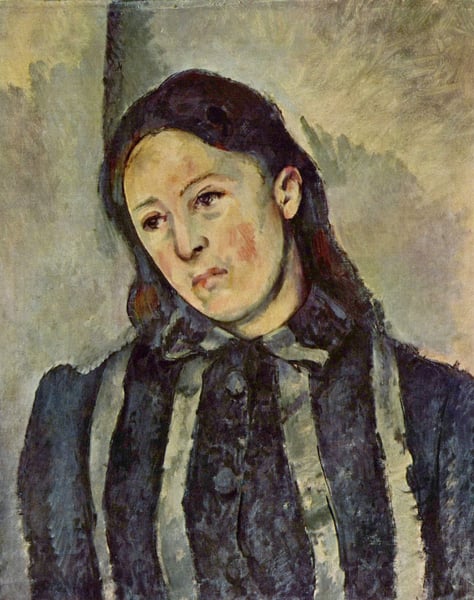
Madame Cezanne with Unbound Hair
Details
Expertenanalyse zu Paul Cezannes Madame Cezanne with Unbound Hair
Stil: Post-Impressionism · Genre: portrait
Expert Analysis: Madame Cezanne with Unbound Hair (c. 1890–1892)
Paul Cezanne’s portrait of his wife, Hortense Fiquet, belongs to his mature period (the 1880s–1890s), a time when he systematically deconstructed traditional perspective and modeling to forge the visual language that would later be called Post-Impressionism.
What makes this work significant:
-
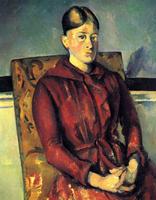
Formal rigor over anecdote – Unlike conventional portraits that emphasize likeness or narrative, Cezanne subordinates Hortense’s individual features to a geometric logic. Her face is built from interlocking planes of ochre, pink, and green, with the unbound hair treated as a sculptural mass that merges with the background. This flattening of depth—achieved through broken, parallel brushstrokes and a muted, earthy palette—foreshadows Cubism.
-
Psychological distance – Hortense appears stoic, almost mask-like, her gaze averted. Cezanne was notoriously slow and analytical in his method, requiring her to sit for dozens of sessions. The resulting stillness is not coldness but a meditative quality: the sitter becomes an object of structural investigation, not sentiment. This shift from “portrait as story” to “portrait as form” is a hallmark of Cezanne’s mature style and a direct precursor to twentieth-century abstraction.
-
Color as structure – The unbound hair is not painted with black or brown but with blues, greens, and violet-tinged greys, entwined with the warm tones of the face. Cezanne uses color to model volume rather than relying on chiaroscuro. The background—deep green and burnt sienna—pushes forward, denying illusionistic space and affirming the picture plane. This “constructive stroke” (as art historian Roger Fry called it) makes the canvas a unified, vibrating field.
-
Significance within Post-Impressionism – While Van Gogh used color for expression and Seurat for optical science, Cezanne used it to rebuild the solidity of the world without losing the flatness of the surface. Madame Cezanne with Unbound Hair exemplifies his lifelong goal: “to make of Impressionism something solid and enduring, like the art of the museums.” The portrait stands as a bridge between the fleeting light of Impressionism and the conceptual geometry of modernism, influencing Picasso, Matisse, and countless others. Its quiet monumentality proves that a simple domestic subject can yield radical artistic innovation.
Museum / Gallery
Visuell ähnlich
20 Werke mit ähnlicher Komposition und Farbpalette
Portrait of Nini
Camille Pissarro
Rapha Maitre
Pierre-Auguste Renoir
Nora
Robert Henri
Madame Cezanne in a Striped Rob
Paul Cezanne
Portrait of Eugenie Estruc
Camille Pissarro
Portrait of Madame Cezanne
Paul Cezanne
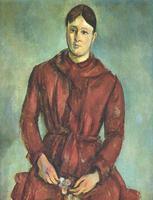
Portrait of Madame Cezanne in a Red Dress
Paul Cezanne
Portrait of Jeanne Serveau
Claude Monet
Portrait of Therese Berard
Pierre-Auguste Renoir
Female Portrait
Konstantin Makovsky
Portrait of Miss Lina Kyburz
Ferdinand Hodler
Portrait of the artist daughter Nadezhda
Ilya Repin
My Sister Maud
Guy Rose
Portrait of young woman
Vasily Surikov
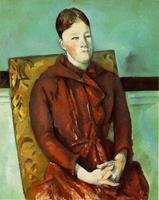
Madame Cezanne in a Yellow Chair
Paul Cezanne
Blanche Hoschede
Claude Monet
Portrait of Vera Repina
Valentin Serov
Portrait of Madame Felicie Vellay Estruc
Camille Pissarro
Madame Cezanne with a Yellow Armchair
Paul Cezanne
Portrait of Madame Monnon, the Artist s Mother in Law
Theo van Rysselberghe