
Expertenanalyse zu Paul Cezannes Medea
Stil: Post-Impressionism · Genre: mythological painting
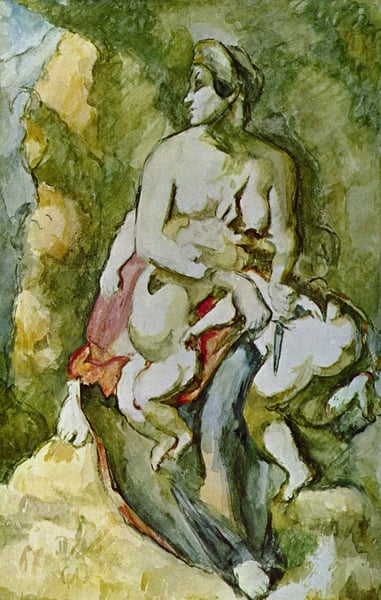
Paul Cézanne’s Medea (c. 1880–1885) is a remarkable example of how the artist reimagined a classical mythological subject through the lens of his mature Post-Impressionist style. While Cézanne is more famous for his still lifes and landscapes, this painting demonstrates his deep engagement with traditional themes—here the tragic sorceress Medea—yet transforms them into a radical formal experiment that bridges Romantic passion and modern abstraction.
Significance within the Mature Period and Post-Impressionism:
-
Dialogue with Delacroix and Romanticism
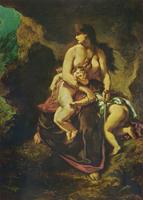
Cézanne directly borrows the composition from Eugène Delacroix’s earlier Medea (1838), but his treatment is decisively different. Where Delacroix’s version was tempestuous, with dramatic chiaroscuro and swirling brushwork, Cézanne strips away emotional excess. He flattens the space, reduces anatomical detail, and emphasizes geometric structure. This is a hallmark of his mature period: taking a highly dramatic narrative and subjecting it to a calm, analytic rearrangement of form. -
Color as Structure, Not Atmosphere
The palette is subdued yet deliberate—ochres, umbers, and muted blues are arranged in broad, patchy strokes. Cézanne uses color not to describe light or atmosphere but to build volumetric mass. Medea’s body becomes a series of interlocking planes; her cloak is rendered as a sculptural block of deep red-brown. This method anticipates Cubism’s later fragmentation of form. -
Tension Between Subject and Style
The myth of Medea—infanticide, revenge, sorcery—is inherently violent and chaotic. Yet Cézanne’s rendering is almost monumentally static. The figures are locked into a compact, almost pyramidal composition. This tension between violent content and serene, formal construction is what makes the work so significant: it shows Cézanne prioritizing pictorial harmony over narrative emotion, a central tenet of Post-Impressionism. -
Influence on Modernism
Medea exemplifies how Cézanne reinterpreted academic subject matter (mythology) without abandoning it. He uses the tradition as a scaffold for his own investigations into shape, color, and structure. Later artists from Picasso to Matisse would follow this path—using classical themes as departures for purely visual explorations.
In short, Medea is not merely a mythological painting; it is a manifesto of Cézanne’s mature style. It demonstrates his ability to distill narrative into form, to balance the legacy of Romanticism with the emerging language of modern abstraction, and to prove that even the most dramatic subjects can be rendered as quiet, enduring arrangements of color and plane.
Visuell ähnlich
20 Werke mit ähnlicher Komposition und Farbpalette
Medea
Eugene Delacroix
Mother and child
Pablo Picasso
Virgin and Child
Giulio Cesare Procaccini
Venus and Cupid
Adam Elsheimer
Bathsheba
Paul Cezanne
Charity, from the Series the Virtues
Lucas van Leyden
Virgin and Child
Bartolome Esteban Murillo
“Mars et Vénus”
Ker-Xavier Roussel
Virgin and Child with Saint Anne and John the Baptist
Francesco de' Rossi (Francesco Salviati), "Cecchino"
Love`s Resistance
William-Adolphe Bouguereau
The Rum Punch
Paul Cezanne
The Temptation of St. Anthony
Paul Cezanne
Getting up
Paul-Albert Besnard
Mermaid With Her Offspring
Edward Burne-Jones
Mythological Group
David Scott
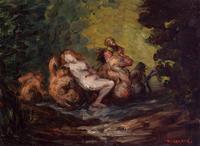
Neried and Tritons
Paul Cezanne
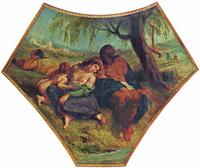
Babylonian Captivity
Eugene Delacroix
Study for the Holy Family
Raphael
The Virgin with the Infant Jesus and St. John
Palma il Giovane
Madonna, Child and St.John the Baptist
Michelangelo