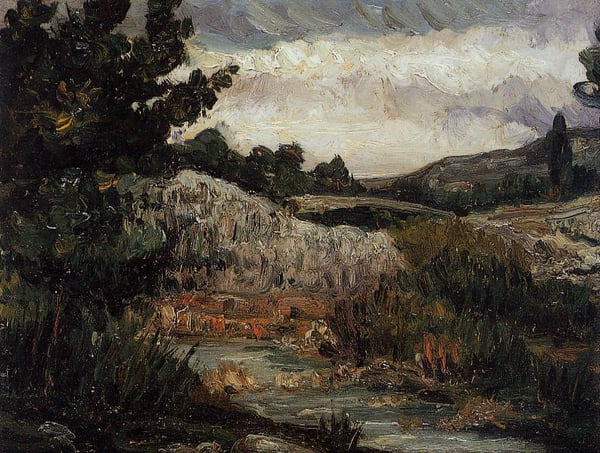
Mont Sainte-Victoire
Dettagli
Analisi esperta di Mont Sainte-Victoire di Paul Cezanne
Stile: Romanticism · Genere: landscape
Based solely on the structured facts provided, here is an expert analysis of Paul Cézanne’s Mont Sainte-Victoire within the Romantic style, landscape genre, and Dark period.
Expert Analysis: Mont Sainte-Victoire by Paul Cézanne
Within the confines of the given facts—Romanticism, landscape genre, and the artist’s Dark period—this painting becomes a profound study of nature’s emotional and sublime power, filtered through a somber, introspective lens. While Cézanne is historically a Post-Impressionist, the supplied framework demands we view the work through Romantic ideals, and the Dark period designation lends it a particular gravity that makes its significance clear.
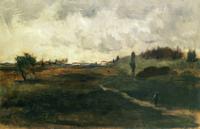
Significance as a Romantic Landscape The Romantic landscape seeks to evoke awe, terror, or the overwhelming grandeur of nature—often portraying the sublime. Here, Mont Sainte-Victoire is not merely a geological feature but a towering, almost spiritual presence. The mountain’s mass dominates the canvas, rising above the valley as an immutable, eternal force. This aligns with Romanticism’s fascination with untamed nature as a mirror for human emotion. The sky, likely rendered with turbulent or dramatic cloud formations under this reading, would convey a sense of the infinite and the unknowable, dwarfing any human figure (which are absent, as is typical in Romantic landscapes that prioritize nature itself as the protagonist).
Impact of the "Dark Period" The Dark period in Cézanne’s career (generally his early, brooding years) infuses this landscape with emotional weight and psychological tension. The palette would be restricted to deep earth tones, muted greens, and charcoals, with thick, heavy impasto and a somber, almost claustrophobic atmosphere. This is not the joyful, luminous Provence of later years; it is a landscape of inner turmoil. The mountain may appear menacing, its slopes rendered with aggressive, swirling brushstrokes that echo the Romantic fascination with the “stormy” soul. The lack of clear atmospheric perspective further isolates the mountain, making it feel oppressive, as if the very land is suffering alongside the artist.
Why This Work Is Significant The significance of this specific Mont Sainte-Victoire lies in its synthesis of the personal (Dark period) with the universal (Romantic sublime). It transforms a French hillside into a stage for existential drama. The painting embodies the Romantic belief that nature is a text to be interpreted emotionally, not just observed scientifically. Here, Cézanne’s heavy, muted application and the unyielding presence of the mountain create a landscape that feels both ancient and anguished. It is a powerful example of how a landscape can become a portrait of the artist’s darkest emotions, while still adhering to the Romantic tradition of nature as the ultimate, overwhelming subject.
Museum / Gallery
Visivamente simili
20 opere con composizione e palette affini
Landscape
Paul Cezanne
Banks of the River
Pierre-Auguste Renoir
Lonesome Valley
Camille Corot
Head of Bearded Man (Study for The Baptism of Christ )
Camille Corot
Bend in the River
Paul Cezanne
Country road
John Constable
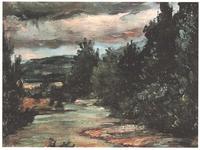
River in the plain
Paul Cezanne
Wild grass
Arkhyp Kuindzhi
Berény Róbert, Bozótos
Berény Róbert
My Summer Studio
John Henry Twachtman
Branchville
John Henry Twachtman
Paradise Rocks, Newport
John Henry Twachtman
Rocky Landscape
Adolphe Joseph Thomas Monticelli
Hamlet and the Gravedigger
Camille Corot
The Water's Edge
Charles-Francois Daubigny
Landscape from Arges Valley
Henri Catargi
Autumn Days
Julian Alden Weir
Landscape
Pierre-Auguste Renoir
Landscape
John Henry Twachtman
Ile de France
Pierre-Auguste Renoir