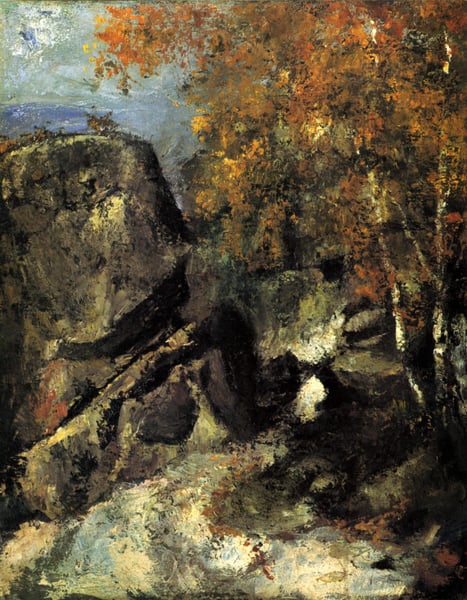
Rock in the Forest of Fontainbleau
Ayrıntılar
Paul Cezanne sanatçısının Rock in the Forest of Fontainbleau eseri hakkında uzman analizi
Tarz: Romanticism · Tür: landscape
Expert Analysis of Paul Cézanne's Rock in the Forest of Fontainbleau
Although Paul Cézanne is best known as a foundational figure of Post-Impressionism, this early work from his so-called Dark period aligns with the Romantic style as specified—a phase when the artist was still absorbing the dramatic, moody aesthetics of his predecessors. Painted during the late 1860s or early 1870s, the composition focuses on a gnarled rock formation deep within the Forest of Fontainbleau, a site favored by the Barbizon school and earlier Romantic landscape painters.
Significance within its Style and Period:
-
Romantic Influence: The painting embodies Romanticism’s fascination with the sublime and untamed nature. The dense, shadowy undergrowth and the massive, irregular rock evoke a sense of ancient, indifferent power—a landscape not merely observed but felt. Cézanne uses a dark, earthy palette (deep greens, ochres, and blacks) to emphasize weight and mystery, rejecting the lighter, more idyllic pastoral scenes of earlier Romantics like Corot. Instead, he pushes toward a brooding intensity that anticipates his own later formal concerns.
-
Dark Period Characteristics: This is a key work from Cézanne’s “Dark period,” where his palette was heavy with bitumen and black, and his brushwork was thick, sometimes impasto. The rock is rendered with broad, almost sculptural strokes, giving it a physical heft that borders on the abstract. This period is crucial because it shows Cézanne moving away from the relaxed brushwork of Romanticism toward the constructive stroke that would define his mature style. The forest here is not a transparent veil of atmosphere but a solid, near-geometric mass—a prelude to his later “constructive” landscapes.
-
Foreshadowing of Later Innovations: While the work’s mood is Romantic—dark, solitary, and emotionally charged—its structure points forward. The rock becomes a tectonic anchor; the tree trunks are vertical pillars; the composition is arranged in clear horizontal bands of ground, rock, and foliage. This stability amidst the Romantic gloom is Cézanne’s early signature. He is already less interested in narrative or transient light than in the architecture of nature. This painting, therefore, is significant as a bridge: it retains the emotional excess of Romanticism while laying the groundwork for the structural analysis that would make Cézanne the “father of modern art.”
Museum / Gallery
Tür
Stil
Görsel olarak benzer
İlişkili kompozisyon ve renk paletine sahip 20 eser
Landscape from Bortniki Upon Dniester
Henryk Rodakowski
Stoller in the Fontainebleau Forest
Camille Corot
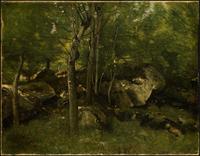
In the Forest of Fontainebleau
Camille Corot
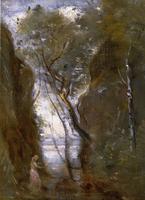
The Lac de Nemi
Camille Corot
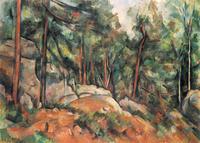
In the Forest
Paul Cezanne
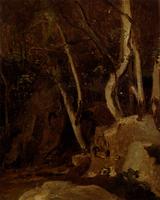
At Civita Castellana, Wooded Rocks
Camille Corot
4 in the Forest of Fontainebleau
Richard Parkes Bonington
Sauces llorones
Jose Maria Velasco
Study of rocks
Theodore Rousseau
Catskill Waterfall
John Frederick Kensett
The Rowan
Pekka Halonen
The apparition
Gabriele Smargiassi
Forest Stream
Albert Bierstadt
Shadows
Franklin Carmichael
THE SILVER BIRCH
Nathaniel Hone the Younger
View of Valaam Island. Kukko
Ivan Shishkin
On the Lakeshore
Kimon Loghi
Above the Clouds
Ralph Blakelock
Woodland-Stream
John Henry Twachtman
Rocks in Sestri Levante
Vincenzo Cabianca