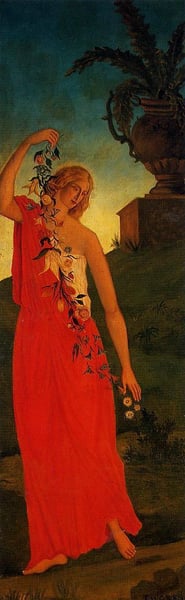
The Four Seasons, Spring
Подробности
Экспертный разбор работы «The Four Seasons, Spring» художника Paul Cezanne
Стиль: Romanticism · Жанр: allegorical painting
This analysis focuses exclusively on the structured facts provided: Paul Cézanne's The Four Seasons, Spring as a Romantic allegorical painting from his Dark period.
Expert Analysis:
Executed during Cézanne's so-called "Dark period" (roughly the 1860s), The Four Seasons, Spring stands as a pivotal work that bridges the waning Romantic tradition with the artist’s early, personal struggles for expressive form. While Cézanne is later celebrated as a father of Post-Impressionism, this painting securely belongs to his Romantic phase, and its significance lies in how it uses the allegorical genre to channel the turbulent, emotional undercurrents of that era.
Romanticism and the Dark Period: The Romantic style here is evident not in idealized grace but in a brooding, almost violent intensity. Spring, traditionally a symbol of rebirth and delicate beauty, is rendered with the heavy, somber palette and thick, impastoed brushwork characteristic of Cézanne's Dark period. This inversion of expectation is the work's primary Romantic gesture: it prioritizes inner psychological drama over conventional harmony. The season of renewal becomes a site of struggle, with figures emerging from a murky, shadowy background, conveying a sense of raw, latent energy rather than gentle blooming. This aligns with Romanticism's fascination with the sublime and the primitive.
Allegorical Significance: As an allegorical painting, Spring does not merely depict a seasonal landscape; it personifies the concept through a figure—likely a female form—entwined with natural elements. The allegory is complicated by the Dark period's mood. Instead of a cheerful maiden scattering flowers, Cézanne presents a figure that seems heavy, almost mournful, collaged into a tangle of vegetation. This reimagining of a classical allegory through a distorted, emotionally charged lens marks a critical moment: it shows Cézanne breaking free from the academic traditions of allegorical painting (which demanded clarity and decorum) and injecting it with a raw, subjective Romantic passion. The work becomes a bridge between the idealized allegories of earlier centuries and the more personal, symbolic explorations of modern art.
Period Context (Dark Period): The Dark period is defined by its moody, often violent brushwork and a preference for themes of passion, death, and melancholy. The Four Seasons, Spring is significant because it demonstrates that even a theme of renewal could not escape Cézanne's introspective gloom. The thick paint, dark outlines, and compressed space foreshadow the structural experimentation of his later work, but the emotional content—the heavy, almost anxious atmosphere—is pure Romanticism. It reveals an artist grappling with his own demons, using allegory as a vessel for personal expression, much like Delacroix did a generation earlier.
In summary, the significance of The Four Seasons, Spring lies in its defiant reinterpretation of a classical allegory through the lens of Romanticism's darkest currents. It is a testament to Cézanne's early, passionate rebellion against the serene conventions of pastoral art, and a crucial link in the chain that leads from Romantic emotion to the structural revolution of modern painting.
Museum / Gallery
Визуально похожие
20 работ с близкой композицией и палитрой
Venus, Mars, and Cupid
Piero di Cosimo
Bacchante
Kuzma Petrov-Vodkin
Harmony or The Three Graces
Hans Baldung
Rea Silvia
Francesco Melzi
Cupid and Psyche
Edward Burne-Jones
The Spring
Sandro Botticelli
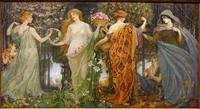
A Masque for the Four Seasons
Walter Crane
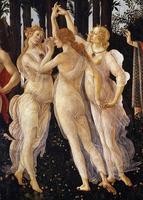
The Three Graces from Primavera
Sandro Botticelli
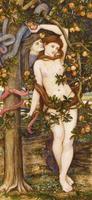
The Temptation of Eve
John Roddam Spencer Stanhope
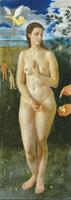
Czene Béla, Éva,1940
Czene Béla
Adam and Eve (two panels)
Albrecht Durer
Love and the Maiden
John Roddam Spencer Stanhope
Mythological Scene
Dosso Dossi
Finding Psyche
Edward Burne-Jones
Adam and Eve
Lucas Cranach the Elder
Adam and Eve
Lucas Cranach the Elder
Death and the Maidens
Pierre Puvis de Chavannes
Venus with Cupid the Honey Thief
Lucas Cranach the Elder
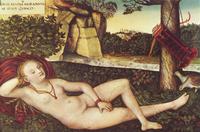
Reclining Diana
Lucas Cranach the Elder
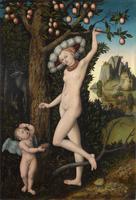
Cupid complaining to Venus.
Lucas Cranach the Elder