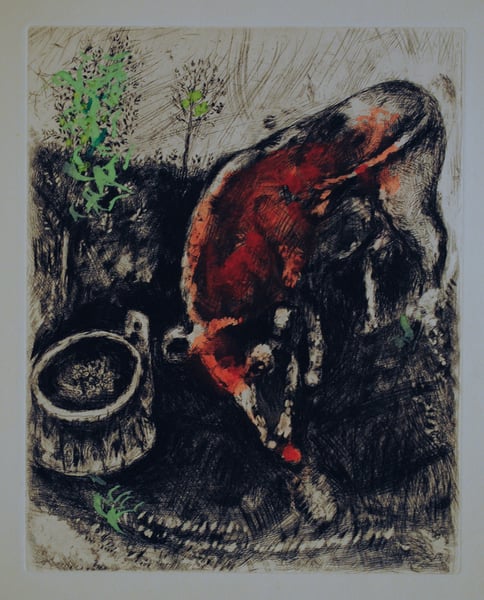
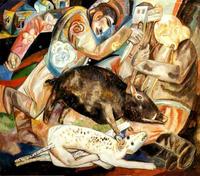
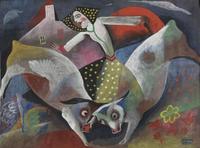
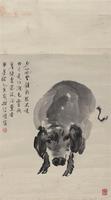
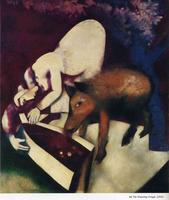
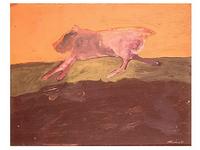
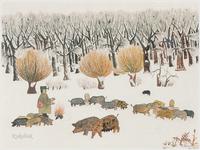
The significance of Marc Chagall's "The frog who wished to be as big as the ox" lies in its convergence of allegorical storytelling with the stylistic principles of Naïve Art (Primitivism). As a work in this style, it deliberately eschews academic perspective and realism in favor of a childlike, direct visual language—flat planes, simplified forms, and vibrant, non-naturalistic color—that mirrors the moral fable’s timeless, universal quality. The allegorical genre here is not merely illustrative; Chagall transforms the Aesopian tale of overreaching ambition into a modern parable, using the naïve aesthetic to strip away artifice and present the lesson with raw, emotional immediacy. Within the context of early 20th-century art, this painting exemplifies how Naïve Art could reclaim folkloric and narrative traditions, blending them with a modernist rejection of conventional technique. Chagall’s personal poetic imagination elevates a simple fable into a resonant symbol, making the work a key example of how Primitivism could serve allegorical depth without sacrificing expressive simplicity.