
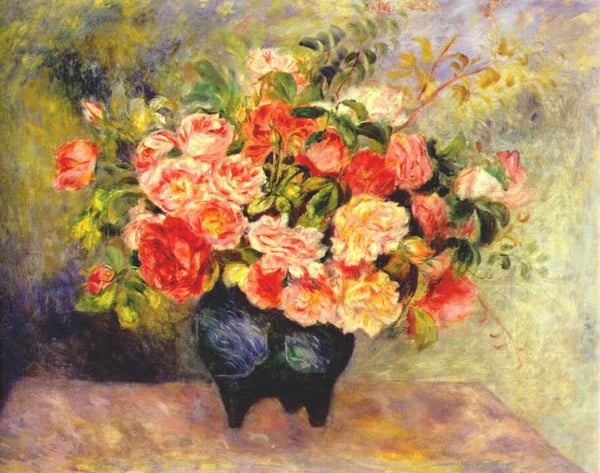
Expertenanalyse zu Pierre-Auguste Renoirs Bouquet of flowers
Stil: Impressionism · Genre: flower painting
Expert Art Historical Analysis: "Bouquet of Flowers" by Pierre-Auguste Renoir
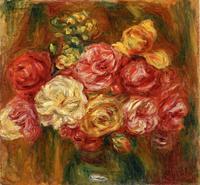
Pierre-Auguste Renoir’s Bouquet of Flowers stands as a telling document of his stylistic evolution, executed during what art historians term his “Rejection of Impressionism” phase (circa 1880s-1890s). While the work retains the genre of flower painting—a staple of the earlier Impressionist still-life tradition—its significance lies in how Renoir deliberately distances himself from the purely optical, ephemeral concerns of his youth and re-embraces a more structured, classical vocabulary.
Technical and Stylistic Shifts
Where an earlier Impressionist floral piece might prioritize atmospheric vibration and broken color, Renoir here introduces a firmer sense of mass and contour. The bouquet is no longer a mere shimmer of reflected light; petals are modeled with richer, more opaque pigment, and the arrangement is organized into a balanced pyramid—a compositional nod to 18th-century masters like Jean-Baptiste-Siméon Chardin. The background, often dissolved in Impressionist works, is treated with deeper, more velvety darks that push the flowers forward, creating a tangible, sculpture-like presence. Renoir still employs pure, brilliant hues—crimson, cerulean, lemon yellow—but applies them in broader, smoother strokes rather than the short, staccato dabs of his 1870s manner.
Significance within the Artist’s Arc
This painting exemplifies a critical pivot in Renoir’s career: his conscious retreat from the “intransigent” Impressionist label (which he felt had become formulaic) and his turn toward a “dry” or “Ingres-like” style—often called his aigre period. By choosing flowers—a subject that could easily be treated purely decoratively—Renoir tests his new discipline on a forgiving motif. The result is a synthesis: the garden-fresh sensuality of Impressionist color married to the firm geometry of academic draftsmanship. This tension between spontaneity and control marks the work as a transitional masterpiece, revealing how Renoir sought to rejuvenate Impressionism from within, rather than abandon it entirely.
Legacy
Bouquet of Flowers is not merely a pretty still life; it is a deliberate artistic statement. It demonstrates that even as Renoir rejected the surface-level tenets of his own movement, he never lost the Impressionist conviction that painting must capture life—here, the lush, palpable vitality of nature, rendered with a newfound structural confidence that would later culminate in his monumental bathers.
Visuell ähnlich
20 Werke mit ähnlicher Komposition und Farbpalette
Roses
Pierre-Auguste Renoir
Roses in a Vase
Pierre-Auguste Renoir
Roses in a Vase
Pierre-Auguste Renoir
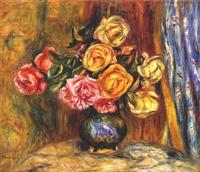
Roses in front of a blue curtain
Pierre-Auguste Renoir
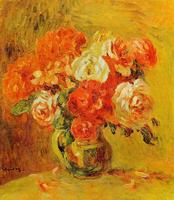
Flowers in a Vase
Pierre-Auguste Renoir
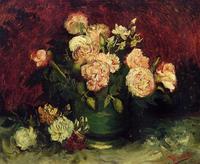
Bowl with Peonies and Roses
Vincent van Gogh
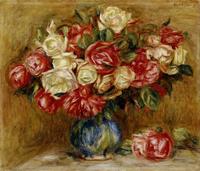
Roses in a vase
Pierre-Auguste Renoir
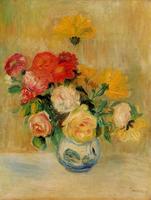
Vase of Roses and Dahlias
Pierre-Auguste Renoir
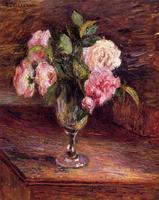
Roses in a Glass
Camille Pissarro
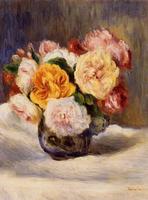
Bouquet of Roses
Pierre-Auguste Renoir
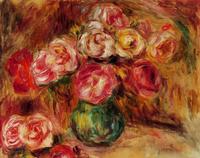
Vase of Flowers
Pierre-Auguste Renoir
Roses in a Vase
Pierre-Auguste Renoir
Roses By The Window
Pierre-Auguste Renoir
White Roses
Stefan Luchian
Roses
Stefan Luchian
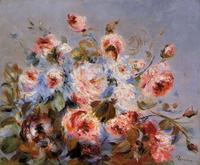
Roses from Wargemont
Pierre-Auguste Renoir
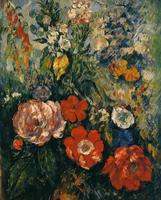
Bouquet of Flowers
Paul Cezanne
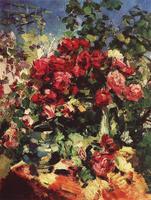
Roses
Konstantin Korovin
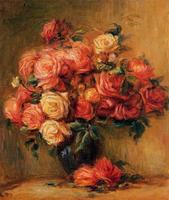
Bouquet of Roses
Pierre-Auguste Renoir
Bouquet of Roses in a Green Vase
Pierre-Auguste Renoir