
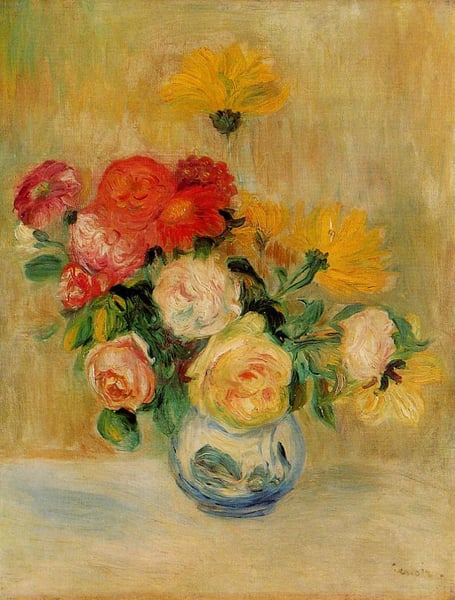
Expert analysis of Pierre-Auguste Renoir’s Vase of Roses and Dahlias
Style: Impressionism · Genre: flower painting
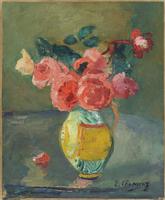
Expert Analysis: "Vase of Roses and Dahlias" by Pierre-Auguste Renoir
This still life captures a pivotal moment in Renoir’s career—the so-called "Rejection of Impressionism" period (roughly the early-to-mid 1880s). Although the artwork is stylistically rooted in Impressionism, Renoir was then actively turning away from the movement’s spontaneity in search of a more structured, classical approach. The significance of the painting lies in this very tension: it is an Impressionist flower piece executed by an artist who was already questioning the core tenets of Impressionism.
Formal and Technical Significance
-
Brushwork and handling: The petals of the roses and dahlias are built from short, broken strokes of pure, unblended color—a hallmark of Impressionist technique. Yet Renoir’s touch here is more deliberate and controlled than in his earlier, looser works. The composition is carefully balanced, with the vase anchoring a pyramidal arrangement, reflecting his growing interest in Renaissance stability.
-
Color and light: Renoir exploits the Impressionist palette of unmixed hues—creamy whites, soft pinks, deep crimson, and vivid yellows—to simulate the shimmer of natural light on the flowers. However, the shadows are not merely atmospheric dabs; they are modulated with subtle tonal transitions, hinting at the classical modeling he would soon adopt.
-
Subject matter: Flower still lifes were Renoir’s laboratory for color experiments throughout his career. Here, the focus on a domestic bouquet allows him to explore texture and light without the narrative demands of his figure paintings. The choice of roses and dahlias (flowers with complex petal structures) showcases his ability to render form through pure color rather than line.
Art-Historical Context and Period Significance
The “Rejection of Impressionism” period is defined by Renoir’s disillusionment with the formlessness of Impressionism after travels to Italy (1881–1882). He began to study Raphael and Ingres, seeking disegno (drawing) and solidity. "Vase of Roses and Dahlias" is transitional: it retains the luminous surface of Impressionism but signals a shift toward the more linear, sculptural style of his later works.
This tension makes the painting significant as a record of an artist in flux. Unlike Renoir’s purely Impressionist flower pieces (e.g., Bouquet of Chrysanthemums, 1873), this work shows a greater emphasis on compositional order and a reduction of atmospheric blur. The dahlias, in particular, are rendered with a tighter, more volumetric handling that prefigures his return to classical form.
Legacy
In the broader history of Impressionism, flower still lifes are often undervalued compared to landscapes or figure scenes. Yet Renoir’s bouquets—and this one especially—are essential for understanding his artistic evolution. They demonstrate that even as he rejected Impressionism’s visual ideology, he never fully abandoned its coloristic achievements. "Vase of Roses and Dahlias" is therefore a key transitional work, bridging the early, plein-air spontaneity of Impressionism with the mature, polished classicism of Renoir’s later years.
Museum / Gallery
Visually similar
20 works with related composition and palette
Flowers in a Vase
Pierre-Auguste Renoir
Vase of Flowers
Pierre-Auguste Renoir
Roses
Pierre-Auguste Renoir
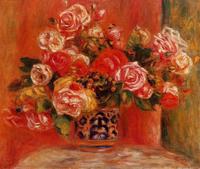
Roses in a Vase
Pierre-Auguste Renoir
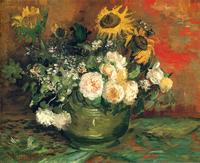
Still Life with Roses and Sunflowers
Vincent van Gogh
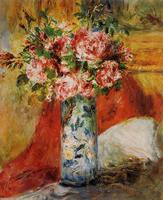
Roses in a Vase
Pierre-Auguste Renoir
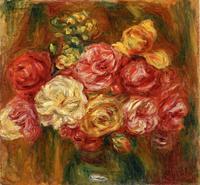
Bouquet of Roses in a Green Vase
Pierre-Auguste Renoir
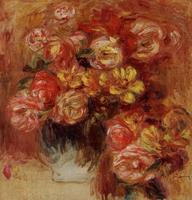
Vase of Roses
Pierre-Auguste Renoir
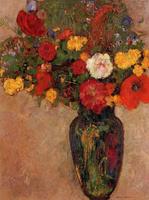
Vase of Flowers
Odilon Redon
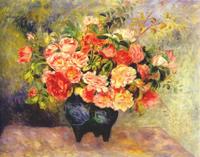
Bouquet of flowers
Pierre-Auguste Renoir
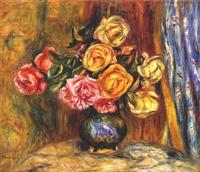
Roses in front of a blue curtain
Pierre-Auguste Renoir
Bowl with Peonies and Roses
Vincent van Gogh
Bouquet
Pierre-Auguste Renoir
Roses
Stefan Luchian
Summertime Flowers
Stefan Luchian
Roses in a Vase
Pierre-Auguste Renoir
Roses
Berthe Morisot
Bouquet of Roses
Pierre-Auguste Renoir
Bouquets of Flowers
Pierre-Auguste Renoir
Roses
Émilie Charmy