
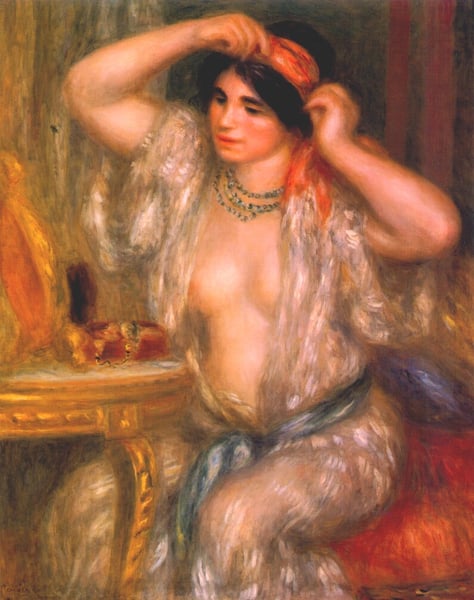
Analyse experte de Gabrielle at the mirror de Pierre-Auguste Renoir
Style : Impressionism · Genre : portrait
Expert Analysis of "Gabrielle at the Mirror" by Pierre-Auguste Renoir
Style & Period Context:
Painted during Renoir’s later years (post-1890s), this portrait exemplifies his mature departure from strict Impressionist optical theory toward a more classical, sensuous, and structurally balanced style. While still rooted in Impressionism’s love for luminous color and intimate naturalism, Renoir now prioritizes the tactile warmth of flesh, the rhythm of flowing forms, and a harmonious, almost sculptural solidity. This work belongs to his numerous paintings of Gabrielle Renard—the family nurse and his most trusted model—whom he rendered with both familiarity and idealized tenderness.
Composition & Technique:
The composition employs a mirror as a framing device, allowing Renoir to explore two viewpoints simultaneously: the direct gaze of Gabrielle facing us and her reflected profile. This duality creates a subtle narrative of self-contemplation while showcasing Renoir’s mastery of soft-focus edges and embedded light. His brushwork remains feathery and fluid, but the strokes are more controlled than in his high-Impressionist phase, building form through layers of warm pinks, golds, and milky whites. The background dissolves into atmospheric patches of blue-green and amber, typical of Renoir’s late palette.
Significance within Renoir’s Oeuvre and Impressionism:
- Blending of Opposites: The painting synthesizes Impressionism’s transient, atmospheric light with a neo-Rococo celebration of feminine grace. It stands as a bridge between the movement’s early plein-air ideals and Renoir’s personal, decorative classicism.
- Humanism over Objectivity: Unlike earlier Impressionist portraits often concerned with capturing a momentary expression, this work conveys a timeless, serene intimacy. The mirror motif—common in Western art history—is not used for Vanitas moralizing but as a device to deepen psychological presence, making Gabrielle both subject and observer.
- Touch and Texture: Renoir’s late technique, sometimes criticized as “over-soft,” here achieves a remarkable unity: the flesh appears to glow from within, almost weightless yet concrete. This tactile quality anticipates the sensuous modernism of Matisse and Bonnard.
Conclusion:
“Gabrielle at the Mirror” is significant as a masterful synthesis of Impressionist color and classical structure, emblematic of Renoir’s later years where personal vision triumphed over doctrinal purity. It captures the very essence of his art: the belief that beauty, warmth, and the simple act of looking—whether at oneself or at another—can become a transcendent, painterly experience.
Visuellement similaire
20 œuvres à la composition et à la palette proches

Gabrielle Sun
Pierre-Auguste Renoir

Gabrielle with a Rose
Pierre-Auguste Renoir
Young Woman Seated in an Oriental Costume
Pierre-Auguste Renoir
Gabrielle with bare breasts
Pierre-Auguste Renoir
Misia
Pierre-Auguste Renoir
Andree in Yellow Turban and Blue Skirt
Pierre-Auguste Renoir
Woman with a Yellow Turban
Pierre-Auguste Renoir
Dedee in spanish dress
Pierre-Auguste Renoir
Madelaine in a White Blouse and a Bouquet of Flowers
Pierre-Auguste Renoir
Model with bare breast
Pierre-Auguste Renoir
Torso Before the Bath
Pierre-Auguste Renoir
Contemplation
Benjamin Constant
Madeline wearing a Rose
Pierre-Auguste Renoir
Gabrielle with open blouse
Pierre-Auguste Renoir
The Agreement
Pierre-Auguste Renoir
The Concert
Pierre-Auguste Renoir
Tilla Durieux
Pierre-Auguste Renoir
Seated Nude
Pierre-Auguste Renoir
Madeleine Leaning on Her Elbow with Flowers in Her Hair
Pierre-Auguste Renoir
Bather Arranging her Hair
Pierre-Auguste Renoir