
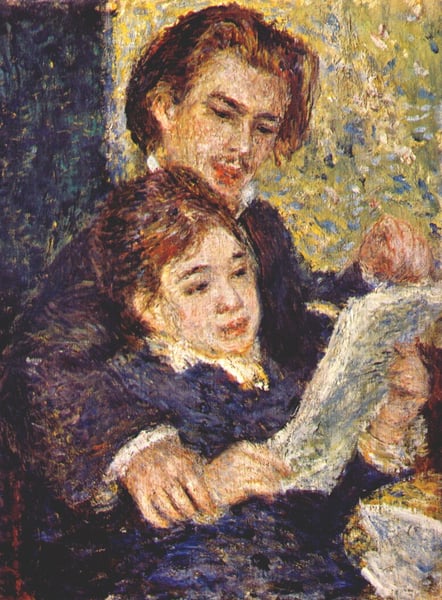
Analyse experte de Georges riviere and margot de Pierre-Auguste Renoir
Style : Impressionism · Genre : portrait
Expert Analysis: "Georges Rivière and Margot" by Pierre-Auguste Renoir
This painting is a quintessential example of Renoir’s Impressionist portraiture, capturing a fleeting, intimate moment between two figures from his close social circle. The work’s significance lies in how it embodies the Impressionist rebellion against formal, staged portraiture, instead prioritizing natural light, informal composition, and the vitality of everyday life.
Period and Style Context
Painted during Renoir’s association with the Impressionist group (roughly 1870s–1880s), the piece reflects the movement’s core preoccupations: loose, visible brushwork; a bright, high-key palette; and a focus on contemporary leisure and personal relationships. Here, Renoir abandons the stiff, posed studio conventions of academic portraiture in favor of a candid, snapshot-like composition.
Subject Matter and Composition
The sitters are Georges Rivière, a noted art critic and staunch defender of the Impressionists, and Margot (often identified as Marguerite Legrand, a model and occasional companion of Renoir). Their placement — close together, with Rivière leaning in attentively — suggests a shared confidence or quiet dialogue. The composition is deliberately off-center, with the figures cropped casually, as if captured in a spontaneous moment. This informal arrangement amplifies the sense of real-life intimacy, a hallmark of Impressionist portraiture.
Technical and Aesthetic Significance
Renoir’s handling of light is central: dappled, soft, and filtering through what appears to be an outdoor setting, it blurs edges and unifies the figures with their surroundings. The skin tones are built from layered strokes of pink, peach, and cool lavender, while the background is a vibrant, abbreviated suggestion of foliage and sky — not a literal backdrop, but an atmospheric envelope. The brushwork is feathery and broken, dissolving form into pure sensation. This technique prioritizes the optical experience over detailed realism, allowing the viewer to feel the warmth and fleetingness of the moment.
Historical Importance
Beyond its aesthetic merits, the painting documents a crucial alliance: Rivière was a key advocate for Renoir and his peers, writing articles that defended their radical style. By portraying him with Margot in this unguarded, affectionate manner, Renoir celebrates personal friendship as much as artistic theory. The work thus stands as both a masterful Impressionist portrait and a historical marker of the movement’s social fabric — a testament to the bonds that sustained one of art history’s most revolutionary periods.
Visuellement similaire
20 œuvres à la composition et à la palette proches
Portrait of Alexander J. Cassat and His Son Robert Kelso Cassatt
Mary Cassatt
Reading Couple (Edmond Renoir and Marguerite Legrand)
Pierre-Auguste Renoir
The Reader
Pierre-Auguste Renoir
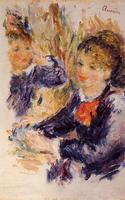
At the Milliner`s (study)
Pierre-Auguste Renoir
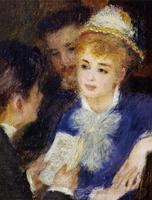
Reading the Part
Pierre-Auguste Renoir
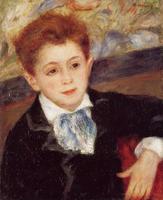
Paul Meunier
Pierre-Auguste Renoir
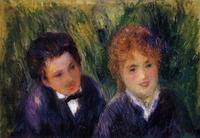
Young Man and Young Woman
Pierre-Auguste Renoir
At the Milliner`s
Pierre-Auguste Renoir
At the Coffee Table
Edvard Munch
Miss Reynolds
Berthe Morisot
The Cafe
Pierre-Auguste Renoir
The Reader (Young Woman Reading a Book)
Pierre-Auguste Renoir
Pagan and Degas' Father
Edgar Degas
The Solfege
Pierre Bonnard
By the Fireside
Pierre-Auguste Renoir
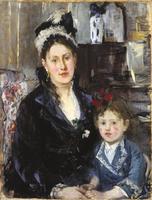
Mme Boursier and Her Daughter
Berthe Morisot
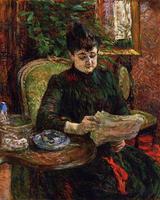
Madame Aline Gibert
Henri de Toulouse-Lautrec
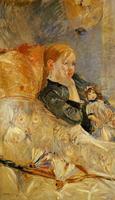
Little Girl with a Doll
Berthe Morisot
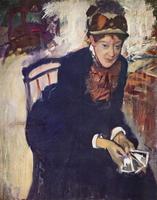
Portrait of Miss Cassatt, holding the cards
Mary Cassatt
Portrait of Mary Cassatt
Edgar Degas