
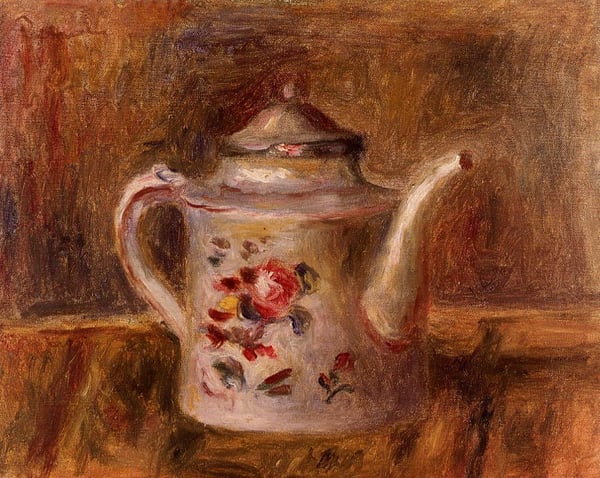
Analisi esperta di Watering Can di Pierre-Auguste Renoir
Stile: Impressionism · Genere: still life
Expert Analysis: "Watering Can" by Pierre-Auguste Renoir (Later Years)
In this still life from Renoir's later period, the artist transforms an ordinary household object into a study of light, texture, and quiet beauty—hallmarks of his mature Impressionist style. While Renoir is celebrated for his lively figure paintings and landscapes, this lesser-known work demonstrates his enduring fascination with everyday subjects, reimagined through a luminous, almost tactile warmth.
Significance within Impressionism and Renoir’s Later Years:
-
A Shift Toward Classical Restraint – Renoir’s later years marked a move away from the fragmented, rapid brushstrokes of high Impressionism toward a smoother, more sculptural handling of form. Here, the watering can feels solid yet soft, its metallic surface catching dappled light in a way that merges realism with atmospheric suggestion.
-
The Everyday as Poetic Subject – Impressionists often elevated mundane scenes—haystacks, water lilies, or in this case, a watering can. Renoir’s choice of a simple garden tool reflects a deep appreciation for the beauty found in domestic life and nature’s cycles. The watering can is not merely an object; it becomes a vessel for light, memory, and the artist’s joy in sensory experience.
-
Color and Light – True to Impressionism, the painting relies on broken color and reflected hues. Expect warm pinks, soft greens, and creamy whites—Renoir’s signature “pearly” palette of his later career. The watering can likely sits amidst foliage or flowers, its metal surface capturing the sun’s shimmer and the surrounding environment’s subtle reflections.
-
Still Life as a Window to Renoir’s World – While Renoir painted fewer still lifes than many contemporaries, this work shows his mastery in arranging form and atmosphere. It underscores that for the Impressionists, no subject was too humble to evoke a sense of fleeting, lived-in tranquility.
In summary, "Watering Can" is significant for its demonstration of Renoir’s evolving technique—blending Impressionist light with a newfound classical warmth—and for its celebration of the overlooked, everyday charm that defined the movement’s revolutionary vision.
Museum / Gallery
Visivamente simili
20 opere con composizione e palette affini
Jug
Pierre-Auguste Renoir
Still Life with a red tray.
Pyotr Konchalovsky
Still Life with a red tray
Pyotr Konchalovsky
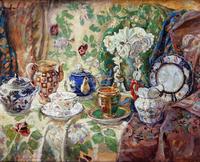
Still Life
Nikolay Bogdanov-Belsky
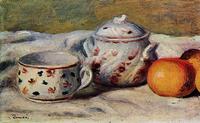
Still Life with Cup and Sugar Bowl
Pierre-Auguste Renoir
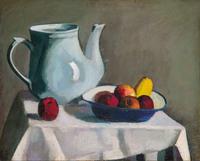
Berény Róbert, Csendélet 1910
Berény Róbert
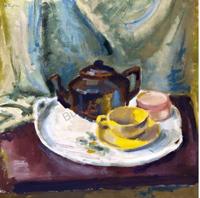
Bortnyik Sándor, Kancsó
Sandor Bortnyik
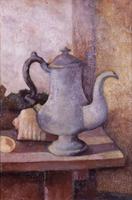
French Coffee Jug
William Balthazar Rose
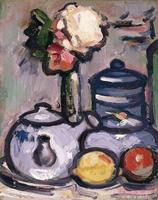
Still Life: Teapot with Flowers and Fruit
John Duncan Fergusson
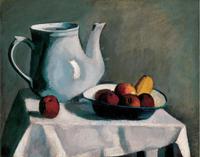
Bereny Robert, Still Life 1910
Berény Róbert
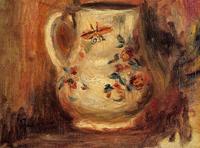
Pitcher
Pierre-Auguste Renoir
House of Venus IV
Rosemarie Beck
Tea-party in Mytishchi
Alexander Roitburd
Still Life
Henri Catargi
Still Life
George Bouzianis
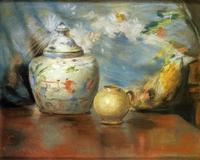
Still LIfe with Flowers
William Merritt Chase
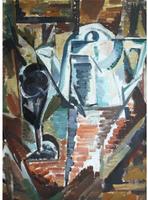
Composition. Still Life with a Coffee Pot
Valerii Lamakh
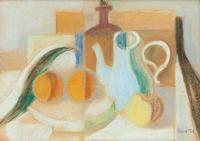
Still Life
Kmetty János
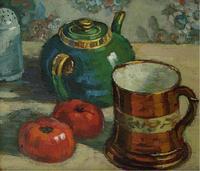
Still life with teapot
Gregoire Boonzaier
Still life
Alessandro Milesi