
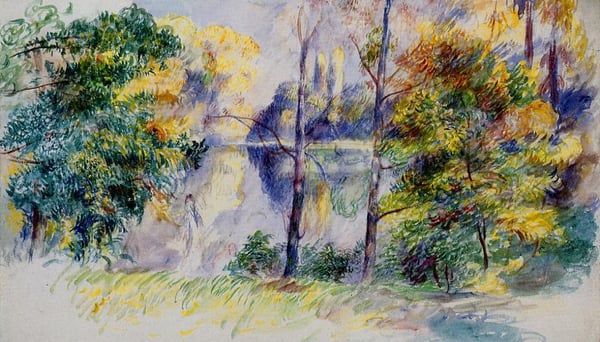
Park Scene
Analisi esperta di Park Scene di Pierre-Auguste Renoir
Stile: Impressionism · Genere: landscape
Expert Analysis: "Park Scene" by Pierre-Auguste Renoir
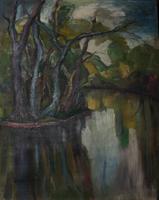
Pierre-Auguste Renoir’s Park Scene stands as a quintessential example of Impressionist landscape painting, a genre that Renoir helped define through his emphasis on light, color, and the fleeting pleasures of modern life. While the specific park depicted is not identified here, the work embodies core Impressionist principles: a commitment to capturing the immediate visual sensation of a moment, often outdoors (en plein air), with vibrant, broken brushwork and a luminous palette.
Significance within Impressionism
Renoir’s landscapes, particularly park scenes, are significant for their fusion of human presence with natural setting. Unlike earlier landscape traditions that treated figures as mere staffage, Renoir integrates people—typically members of the Parisian bourgeoisie—as active participants in a sun-drenched, leisurely environment. This reflects the Impressionist fascination with contemporary urban and suburban leisure, a theme central to the movement’s break from academic history painting.
In Park Scene, the artist likely employs his signature technique: small, distinct dabs of pure color placed side by side, allowing the viewer’s eye to optically blend them into a shimmering whole. This method, derived from contemporary color theory, creates an effect of flickering sunlight filtering through leaves and dappling the ground. Renoir’s handling of light is particularly warm and sensual, often described as “pearly” or “iridescent,” which gives his scenes a vital, joyous atmosphere.
Contributions to Landscape Genre
Renoir’s park landscapes are notable for their compositional structure—often a diagonal path, a cluster of trees framing the scene, or a body of water reflecting sky and foliage. This carefully ordered naturalism was a departure from the more spontaneous, seemingly chaotic compositions of some Impressionists (like Monet). Renoir retained a classical sense of balance, even while dissolving form into color and light. This balance between tradition and innovation makes Park Scene a valuable example of how Impressionism could be both radical and accessible.
Moreover, Renoir’s treatment of the human figure within the landscape prefigures his later, more monumental works. The figures in a Renoir park scene are not merely decorative; they are suffused with the same atmospheric vibration as the trees and grass, uniting humanity and nature in a single, harmonious vision. This unity is a hallmark of Renoir’s mature style and underscores his lifelong belief that art should be beautiful and life-affirming.
Conclusion
In summary, Park Scene is significant as a masterful synthesis of Impressionist technique—light, color, and brushwork—with a subject that captures the spirit of modern leisure. Renoir’s ability to transform a simple park into a shimmering tapestry of joy and sensuality elevates this landscape beyond mere depiction, making it a celebration of natural beauty and human pleasure. It is a work that typifies the Impressionist revolution’s core achievement: finding the extraordinary in the ordinary, and the eternal in the ephemeral.
Museum / Gallery
Visivamente simili
20 opere con composizione e palette affini
Grove on the shore of the pond
Ivan Shishkin
The summer morning at the Korana river
Alfred Freddy Krupa
A river
Isaac Levitan
Autumn forest
Endre Bartos
Trees by the Water
Paul Cezanne
Forest
Ivan Shishkin
The Banks of the River
Pierre-Auguste Renoir
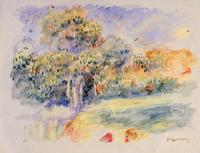
Landscape
Pierre-Auguste Renoir
Autumn Lake
Konstantin Gorbatov
Golden Cape
Sergiy Grigoriev
Autumn on the River
Konstantin Gorbatov
Village at the edge of forest
Isaac Levitan
Vaszary János, Táj
Vaszary János
Autumn
Sergiy Grigoriev
Parkland
Károly Lotz
Koncha Ozerna
Victor Zaretsky
A pond
Pyotr Konchalovsky
Alder against the sun
Pyotr Konchalovsky
Hampstead
John Constable
River
Adalbert Erdeli