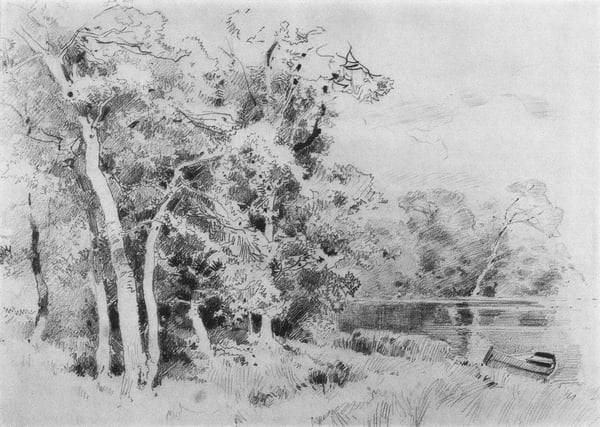
Grove on the shore of the pond
Analyse experte de Grove on the shore of the pond de Ivan Shishkin
Style : Realism · Genre : sketch and study
Expert Analysis: "Grove on the shore of the pond" by Ivan Shishkin
Ivan Shishkin is celebrated as a master of Russian Realism, and this work—classified as a sketch and study—offers a rare, intimate glimpse into his artistic process. While Shishkin’s finished landscapes are renowned for their meticulous detail and atmospheric grandeur, this piece is significant precisely because it captures the raw, observational energy that underpins his mature style.
Realism as Precision and Presence
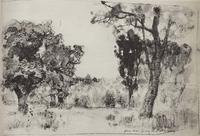
As a Realist, Shishkin was committed to the faithful representation of the natural world. In Grove on the shore of the pond, this manifests not as a polished final statement but as a direct, unmediated encounter with a specific place. The sketch format allows Shishkin to record the essential structure of the scene—the vertical trunks of the grove, the horizontal line of the pond’s shore, the interplay of light and shadow—with economy and vigor. His characteristic attention to the individual character of trees (their bark textures, branch patterns, and spacing) is already present, demonstrating that for Shishkin, truth to nature began in the first mark.
Significance as a Study: Process over Perfection
This work’s classification as a sketch and study elevates its importance beyond that of a mere preparatory drawing. In the context of 19th-century Russian Realism, such studies were not simply rehearsals but autonomous works of art that revealed the artist’s thinking. Here, Shishkin experiments with composition and atmosphere: the pond’s reflective surface is suggested with loose, confident strokes, while the grove is built from layered, varied marks that mimic foliage density. The unfinished quality—areas left open or only lightly indicated—draws the viewer’s eye to Shishkin’s decision-making, making visible the dialogue between observation and interpretation.
Contribution to the Landscape Tradition
Shishkin was part of the Peredvizhniki (The Wanderers), a movement that sought to bring art to the people by depicting the authentic Russian landscape. Grove on the shore of the pond exemplifies this mission: it is a humble, unidealized view—no dramatic mountains or storms, just a quiet corner of a pond. Yet in its honest recording of light filtering through leaves and the quiet solidity of tree trunks, Shishkin elevates the ordinary to the sublime. The sketch form underscores that for him, every aspect of nature, no matter how modest, was worthy of study and reverence.
Conclusion
Grove on the shore of the pond holds significance as a document of the Realist artist’s craft. It shows Shishkin not as the distant creator of monumental paintings but as a field observer, using his pencil and brush to capture the living texture of the Russian countryside. For art historians, this study provides key insights into his working method—how he built his iconic landscapes from direct, sensory encounters. For viewers, it offers the pleasure of seeing the world through the eyes of a master, in a moment before it was perfected, but already full of truth.
Visuellement similaire
20 œuvres à la composition et à la palette proches
Forest
Ivan Shishkin
Park Scene
Pierre-Auguste Renoir
Trees in the field. Bratsevo
Ivan Shishkin
Stream
Ivan Shishkin
Landscape
Pierre-Auguste Renoir
Edge of the Forest
Ivan Shishkin
Village at the edge of forest
Isaac Levitan
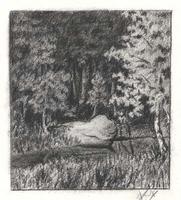
Izvarka
Nicholas Roerich
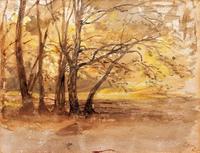
Parkland
Károly Lotz
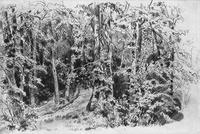
In the deciduous forest
Ivan Shishkin
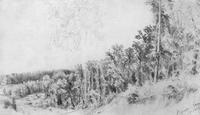
Ravine in Kozlovka-Zaseka
Ivan Shishkin
Early spring. Birches by the river
Aleksey Savrasov
Trees by the Water
Paul Cezanne
A Parkland View at Dusk
William Leighton Leitch
“Sous-bois”
Ker-Xavier Roussel
The oak tree crashed into the forest of Fontainebleau
Theodore Rousseau
Zelenina grove
Ivan Shishkin
The sketch for the painting "Rye"
Ivan Shishkin
Moorland landscape (Tree Study)
William Leighton Leitch
Spring Landscape
Adam Baltatu