
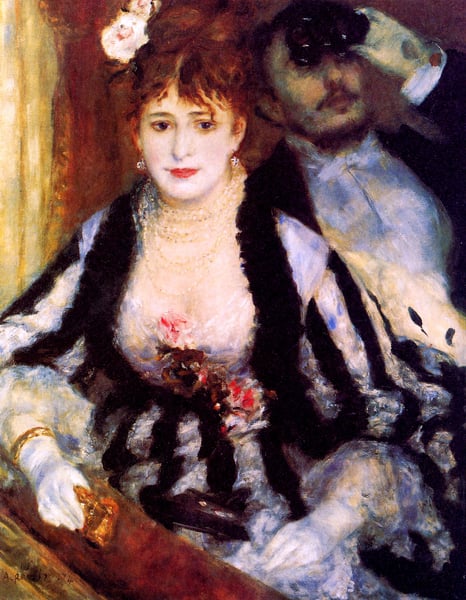
Expert analysis of Pierre-Auguste Renoir’s The Box
Style: Impressionism · Genre: portrait
Expert Analysis of The Box by Pierre-Auguste Renoir
Renoir’s The Box (often titled La Loge) is a seminal work within the Impressionist movement, created during the artist’s most active period of association with the group. As a portrait, it transcends traditional individual likeness to capture a vivid slice of modern urban life—a hallmark of Impressionist innovation.
Significance within Impressionism:
The painting epitomizes the Impressionist fascination with leisure, spectacle, and the interplay of artificial light. Renoir renders the theater box not as a static setting but as a stage for social observation. The composition’s tight, almost cropped framing—borrowed from photography and Japanese prints—emphasizes the immediacy of the moment, a key break from Academic portraiture.
Genre and Portrait Innovation:
While classified as a portrait, The Box actually depicts two figures: a fashionably dressed woman in the foreground, her opera glasses raised, and a gentleman in the background. This dual focus shifts the genre from a single sitter to a narrative of class and gaze. The woman’s direct, yet distant, expression engages the viewer, while her companion remains absorbed in the audience, creating a dynamic tension between performer and spectator.
Stylistic Mastery:
Renoir’s brushwork is characteristically loose and vibrant, with rapid strokes of white, black, and touches of color that simulate the shimmer of silk and the glow of gaslight. The strong diagonal of the balcony railing and the mirror behind the figures add depth, while the blurring of details—like the man’s face—suggests movement and the fleeting quality of modern experience.
Historical Context:
Exhibited at the first Impressionist exhibition in 1874, The Box was among the works that scandalized critics with its apparent sketchiness. Yet it perfectly embodies the movement’s mission to capture the “impression” of a scene—here, the ephemeral pleasure of Parisian theater life. Renoir’s focus on the female sitter’s elegance, without moralizing, also reflects the changing roles of women in public entertainment.
In sum, The Box is significant for its bold synthesis of Impressionist technique, modern subject matter, and a reimagined approach to portraiture that documents the sensory and social textures of its era.
Museum / Gallery
Visually similar
20 works with related composition and palette
Madame Charpentier
Pierre-Auguste Renoir
First Portrait of Madame Georges Charpeitier
Pierre-Auguste Renoir
Portrait of M. and Mme. Bernheim de Villers
Pierre-Auguste Renoir
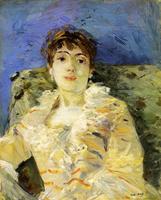
Young Woman on a Couch
Berthe Morisot
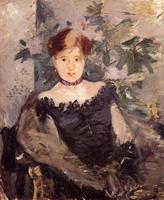
Woman in Black
Berthe Morisot
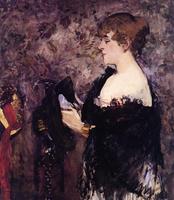
The Milliner
Edouard Manet
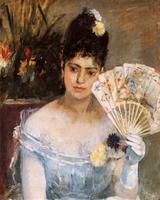
At the Ball
Berthe Morisot

Mrs. Kate A More
John Singer Sargent
Misia
Pierre-Auguste Renoir
A Box at the Theatre des Italiens
Eva Gonzales
Portrait of a Woman in a pink dress
Berthe Morisot
Girl in a Flowery Hat
Pierre-Auguste Renoir
Portrait of the countess pourtales
Pierre-Auguste Renoir
Marchesi Blanche
Solomon Joseph Solomon

Lady
Georgina de Albuquerque
Woman in Blue
Pierre-Auguste Renoir
Portrait of Madame Léon Maître
Henri Fantin-Latour
Young Woman in a Blue and Pink Striped Shirt
Pierre-Auguste Renoir
Mette Gauguin in an Evening Dress
Paul Gauguin

A man with two women in an interior
Umberto Veruda