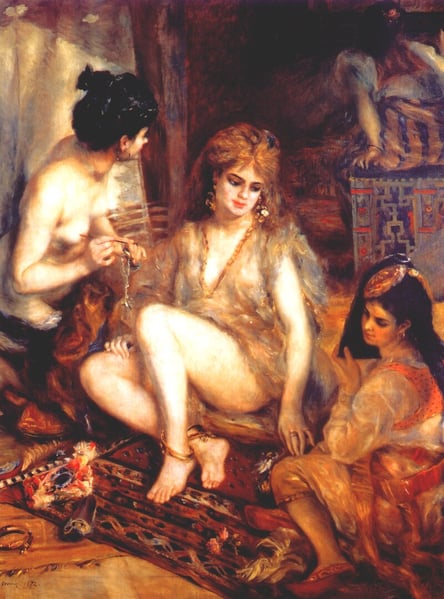
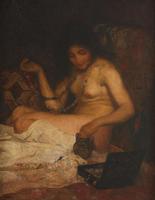
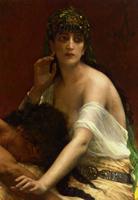
Pierre-Auguste Renoir's The Harem (Parisian Women Dressed as Algerians) (c. 1872) is a fascinating hybrid that bridges the painter's Impressionist sensibilities with the era's enduring fascination for Orientalist subject matter. What makes this work significant is its self-aware theatricality: as the title explicitly states, the scene does not depict an authentic Algerian harem but rather Parisian models playing dress-up in a studio, a layered commentary on Western fantasies of the Orient.
Renoir applies his characteristic Impressionist loose brushwork and vibrant, sun-dappled palette to a theme typically rendered in the more polished, academic style of official Orientalist painters like Delacroix or Gérôme. The result is a genre scene that feels less like ethnographic documentation and more like a relaxed, contemporary costume party—note the informal grouping of women lounging on cushions, the palpable atmosphere of urban leisure. This tension between the exotic subject and the modern, painterly technique underscores the constructed nature of Orientalism itself.
By having his models frankly acknowledge their Parisian identity, Renoir disrupts the exotic illusion and invites the viewer to see the painting as a playful masquerade. In doing so, it reveals more about 19th-century French bourgeois culture—its desire to possess and perform "otherness" in safe, domestic settings—than about Algeria. The work is thus a key example of how Impressionism could both adopt and subvert popular Orientalist tropes, making it a critical piece for understanding the intersection of modern art, colonial fantasy, and theatricality.