Pierre-Auguste Renoir の The palm tree の専門的な分析
スタイル:Impressionism · ジャンル:landscape
Expert Analysis: "The Palm Tree" by Pierre-Auguste Renoir
As a landscape executed during Renoir's later years, The Palm Tree exemplifies the artist's mature Impressionist sensibility while subtly nodding to his evolving classical tendencies. Painted during a period when Renoir increasingly sought to blend the loose brushwork and vibrant color of Impressionism with a more structured composition, this work is significant for several reasons.
1. The Exotic Turn in Renoir's Impressionism
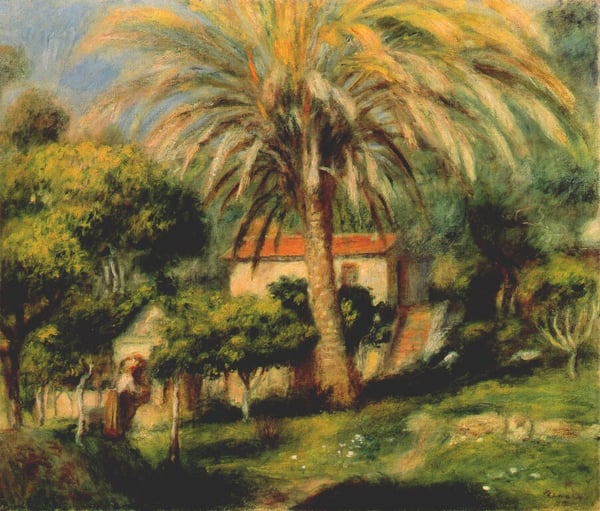
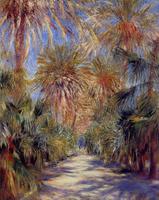
The palm tree as a central subject reflects Renoir's travels to Algeria in 1881 and 1882, where he was captivated by the intense light, vivid hues, and lush vegetation of North Africa. In this piece, the palm becomes a vehicle for exploring the interplay of sunlight and shadow in a foreign landscape—a hallmark of Impressionist plein-air practice. The tree's fronds are rendered with rapid, feathery strokes, capturing the shimmering movement of light, while the surrounding sky and ground are treated with a looser, more atmospheric touch.
2. Later Years: A Shift Toward Structure and Warmth
During his later period (roughly 1886 onward), Renoir began to temper Impressionism's spontaneity with a greater emphasis on form and volume, influenced by a trip to Italy and his admiration for Raphael. In The Palm Tree, this manifests in a more grounded composition: the palm trunk anchors the scene firmly, and the overall palette leans toward warm, earthy tones—golds, ochres, and soft greens—rather than the cooler, more broken color patches of his earlier work. Yet the brushwork remains distinctly Impressionist, with visible dabs of paint that refuse to fully blend, preserving the sense of fleeting atmosphere.
3. Significance Within the Genre
As a landscape, The Palm Tree demonstrates how Impressionism could absorb and reinterpret non-Western subjects. Renoir avoids cliché; the palm is not a mere decorative motif but a living, breathing element of a place bathed in light. The work is a testament to the movement's embrace of modern mobility and its interest in capturing l'impression of a moment—even in an unfamiliar environment.
In sum, The Palm Tree is significant for its fusion of Renoir's mature Impressionist technique with a personal, later-career interest in clarity and serenity. It stands as an example of how the artist continued to evolve while remaining true to the core goals of Impressionism: to record the play of light and color with fresh, vigorous strokes.
視覚的に類似
構図やパレットが近い作品 20 件
Palm Tree at Bordighera
Claude Monet
Small Country Farm in Bordighera
Claude Monet
Untitled
Henri Matisse
Landscape
Henri Matisse
Fifth mural tempera from the villa "La Falconiera"
Giovanni Boldini
Garden in Cannes
Edouard Vuillard
Итальянский Пейзаж
Anton Ivanov-Goluboy
Study of palm trees
Edward Lear
Mediterranean Coast Scene
Nathaniel Hone the Younger
The Garden of Essai in Algiers
Pierre-Auguste Renoir
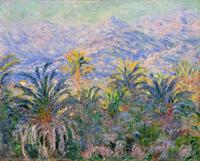
Palm Trees at Bordighera
Claude Monet
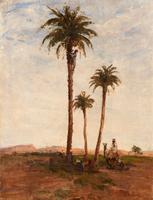
North Africa
Nathaniel Hone the Younger
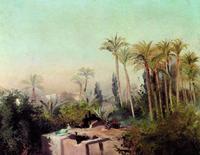
Irrigation in Egypt
Konstantin Makovsky
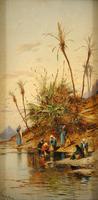
Water fetchers at Giza
Hermann David Salomon Corrodi
Berény Róbert, Horgász a Dunaparton
Berény Róbert
The Hour of Prayer, A Souvenir of Wady Halfa
Elizabeth Thompson
Riverbank Hideaway
Hermann Ottomar Herzog
Algiers, the Garden of Essai
Pierre-Auguste Renoir
Specimens of the Coquito Palm of Chile in Camden Park, New South Wales
Marianne North
Tahitian landscape
Paul Gauguin