
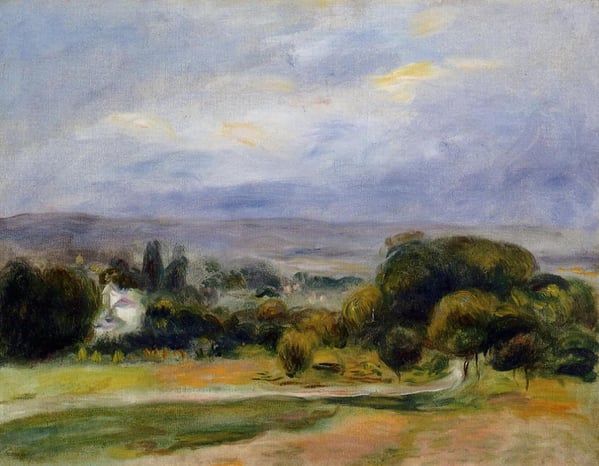
Expertenanalyse zu Pierre-Auguste Renoirs The Path
Stil: Realism · Genre: landscape
Expert Analysis: "The Path" by Pierre-Auguste Renoir
Context & Period Significance
Painted in Renoir’s later years, The Path exemplifies a deliberate departure from the flickering light and broken brushwork of high Impressionism. Though Renoir is most often associated with that movement, the supplied facts identify this work as Realism in style. This is not a contradiction; rather, it reflects Renoir’s mature turn toward a more structured, tangible representation of nature—one that prioritizes solid form, clear spatial recession, and a grounding in observed reality over atmospheric dissolution. Created after his move to the sun-drenched landscapes of the South of France, the painting belongs to a period when the artist, suffering from rheumatoid arthritis, often painted from his garden at Les Collettes. That personal confinement paradoxically yielded some of his most serene and materially present landscapes.
What Makes "The Path" Significant
-
A Synthesis of Realism and Late Renoir Warmth
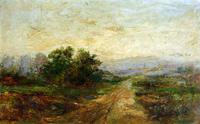
Unlike the blurred edges and dancing highlights of his 1870s works, The Path presents a quiet, orderly lane receding into depth. The composition is stable, almost classical—a pathway flanked by lush foliage, guiding the eye gently toward a softened horizon. The realism here lies in the tactile specificity of the vegetation, the weight of the shadows, and the credible structure of the terrain. Yet Renoir’s signature palette of warm ochres, deep greens, and rose-tinted earth tones softens the hard edges of pure Realism, offering a vision of nature that is both truthful and tender. -
Later-Life Evolution: From Momentary to Enduring
In his late period, Renoir abandoned the snapshot-like immediacy of Impressionism for a more meditative, even timeless quality. The Path captures not a fleeting instant of light but a permanent presence—the sense of a place that holds calm and quiet regardless of the hour. This shift elevates the work beyond mere documentation (as in strict Realism) into a personal, almost philosophical statement: the aged artist finding solace in the immutable beauty of the earth. -
Technical Mastery Within Realist Parameters
Renoir’s brushwork here is controlled yet generous. Thick impasto in the foreground foliage gives physical volume to leaves and bark, while lighter, thinner strokes soften the distance. The path itself is painted with deliberate, grounding earth tones, anchoring the composition. This interplay of texture and restraint demonstrates how Renoir, even when adhering to realist principles, could not suppress his instinct for sensuous surface—making The Path a bridge between the objective eye of Realism and the emotional warmth of his own enduring vision.
Conclusion
The Path is significant as a testament to Renoir’s later artistic evolution. It shows a master of Impressionism willingly folding his sensibilities into the more disciplined language of Realism, yet still imbuing the scene with a gentle, lyrical atmosphere unique to his hand. The painting stands as a quiet masterpiece of that convergence—an honest landscape that is both a slice of nature and a window into the artist’s late-life search for harmony.
Museum / Gallery
Visuell ähnlich
20 Werke mit ähnlicher Komposition und Farbpalette
Landscape
Pierre-Auguste Renoir
Landscape Auvers sur Oise
Pierre-Auguste Renoir
The Edge of the Forest in Brittany
Pierre-Auguste Renoir
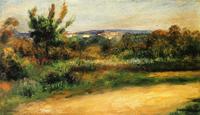
Midday Landscape
Pierre-Auguste Renoir
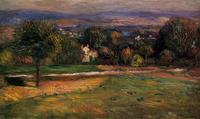
The Clearing
Pierre-Auguste Renoir
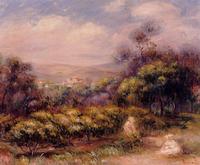
Cagnes Landscape
Pierre-Auguste Renoir
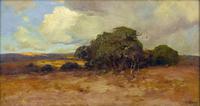
Texas Dry Country
Robert Julian Onderdonk
Landscape near Essoyes
Pierre-Auguste Renoir
Landscape
Edward Mitchell Bannister
Eragny, Twilight
Camille Pissarro
Landscape
John Henry Twachtman
Landscape from Bærum
Harriet Backer
Connecticut Landscape
John Henry Twachtman
Landscape with a View of the Sea
Pierre-Auguste Renoir
A Field with Figure
Henri Martin
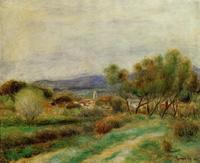
View of La Sayne
Pierre-Auguste Renoir
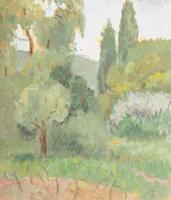
Juan-les-Pins Landscape
Theodor Pallady
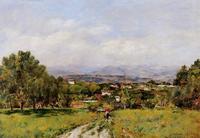
Near Antibes
Eugene Boudin
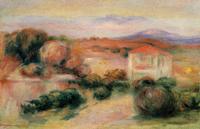
White Houses
Pierre-Auguste Renoir
Landscape
Armando Montaner Valdueza