
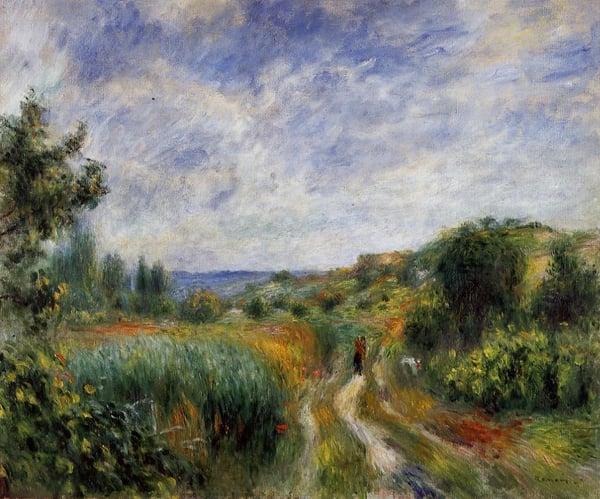
Expert analysis of Pierre-Auguste Renoir’s Landscape near Essoyes
Style: Impressionism · Genre: landscape
Expert Analysis of "Landscape near Essoyes" by Pierre-Auguste Renoir
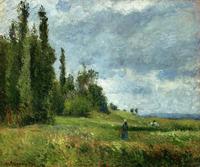
As a work of Pierre-Auguste Renoir’s Later Years, Landscape near Essoyes holds a distinctive place within the Impressionist movement. Executed in the artist’s mature period—when he had moved to the rural village of Essoyes in Champagne—this painting exemplifies the subtle evolution of Impressionist landscape painting beyond its earlier, more radical phase.
Significance within Impressionism and Renoir’s Later Style
The artwork’s significance lies in its synthesis of Impressionist core principles with Renoir’s personal late-career sensibility. While the piece remains firmly rooted in the Impressionist style—capturing the ephemeral effects of light, atmosphere, and color through visible, broken brushwork—it also reflects Renoir’s turn toward a softer, more classical harmony that emerged after his travels to Italy and his struggles with arthritis.
-
Subject and Genre: As a landscape, the painting depicts the familiar, humble countryside of Essoyes, a region Renoir painted repeatedly during his final decades. Unlike the bustling urban scenes of early Impressionism, this work emphasizes a serene, pastoral timelessness. Renoir’s choice of a rural motif speaks to his desire to find a stable, personal subject matter—one that allowed him to explore nuanced relationships between sky, foliage, and earth without the distraction of modern life.
-
Color and Light: True to the Impressionist ethos, the canvas is built from vivid, often complementary colors placed side by side to create a shimmering effect. However, Renoir’s later palette tends to be more atmospheric and unified than his earlier works, with a prevalence of rose, golden, and blue-grey tones that suggest a warm, hazy afternoon. The handling of light here is both Impressionist (capturing a specific moment) and meditative, as if the landscape has been filtered through memory and emotion.
-
Brushwork and Composition: In his later years, Renoir developed a more fluid, almost tactile brushstroke—softer than the choppy dabs of the 1870s. In Landscape near Essoyes, this technique creates a sense of gentle movement across the fields and trees, while still preserving the spontaneous, sketch-like quality prized by Impressionism. The composition is balanced but not rigid, leading the viewer’s eye along pathways or riverbanks into a luminous horizon—a hallmark of Renoir’s ability to merge Impressionist immediacy with a classical sense of order.
Conclusion
Landscape near Essoyes is significant because it embodies the mature phase of Impressionism, demonstrating how Renoir—and the movement itself—evolved from provocative experimentation to a deeply personal, lyrical engagement with nature. It stands as a testament to Renoir’s enduring fascination with light and landscape, even as his physical limitations forced him to adapt his technique, and it remains a compelling example of how Impressionist principles could produce works of both sensory intensity and serene timelessness.
Museum / Gallery
Visually similar
20 works with related composition and palette
Landscape Auvers sur Oise
Pierre-Auguste Renoir
The Gust of Wind
Pierre-Auguste Renoir
Approaching the storm
Léon Augustin Lhermitte
The Seine at Chatou
Pierre-Auguste Renoir
Midday Landscape
Pierre-Auguste Renoir
Strong Wind (Gust of Wind)
Pierre-Auguste Renoir
Landscape
Pierre-Auguste Renoir
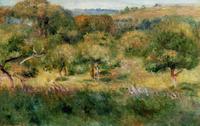
The Edge of the Forest in Brittany
Pierre-Auguste Renoir
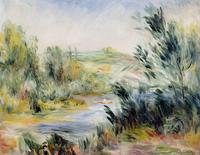
The Banks of a River, Rower in a Boat
Pierre-Auguste Renoir
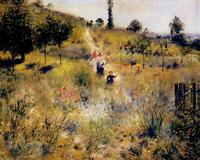
Path Leading through Tall Grass
Pierre-Auguste Renoir
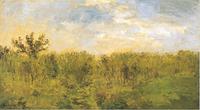
Young corn
Charles-Francois Daubigny
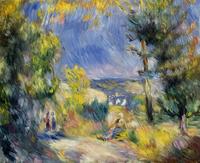
View Close to Antibes
Pierre-Auguste Renoir
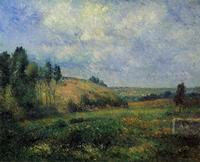
Landscape, near Pontoise
Camille Pissarro
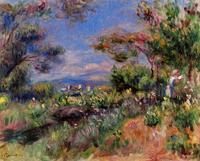
Young Woman in a Landscape, Cagnes
Pierre-Auguste Renoir
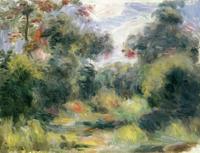
Clearing
Pierre-Auguste Renoir
Field Naturalists
Jane Sutherland
Landscape
Theodore Robinson
Landscape
Pierre-Auguste Renoir
Fields of Wheat
Pierre-Auguste Renoir
A part of Groettes, Pontoise, Gray Weather
Camille Pissarro