
Expert analysis of Pierre-Auguste Renoir’s Two Bathers
Style: Impressionism · Genre: nude painting (nu)
Expert Analysis: "Two Bathers" by Pierre-Auguste Renoir
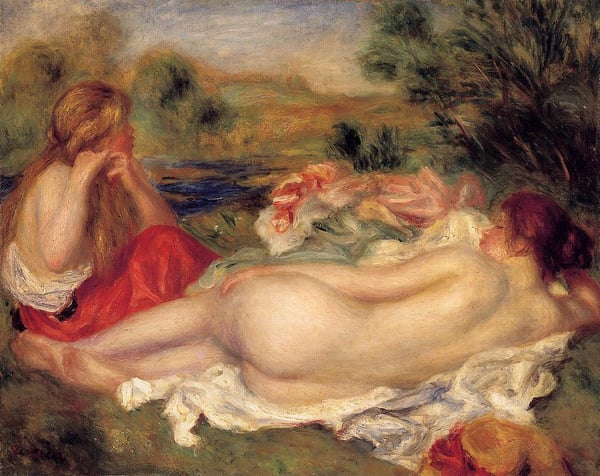
Pierre-Auguste Renoir’s Two Bathers (c. 1887–1890) belongs to the artist’s Later Years, a period marked by a decisive shift away from the feathery, broken brushwork of high Impressionism toward a more sculptural, classical idealization of the human form. Painted when Renoir was in his mid-to-late forties, the work exemplifies his growing fascination with the timeless tradition of the nude—a genre he transformed by merging Impressionist luminosity with the solidity of Renaissance and Rococo masters.
Significance within Impressionism and Renoir’s Oeuvre
-
From fleeting light to enduring flesh
Unlike Renoir’s earlier Impressionist nudes (e.g., Nude in the Sunlight, 1876), where light seems to dissolve the body into shimmering atmosphere, Two Bathers emphasizes volume and contour. The figures are built with dense, warm strokes that model rounded shoulders, thighs, and torsos. The skin is not merely a surface for colored reflections but a palpable, living substance—creamy pink, peach, and ivory tones that glow from within. This change reflects Renoir’s trip to Italy in 1881–82, where he studied Raphael and the frescoes of Pompeii, absorbing their clarity and form. -
The “Ingres period” and synthetic classicism
The composition—two nude women in a landscape, one seated, one standing—invites comparison to Jean-Auguste-Dominique Ingres’s The Turkish Bath (1862) and The Bather of Valpinçon (1808). Renoir’s adaptation, however, is distinctly Impressionist. The background remains loose: water, foliage, and sky are rendered with rapid, diagonal touches of blue, green, and gold. The figures, while monumental, are not static. They seem to breathe in the open air, their poses relaxed and intimate. This synthesis of modern plein-air spontaneity and ancient sculptural serenity is a hallmark of Renoir’s later work and a key contribution to Post-Impressionist figuration. -
Idealized beauty and the female nude
The two bathers are not specific portraits but archetypes of feminine grace. Their fleshy, rounded forms—full hips, soft bellies, and robust arms—celebrate a physicality that is both sensual and wholesome. Renoir deliberately avoided the angular, urbanized figures of Degas or the psychological tension of Manet. Instead, Two Bathers offers a vision of harmony between woman and nature, a pastoral idyll that recalls Boucher’s mythological scenes but without the coy eroticism. The painting’s significance lies in its reaffirmation of the nude as a vehicle for pure beauty, at a time when Impressionism was fragmenting into Neo-Impressionist pointillism and Symbolist abstraction. -
Technical mastery in the later years
Renoir’s health was already beginning to decline (he would develop severe rheumatoid arthritis in the 1890s), yet Two Bathers displays a confident, vigorous touch. The brushstrokes are broader and more deliberate than in his youth, yet they retain the Impressionist habit of mixing colors optically on the canvas. Notice how the shadows on the standing bather’s back are built with blue-gray striations over warm umber, capturing the cool air of the riverside. The seated bather’s knee catches a patch of sunlight—a tiny, golden accretion that anchors the whole scene in observed reality.
Conclusion
Two Bathers is a pivotal work in Renoir’s evolution from Impressionist rebel to a modern classicist. It demonstrates that Impressionism could be more than a fleeting snapshot of light—it could also be a vehicle for timeless, monumental beauty. In this painting, Renoir achieves a perfect equilibrium: the figures are solid enough to recall antique sculpture, yet alive with the warmth of the French countryside. It remains a testament to his belief that art’s highest purpose is to give pleasure, and that even the most traditional genre—the nude—could be reinvented through the lens of Impressionist color and vivacity.
Museum / Gallery
Visually similar
20 works with related composition and palette
Nude Reclining on the Grass
Pierre-Auguste Renoir
Reclining Nude
Pierre-Auguste Renoir
Seated Bather
Pierre-Auguste Renoir
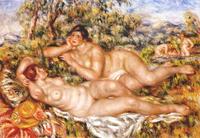
The Great Bathers (The Nymphs)
Pierre-Auguste Renoir
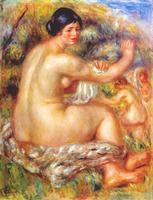
After the bath
Pierre-Auguste Renoir
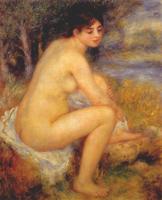
Nude in a landscape
Pierre-Auguste Renoir
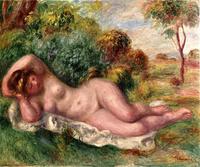
Reclining Nude (The Baker's Wife)
Pierre-Auguste Renoir
Reclining nude
Pierre-Auguste Renoir
After the Bath
Pierre-Auguste Renoir
Bathers
Pierre-Auguste Renoir
A Seating Bather
Pierre-Auguste Renoir
Bather Admiring Herself in the Water
Pierre-Auguste Renoir
Seated Nude
Pierre-Auguste Renoir
Bather
Pierre-Auguste Renoir
Seated Nude in Profile (Gabrielle)
Pierre-Auguste Renoir
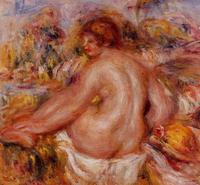
After Bathing, Seated Female Nude
Pierre-Auguste Renoir
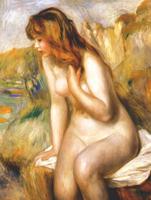
Bather seated on a rock
Pierre-Auguste Renoir
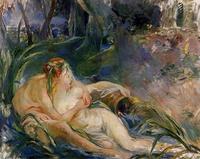
Two Nymphs Embracing
Berthe Morisot
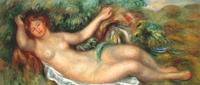
The Spring
Pierre-Auguste Renoir
After the bath
Pierre-Auguste Renoir